
The Socio-Religious Reform Movements UPSC syllabus forms the bedrock of 19th-century Indian Renaissance and anti-colonial awakening. From early reform initiatives by Raja Ram Mohan Roy and Ishwar Chandra Vidyasagar to subaltern assertions led by Mahatma Jyotirao Phule and revivalist trends within the Arya Samaj and Ramakrishna Mission, these transformations redefined Indian society. Reviewing these UPSC Mains questions from 1980 to 2025 provides key insights into women’s legislative reforms, lower-caste mobilizations, and modern national identity formation.
Q.1 The second half of the nineteenth century witnessed in India a strong wave of reformation in the spheres of religion and society. What part was played in this directly or indirectly by Raja Ram Mohan Roy, Keshab Chandra Sen and Justice M.G. Ranade? (1980)
उन्नीसवीं सदी के उत्तरार्ध में भारत में धर्म और समाज के क्षेत्रों में सुधार की एक मजबूत लहर देखी गई। इसमें प्रत्यक्ष या परोक्ष रूप से राजा राम मोहन राय, केशव चंद्र सेन और न्यायमूर्ति एम जी रानाडे ने क्या भूमिका निभाई?
During the late nineteenth century, the Indian Renaissance evolved from localized beginnings in Bengal into an institutionalized, pan-Indian movement. While Raja Ram Mohan Roy provided the foundational framework, Keshab Chandra Sen and Justice M.G. Ranade actively steered reforms across India between 1850 and 1900.
1. Raja Ram Mohan Roy (1772–1833): The Foundational, Indirect Influence
Roy’s intellectual legacy and institutional groundwork (Brahmo Sabha, 1828) guided post-1850 reformers:
- Ideological Blueprint: Introduced internal scriptural critique using Upanishadic and Vedantic texts to challenge idolatry, polytheism, and caste rigidities without severing indigenous roots.
- Precedent of State-Enacted Legislation: His campaign for the 1829 Sati Abolition Act established state petitioning as a valid tool, paving the way for later laws like the Widows’ Remarriage Act (1856).
- Modern Education and Journalism: Championed English education alongside vernacular press (Samvad Kaumudi), cementing public debate as an instrument of awakening.
2. Keshab Chandra Sen (1838–1884): Dynamic Radicalization and All-India Diffusion
Sen transformed the Brahmo movement into a populist, nationwide wave:
- Pan-Indian Expansion: Speaking tours in Bombay and Madras catalyzed the Veda Samaj (1864) and Prarthana Samaj (1867), breaking Bengal’s regional isolation.
- Radical Social Egalitarianism: Promoted inter-caste dining, discarded his sacred thread, and championed widow remarriage, causing the 1866 schism that formed the Brahmo Samaj of India.
- Mass Welfare (Indian Reform Association, 1870): Advanced female education (Calcutta Normal School) and cheap mass literature via the one-pice journal Sulabh Samachar.
- Legislative Achievement: Successfully lobbied for the Native Marriage Act (1872), which banned polygamy and set minimum marriage ages.
- Universal Theism: Formulated the Naba Bidhan (1881), harmonizing diverse world faiths through syncretism.
3. Justice Mahadev Govind Ranade (1842–1901): Institutionalized Gradualism in Western India
Ranade favored reform rooted in continuity rather than radical rupture:
- Prarthana Samaj Leadership: Linked the movement to Marathi Bhakti traditions to avoid charges of Westernization, prioritizing practical social work like night schools and orphanages.
- Widow Upliftment: Co-founded the Widow Marriage Association (1861) and supported reformers like Pandita Ramabai and D.K. Karve.
- National Social Conference (1887): Established the “social wing” of Congress and launched the “Pledge Movement” against child marriage and dowry.
- Age of Consent Controversy (1891): Marshaled legal and scriptural arguments to raise the age of consummation to 12.
- Socio-Economic Philosophy: Through the Poona Sarvajanik Sabha, argued that political liberty, economic growth, and social emancipation were indivisible.
Roy supplied the rational blueprint, Sen provided expansive populist momentum, and Ranade embedded reforms into lasting institutional structures – together forging the ethical bedrock of modern Indian nationalism.
Q.2 The nineteenth century is generally called a period of Indian Renaissance. Which were the major social reform movements of this period and what changes did they bring about? (1984)
उन्नीसवीं शताब्दी को सामान्यतः भारतीय पुनर्जागरण का काल कहा जाता है। इस काल के प्रमुख सामाजिक सुधार आन्दोलन कौन-से थे और उन्होंने क्या परिवर्तन लाए?
The nineteenth-century “Indian Renaissance” was an intellectual, cultural, and spiritual awakening confronting British colonial hegemony and internal socio-religious decadence. Rather than blind Western imitation or orthodox revivalism, thinkers forged a synthesis of rational humanism and indigenous philosophical traditions.
Part I: Major Social Reform Movements
- Brahmo & Western-Liberal Streams (Bengal):
- Brahmo Samaj (1828): Raja Ram Mohan Roy championed monotheistic Vedanta, attacked idolatry and priestly hegemony, and spearheaded the drive against Sati.
- Young Bengal (1820s–1830s): Henry Vivian Derozio’s radical followers promoted free thought and civil liberties.
- Brahmo Offshoots: Keshab Chandra Sen popularized pan-Indian reforms (Brahmo Samaj of India, 1866); Anand Mohan Bose and Sivanath Sastri established the democratic Sadharan Brahmo Samaj (1878).
- Western Indian Reform Stream (Maharashtra & Gujarat):
- Paramahansa Mandali (1849): Secret society breaking caste and dietary taboos.
- Prarthana Samaj (1867): Led by Atmaram Pandurang and M.G. Ranade; drew on Marathi Bhakti traditions for gradualist causes like widow remarriage and night schools.
- National Social Conference (1887): Ranade’s platform driving the anti-child marriage “Pledge Movement.”
- Revivalist and Spiritual Streams:
- Arya Samaj (1875): Swami Dayananda Saraswati urged “Go Back to the Vedas,” rejecting idolatry and hereditary caste while promoting DAV institutions and Gurukuls.
- Ramakrishna Movement (1897): Swami Vivekananda synthesized Advaita Vedanta with social service (Daridra Narayana).
- Theosophical Society: Popularized by Annie Besant; revived pride in ancient philosophy and founded Central Hindu College (1898).
- Subaltern and Anti-Caste Assertions:
- Satyashodhak Samaj (1873): Jyotirao and Savitribai Phule rejected Brahminical hegemony, establishing schools for lower-caste girls and priest-less rites.
- Aravippuram Movement (1888): Sri Narayana Guru consecrated a Shiva idol in Kerala, proclaiming “One Caste, One Religion, One God for Man.”
- Minority Awakenings:
- Aligarh Movement (1875): Sir Syed Ahmad Khan reconciled Islam with Western science and founded MAO College.
- Rahnumai Mazdayasnan Sabha (1851): Modernized Parsi social codes and advanced female education.
- Singh Sabha (1873): Cleansed Sikh shrines of ritualism and opened Khalsa schools.
Part II: Changes Brought About by These Movements
- Emancipation of Women: Legislative milestones abolished Sati (1829), legalized widow remarriage (1856), and raised the marriage age (1872 Native Marriage Act, 1891 Age of Consent Act). Institutions like Bethune School and Pandita Ramabai’s Sharada Sadan normalized female education.
- Re-articulation of Caste: Upper-caste liberals attacked ritual taboos, while subaltern pioneers (Phule, Narayana Guru) dismantled structural caste oppression, prefiguring twentieth-century Dalit mobilization under Ambedkar and Periyar.
- Educational and Vernacular Expansion: Modern scientific curriculums replaced scholastic rote learning, amplified by a prolific vernacular press (Samvad Kaumudi, Kesari, Rast Goftar) that stimulated critical public discourse.
- Fostering National Consciousness: Debunked the colonial “civilizing mission” by reviving cultural self-confidence, forming inter-regional intellectual networks, and furnishing the ethical foundations for the Indian National Congress (1885).
Critical Limitations
Reforms remained largely centered among the urban, educated middle classes (bhadralok, intelligentsia), leaving rural peasant structures largely untouched. Additionally, an uncritical glorification of the ancient Vedic past occasionally stoked revivalist sentiments that sowed seeds for later communal divisions.
Ultimately, the Indian Renaissance modernized society from within, establishing the institutional, moral, and ideological foundation of the mass anti-colonial struggle.
Q.3 Discuss the major social reform movements of the second half of the 19th century. In what way did they contribute to the rise and growth of Indian National Movement? (200 words) (1984)
19वीं शताब्दी के उत्तरार्ध के प्रमुख सामाजिक सुधार आंदोलनों की चर्चा कीजिए। उन्होंने भारतीय राष्ट्रीय आंदोलन के उत्थान और विकास में किस प्रकार योगदान दिया?
The second half of the nineteenth century transitioned Indian socio-religious reform from elite, localized origins into an institutionalized, all-India phenomenon featuring subaltern anti-caste assertions. By reclaiming cultural self-respect, contesting social inertia, and constructing a nationwide public sphere, these movements established the intellectual and ethical foundation for the Indian National Movement.
Part I: Major Social Reform Movements of the Second Half of the 19th Century
- The Reformist Stream (Rationalism and Gradualism):
- Brahmo Offshoots: Keshab Chandra Sen expanded the Brahmo Samaj of India (1866) nationwide, securing the Native Marriage Act (1872) and establishing the Indian Reform Association (1870); later, the democratic Sadharan Brahmo Samaj (1878) emerged.
- Prarthana Samaj (1867): Led by Atmaram Pandurang and guided by Justice M.G. Ranade, it drew on Marathi Bhakti traditions to establish night schools, orphanages, and widow-remarriage initiatives.
- Indian National Social Conference (1887): Ranade’s platform acted as the “social wing” of the Congress, steering the anti-child marriage “Pledge Movement.”
- The Revivalist and Neo-Vedantic Stream (Cultural Self-Respect):
- Arya Samaj (1875): Swami Dayananda Saraswati championed “Go Back to the Vedas,” repudiating idolatry, polytheism, and hereditary caste while pioneering the Dayanand Anglo-Vedic (DAV) network and asserting the primacy of self-rule.
- Ramakrishna Mission (1897): Swami Vivekananda synthesized Advaita Vedanta with social service (“Daridra Narayana”), condemning empty ritualism and “don’t-touchism.”
- Theosophical Society: Popularized by Annie Besant from Adyar, it revitalized pride in indigenous philosophies and founded Central Hindu College (1898).
- Subaltern and Anti-Caste Assertions:
- Satyashodhak Samaj (1873): Jyotirao and Savitribai Phule bypassed elite discourse, opening pioneering schools for lower-caste girls and instituting priest-less weddings.
- Aravippuram Movement (1888): Sri Narayana Guru challenged caste monopolies by consecrating an idol with the proclamation: “One Caste, One Religion, One God for Man.”
- Reform Movements Among Minorities:
- Aligarh Movement (1875): Sir Syed Ahmad Khan harmonized Islam with scientific rationalism, establishing MAO College.
- Singh Sabha Movement (1873): Cleansed Sikhism of casteism and idolatry, founding Khalsa schools.
- Rahnumai Mazdayasnan Sabha (1851): Led by Dadabhai Naoroji and Naoroji Furdunji, modernizing Parsi domestic laws and advancing women’s literacy.
Part II: Contribution to the Rise and Growth of the Indian National Movement
- Demolishing the Colonial “Civilizing Mission”: Thinkers like Vivekananda and Dayananda disproved the imperial “White Man’s Burden,” restoring cultural pride and national self-esteem.
- Defining the Ethical Vocabulary of Nationalism: Key doctrines like Swaraj and Swadeshi originated within reform discourse, notably via Dayananda’s insistence on self-governance.
- Creation of an All-India Public Sphere: Vernacular and English presses (The Bengalee, Kesari, Sulabh Samachar), combined with annual conferences and mass petitions, established the organizational templates of the early Congress.
- Broadening the Social Base for Mass Struggles: Female education and the dismantling of caste taboos enabled women and marginalized groups to eventually mobilize during the Swadeshi and Gandhian eras.
- Overlapping Leadership: Pioneers like Ranade and Naoroji unified social emancipation with political struggle, recognizing that political rights require a just social order.
Critical Limitations and Complexities
Most movements remained confined to urban, upper-caste intelligentsia, rarely engaging rural agrarian structures. Furthermore, revivalist appeals to an idealized Vedic past inadvertently sowed the seeds for twentieth-century communal polarization.
Ultimately, these movements initiated an internal self-critique that forged the modern national consciousness, ensuring the anti-colonial struggle grew beyond an isolated elite enterprise.
Q.4 Explain briefly the nature and activities of either Theosophical Society of India or Servants of Indian Society. (1985)
भारत का आध्यात्मविद्याविषयक समाज या भारतीय समाज के सेवक की प्रकृति और गतिविधियों की संक्षेप में व्याख्या करें।
The Servants of India Society was founded on June 12, 1905, in Pune by moderate nationalist leader Gopal Krishna Gokhale, alongside G.K. Deodhar, Patwardhan, and N.A. Dravid, to train selfless national workers dedicated to the country’s service.
1. Nature of the Society
- Spiritualisation of Politics: Gokhale treated public life as an austere moral duty rather than an avenue for personal power, emphasizing ethical devotion to national regeneration.
- Cadre of National Missionaries: Loosely modeled on monastic orders, the Society enlisted educated youth committed to lifelong national service on a modest subsistence allowance.
- Strict Code of Conduct: Initiates completed a five-year probationary training and took solemn vows to prioritize the nation, renounce personal financial gain, maintain personal integrity, and treat all Indians as brothers regardless of caste or creed.
- Secular and Constitutionalist Character: Maintained a non-sectarian outlook and avoided militant agitation, strictly adhering to peaceful, constitutional methods.
2. Key Activities
- Mass and Primary Education: Championed Gokhale’s vision for free, compulsory primary education by running night schools, mobile libraries, and vocational centers. Co-founder G.K. Deodhar helped launch the Poona Seva Sadan (1909) for women’s literacy, nursing training, and widow rehabilitation.
- Depressed Classes and Tribal Welfare: Pioneered early systematic outreach to marginalized groups. Amritlal V. Thakkar (Thakkar Bapa) dedicated his life to Adivasi and Harijan upliftment, eventually founding the Bhil Seva Mandal (1922).
- Famine, Epidemic, and Disaster Relief: Deployed disciplined volunteer relief corps during floods, famines, and outbreaks of plague and cholera across Gujarat, Orissa, and the United Provinces.
- Journalism and Public Opinion: Published the daily newspaper The Hitavada (launched in Nagpur, 1911) to disseminate secular, liberal views and address socioeconomic issues.
- Labor and Rural Cooperation: Prominent member N.M. Joshi advocated for industrial workers, founding the Social Service League in Bombay (1911) and co-founding the All India Trade Union Congress (AITUC) in 1920.
Q.5 Give an account of the legislative measures passed during 1856-1956 for the uplift of Women.
The century spanning 1856 to 1956 represents a decisive evolution in Indian women’s legal history: moving from piecemeal colonial remedies driven by male reformers to autonomous female lobbying, culminating in post-independence constitutional equality and comprehensive statutory codification under the Hindu Code Bills.
Phase I: Late 19th Century to Early 20th Century (1856–1912)
Focus: Eradication of brutal customs and basic legal enablement.
- Hindu Widows’ Remarriage Act (1856): Championed by Ishwar Chandra Vidyasagar using Vedic texts. It legalized widow remarriage and legitimized offspring, though Section 2 forfeited the widow’s rights to her deceased husband’s ancestral property.
- Female Infanticide Prevention Act (1870): Targeted sex-selective infanticide among select northwestern clans through compulsory registration of births and continuous police oversight.
- Special Marriage Act (1872): Lobbied by Keshab Chandra Sen; enabled civil, inter-caste, and inter-religious marriages, barred polygamy, and set minimum marriage ages at 14 for girls and 18 for boys.
- Age of Consent Act (1891): Catalyzed by Behramji Malabari and the death of Phulmoni Dasi; raised the statutory consent age for girls from 10 to 12 despite fierce orthodox opposition.
Phase II: Inter-War Period and Emerging Nationalism (1920s–1940s)
Focus: Addressing child marriage, economic rights, enfranchisement, and workplace protections.
- Madras Devadasi Legislation (1920s–1947): Spearheaded by Dr. Muthulakshmi Reddi via the Women’s Indian Association (WIA) to abolish institutionalized temple dedication.
- Child Marriage Restraint Act (Sarda Act, 1929): Pushed by Harbilas Sarda and the All India Women’s Conference (AIWC); set minimum marriage ages at 14 for girls and 18 for boys.
- Maternity Benefit Acts (1929–1940s): Provided paid confinement leave and job security for female factory and mine workers.
- Hindu Women’s Right to Property Act (1937): Granted widows a “limited estate” in their husband’s share of property with partition rights, though without alienation rights.
- B.N. Rau Committee (1941 & 1944): Consulted women’s organizations to draft a codified Hindu personal law.
Phase III: The Post-Independence Codification (1950–1956)
Focus: Universal fundamental equality and radical personal law restructuring.
- Constitutional Architecture (1950): Granted universal adult suffrage (Article 326), equal rights and non-discrimination (Articles 14–16), affirmative state action (Article 15(3)), and equal pay directives (Article 39(d)).
- Special Marriage Act (1954): Permitted inter-faith civil marriages without religious renunciation, ensuring equal divorce rights.
- The Hindu Code Bills (1955–1956): Piloted by Dr. B.R. Ambedkar and Jawaharlal Nehru:
| Landmark Legislation | Key Legal Provisions Benefiting Women |
| Hindu Marriage Act, 1955 | Enforced strict monogamy, legalized female-initiated divorce/alimony, and raised marriage age to 15 (girls) / 18 (boys). |
| Hindu Succession Act, 1956 | Converted “limited estate” into absolute property ownership; made widows and daughters Class-I legal heirs. |
| Hindu Minority & Guardianship Act, 1956 | Recognized mother as natural guardian below age five; made child welfare paramount. |
| Hindu Adoptions & Maintenance Act, 1956 | Empowered women to adopt independently; mandated a wife’s consent for spousal adoption. |
Conclusion
Colonial laws offered defensive, humanitarian relief without disrupting patriarchal property relations. The inter-war emergence of autonomous bodies like the AIWC redirected advocacy toward economic independence and franchise. This trajectory culminated in 1955–1956, when independent India dismantled ancient patrilineal orthodoxies to grant absolute property ownership, monogamy, and equal divorce remedies, laying the institutional bedrock for modern gender justice.
Q.6 Give a critical account of the Ramakrishna Mission with special reference to the role played by Swami Vivekananda. (1990)
स्वामी विवेकानंद द्वारा निभाई गई भूमिका के विशेष संदर्भ में रामकृष्ण मिशन का आलोचनात्मक विवरण दीजिए।
The Ramakrishna Mission, founded on May 1, 1897, by Swami Vivekananda (Narendranath Datta), marks a critical turning point in the 19th-century Indian Renaissance by redirecting Hindu philosophy from scholastic quietism and individual ascetic salvation toward organized humanitarian service and collective national regeneration. Rooted in Sri Ramakrishna Paramahansa’s mystical realizations, Vivekananda fused Advaita Vedanta with Western institutional efficiency to create an enduring vehicle for social reform.
Part I: The Foundational Role of Swami Vivekananda
- Formulating “Practical Vedanta”: Translated abstract non-dualism into lived social ethics. Based on “Jiva is Shiva” (service to humanity as direct worship), he coined “Daridra Narayana” (God manifest in the destitute), asserting that preaching religion to a starving person was an insult.
- Rejection of Orthodoxy and “Don’t-Touchism”: Denounced hereditary caste privileges and ritual ossification as mere “kitchen religion,” identifying the historical neglect of women and the lower-caste masses as the root cause of India’s decline.
- Institutional Architecture (Belur Math): Adopted modern organizational structures by creating the twin wings: the monastic Ramakrishna Math and the philanthropic Ramakrishna Mission, unified under the motto “Atmano Mokshartham Jagat Hitaya Cha” (For one’s own salvation, and for the welfare of the world).
- International Assertion (Chicago, 1893): His historic speech at the World’s Parliament of Religions presented Hinduism as a universal faith of tolerance, dismantling the imperial “White Man’s Burden” and restoring cultural self-esteem.
Part II: Major Spheres of Activity
- Disaster and Famine Relief: Pioneered modern disaster mitigation, beginning with the 1897 Murshidabad famine relief by Swami Akhandananda, followed by sanitation drives led by Vivekananda and Sister Nivedita during the 1899 Calcutta plague.
- Healthcare Delivery: Established charitable hospitals, such as the Sevashramas at Varanasi and Kankhal, offering modern medical care to the underprivileged and pilgrims.
- Modern & Value Education: Promoted “man-making and character-building education,” synthesizing Western sciences with indigenous ethics through a nationwide network of schools, polytechnics, and residential colleges.
Part III: Critical Evaluation of the Ramakrishna Mission
| Dimensions | Historical Accomplishments | Critical Limitations & Historiographical Critiques |
| Socio-Religious Approach | Demolished caste seclusion in service; opened monasticism to all; elevated physical relief to spiritual worship. | Non-Structural Reform: Relied on philanthropy rather than directly assaulting systemic caste structures or agrarian inequities (unlike Phule or Ambedkar). |
| Attitude to Tradition | Dynamic reinterpretation of Vedanta; purged blind taboos while preserving the core of Hindu philosophy. | Neo-Hindu Revivalism: Defended idol worship as a developmental stage, slowing radical rationalist iconoclasm. |
| Political Stance | Strict Institutional Neutrality: Maintained official non-involvement in anti-colonial agitation to protect the organization from colonial bans. | Colonial authorities kept it under surveillance; abstaining from active political agitation drew criticism from radicals. |
| Nationalist Legacy | Emerged as the “spiritual father of Indian nationalism,” inspiring revolutionaries, Subhas Chandra Bose, and Mahatma Gandhi. | Reliance on Vedantic motifs inadvertently reinforced a Hindu-centric nationalist idiom, complicating secular cross-communal solidarity. |
Conclusion
The Ramakrishna Mission transformed Indian socio-religious thought by anchoring spirituality in the material upliftment of the masses. While it prioritized organized philanthropy over radical political confrontation, Vivekananda’s doctrine of fearlessness (Abhaya), cultural dignity, and service to Daridra Narayana furnished the psychological and ethical bedrock for twentieth-century mass nationalism.
Q.7 What were the contributions of the Arya Samaj to social and religious movements of India? (1992)
भारत के सामाजिक और धार्मिक आंदोलनों में आर्य समाज का क्या योगदान था?
Founded by Swami Dayananda Saraswati in Bombay (1875) and later headquartered in Lahore (1877), the Arya Samaj was the foremost revivalist socio-religious movement in 19th-century India. Under the clarion call “Go Back to the Vedas,” it used Vedic authority not for blind revivalism, but as a rational weapon to purge orthodox corruptions, dismantle hereditary hierarchies, and counter Western cultural hegemony.
Part I: Religious Contributions and Reformation
- Infallibility of the Four Vedas: Rejected post-Vedic texts (Puranas, Smritis) as priestly fabrications, accepting only the four primary Vedic Samhitas as timeless divine revelations containing universal truths.
- Monotheism and Iconoclasm: Attacked image worship (murti puja), animal sacrifices, pilgrimages, and astrology, defining God as formless, omnipotent, and just (Satchidananda), worshipped through congregational prayer and simple Homa/Yajna.
- Eradication of Priestly Intermediation: Universalized Vedic study to all castes and women. Dayananda’s Satyarth Prakash (1875) systematically critiqued orthodox Hindu sectarianism, Christianity, and Islam.
- The Shuddhi Movement: Pioneered the purification ritual to reconvert proselytized individuals and elevate outcastes with the sacred thread (Yajnopavita), turning Hinduism into an assertive, proselytizing faith.
Part II: Social Contributions and Modernization
- Redefining Caste (Merit over Birth): Rejected birth-based Jati in favor of functional Varna determined strictly by conduct and merit (Guna, Karma, Swabhava). Spearheaded campaigns against untouchability through the Dayanand Dalit Uddhar Mandal, opening Sanskrit study to outcastes.
- Emancipation of Women: Opposed purdah, advanced female literacy via institutions like the Kanya Mahavidyalaya (1896), promoted widow remarriage, and lobbied for the Child Marriage Restraint Act (Sarda Act, 1929).
- Institutionalization of Education: Following the 1892–93 split over curriculum and vegetarianism, two streams emerged:
- Anglo-Vedic Stream (College Party): Led by Lala Hansraj and Lala Lajpat Rai; founded the vast DAV network combining modern Western sciences and English with Vedic values.
- Gurukul Stream (Mahatma Party): Led by Swami Shraddhanand; established Gurukul Kangri (1902) to revive the ancient, austere Brahmacharya system taught in Hindi and Sanskrit.
- Humanitarian Relief: Established indigenous secular orphanages (Ferozepur, 1887) and ran crucial famine relief operations in 1897 and 1899–1900.
Part III: Catalyst for Political Nationalism
- Articulating Swaraj and Swadeshi: Dayananda was the first modern reformer to proclaim that “Good government is no substitute for self-government,” while advocating Swadeshi manufacturing and Hindi as Rashtra Bhasha.
- Incubator for Freedom Fighters: Provided ideological grounding to frontline nationalists like Lala Lajpat Rai and Swami Shraddhanand, as well as revolutionaries like Ram Prasad Bismil and Bhagat Singh’s family.
- Colonial Surveillance: Viewed by the British administration (notably Sir Denzil Ibbetson) as a potent subversive political movement.
Critical Limitations and Historical Assessment
| Dimension | Achievements | Critical Limitations / Contradictions |
| Scriptural Stance | Democratic, universal access to Vedic scriptures. | Dogmatic Infallibility: Replaced priestly hegemony with rigid Vedic fundamentalism. |
| Social Reform | Attacked untouchability, championed female literacy and widow rights. | Preservation of Varna: Retaining functional Varna drew criticism (notably from Dr. B.R. Ambedkar) for legitimizing social hierarchy. |
| Communal Impact | Checked proselytization; restored Hindu cultural self-esteem. | Communal Friction: Polemical debates and Shuddhi triggered counter-mobilizations (Tabligh/Tanzeem), straining inter-faith ties. |
By shifting the Indian Renaissance from urban intellectual salons to the agrarian and middle classes of northern India, the Arya Samaj turned socio-religious reform into an assertive mass movement, establishing the cultural pride and democratic consciousness that underpinned the freedom struggle.
Q.8 Chief features of Wahabi Movement. (1993)
वहाबी आंदोलन की मुख्य विशेषताएं।
The Wahabi Movement in India (originally Tariqah-i-Muhammadiya) was an Islamic revivalist and anti-colonial militant movement founded in the 1820s by Syed Ahmad Barelvi, inspired by Shah Waliullah Dehlawi and Muhammad ibn Abd al-Wahhab. Beginning as an internal purification effort, it evolved into an organized, underground armed resistance against Sikh rule in Punjab and British colonial domination across northern and eastern India.
1. Ideological and Religious Revivalism
- Return to Early Islam: Aimed to purge Indian Islam of syncretic accretions (bid’ah), condemning saint-veneration at Sufi shrines (ziyarat) and excessive devotion to Pirs.
- Doctrinal Purification: Emphasized strict monotheism (Tawhid) and rejected polytheistic tendencies (shirk). Advocated Ijtihad (independent legal reasoning based on the Quran and Hadith) over rigid Taqlid (medieval scholasticism).
- The Doctrine of Dar-ul-Harb: Declared British India Dar-ul-Harb (Abode of War), obligating Muslims to wage armed struggle (Jihad) or migrate (Hijrat) to establish Dar-ul-Islam.
2. Dual-Track Organizational Architecture
- Military Headquarters at Sitana: Established an independent forward base in the Swat borderlands of the North-West Frontier, mobilizing Afghan and Pashtun warrior recruits outside direct British control.
- Patna as the Central Secretariat: Served as the movement’s logistical, financial, and administrative nerve center, led by Wilayat Ali and Inayat Ali.
- Underground Courier and Financial Channels: Deployed network agents (Khalifas) across Bengal, Bihar, Awadh, and southern India to collect religious taxes (Zakat), recruit volunteer fighters (Mujahideen), and funnel arms to Sitana.
3. Evolutionary Phases: From Anti-Sikh to Anti-British Resistance
- Anti-Sikh Campaign (1826–1831): Initially fought Maharaja Ranjit Singh’s Sikh Empire over restrictions on Muslim practices. Captured Peshawar briefly in 1830, but tribal alienation erupted over strict legal codes. Syed Ahmad and Shah Ismail fell at the Battle of Balakot (1831).
- Reorientation Against the British (Post-1849): Shifted focus following the British annexation of Punjab. Wahabis backed mutineers during the 1857 Revolt, prompting over twenty British military expeditions to Sitana between 1850 and 1863, including the Ambala Campaign.
4. British Suppression and the Great Conspiracy Trials (1860s–1870s)
- Conspiracy Trials (1864–1871): Raids at Ambala, Patna, and Malda unraveled the Patna-Frontier underground supply chain, sentencing key leaders to the Andaman Penal Colony.
- High-Profile Assassinations: Led to the murder of Calcutta High Court Justice J.P. Norman (1871) and Viceroy Lord Mayo in the Andamans (1872) by frontier-linked convicts.
- Sedition Law Enactment (1870): The scale of Wahabi underground agitation prompted the British to introduce Section 124A (Sedition) into the Indian Penal Code.
Significance and Limitations
| Dimension | Achievements & Strengths | Structural Weaknesses & Limitations |
| Anti-Colonial Resistance | Built a long-lasting, resilient inter-provincial underground resistance network. | Revivalist Ideology: Backward-looking goal aimed at resurrecting medieval Islamic supremacy rather than modern secular nationalism. |
| Mobilization Base | Mobilized thousands of rural artisans, peasants, and Pashtun tribesmen. | Communal Character: Framing struggle solely as Jihad precluded composite alliances with non-Muslim groups. |
| Colonial Impact | Spurred W.W. Hunter’s The Indian Musalmans (1871), shifting British policy toward cultivating loyalist Muslim elites. | Sowed the seeds of religious revivalism that later challenged 20th-century secular cross-communal unity. |
Q.9 Temple Entry Programme. (1993)
मंदिर प्रवेश कार्यक्रम।
The Temple Entry Programme was among the most transformative socio-religious movements of modern India. By dismantling ritual prohibitions that excluded lower castes (such as Ezhavas, Pulayas, and Mahars) from temples and surrounding public thoroughfares, it bridged the gap between subaltern anti-caste assertions and mainstream nationalism.
Socio-Historical Background and the Principle of “Pollution”
- Geography of Exclusion: In regions like Travancore and Malabar, caste oppression enforced “distance-pollution” (theendal), mandating that Ezhavas and Pulayas remain 16 to 64 feet away from upper castes.
- Denial of Public Roads: Barred lower castes from approach roads surrounding temple enclosures (sankethams), cutting them off from public facilities, markets, and schools.
- The Aravippuram Precedent (1888): Sri Narayana Guru consecrated a stone Shiva idol, affirming fraternity without caste rivalry and demonstrating that religious access was indivisible from civic dignity.
Major Landmarks: From Local Satyagraha to Pan-Indian Agitation
- Vaikom Satyagraha (1924–1925):
- Immediate Issue: Demanded open access to the four roads surrounding the Vaikom Shiva temple.
- Mobilization: Led by KPCC leaders (T.K. Madhavan, K.P. Kesava Menon, K. Kelappan). Periyar E.V. Ramasamy joined upon their arrest, earning the title “Vaikom Veerar.”
- Resolution: Mannath Padmanabhan led the forward-caste Savarna Jatha in solidarity. Following Mahatma Gandhi’s negotiations with the Queen Regent, the surrounding roads were opened by late 1925.
- Kalaram Temple Satyagraha, Nashik (1930–1935):
- Dr. B.R. Ambedkar and Bhaurao Gaikwad led 15,000 Dalit satyagrahis seeking sanctum entry.
- Fierce orthodox resistance closed the temple for years, convincing Ambedkar that social rights could not be won by moral persuasion alone—prompting his 1935 vow to renounce Hinduism.
- Guruvayur Satyagraha (1931–1932):
- K. Kelappan undertook a fast unto death, supported by volunteer leader A.K. Gopalan.
- Ended upon Gandhi’s advice to conduct a referendum, where over 77% of forward-caste respondents favored temple entry for depressed classes.
Legislative Triumphs and Policy Outcomes
- Travancore Proclamation (1936): Issued by Maharaja Chithira Thirunal on the advice of Dewan C.P. Ramaswami Aiyar, opening all state-controlled temples to lower castes; Gandhi hailed it as a “miracle of modern times.”
- Madras Temple Entry Act (1939): Passed under C. Rajagopalachari’s ministry; facilitated A. Vaidyanatha Iyer leading Dalits into the Madurai Meenakshi Temple with legal indemnity.
Significance
- Secularization of Public Space: Transformed access to roads, tanks, and shrines from a religious issue into a demand for equal civic citizenship.
- Nationalist Integration: Congress adopted temple entry into its Constructive Programme, drawing marginalized communities into the anti-colonial mass struggle.
- Constitutional Architecture: Cemented into the 1950 Constitution via Article 17 (abolition of untouchability), Article 15(2) (access to public spaces), and Article 25(2)(b) (opening public Hindu temples to all classes).
Q.10 Satyashodak Movement? (1994)
सत्यशोधक आंदोलन?
The Satyashodhak Samaj (Truth-Seekers’ Society) was a radical socio-religious protest movement founded on September 24, 1873, in Pune, Maharashtra, by the visionary social reformer and philosopher Jyotirao Govindrao Phule (affectionately known as Mahatma Phule).
Unlike the contemporary upper-caste reform movements of Bengal and Maharashtra (such as the Brahmo Samaj or Prarthana Samaj), which sought gradualist reforms within existing Vedic frameworks, the Satyashodhak movement was a subaltern revolt from below. It launched an uncompromising, total assault on Brahminical scriptural supremacy, ritual hegemony, and the structural exploitation of lower castes and women.
1. Ideological Foundations: Subverting Hegemony
- The Concept of Nirmik (The Universal Creator):
- Phule discarded polytheism, idol worship, and hierarchical pantheons, positing belief in a single, benevolent Creator termed the Nirmik.
- He maintained that all human beings are equal children of the Nirmik, meaning that no priest, intermediary, or sacred scripture possesses exclusive authority to broker salvation between humanity and God.
- Redefining Social Categories (Bahujan Samaj):
- Phule integrated intermediate agrarian castes (Shudras, predominantly Marathas, Malis, and Kunbis) and untouchable communities (Ati-shudras, such as Mahars and Mangs) into a unified identity of the oppressed masses, laying the foundation for modern Bahujan politics.
- Subverting Colonial and Brahminical Mythologies:
- In his landmark 1873 text Gulamgiri (Slavery), Phule systematically inverted Hindu mythological narratives:
- He rejected the Avatar theory, reinterpreting figures like Vamana, Parashurama, and Rama as historical Aryan invaders who conquered and subjugated the indigenous inhabitants of India.
- He elevated mythical figures historically vilified in orthodox texts—such as King Bali (Mahabali)—as just, egalitarian, indigenous peasant rulers, popularizing the subaltern cry: “Let all sorrows vanish, and the kingdom of Bali arrive!” (Ida, Pida Javo, Baliche Rajya Yevo!).
- Dedication of Gulamgiri: Phule famously dedicated the book to the people of the United States who fought for the abolition of African-American slavery, drawing an early global connection between racial slavery and the caste-based oppression of Dalits.
- In his landmark 1873 text Gulamgiri (Slavery), Phule systematically inverted Hindu mythological narratives:
2. Major Spheres of Activity and Modus Operandi
A. Education as the Weapon of Liberation
- The Root Cause of Exploitation: In Shetkaryacha Asud (The Cultivator’s Whip-cord, 1883), Phule penned his famous aphorism tracing social degradation directly to educational denial:“For want of vidya (knowledge), mati (intellect) was lost; for want of mati, niti (morality) was lost; for want of niti, gati (dynamism) was lost; for want of gati, vitta (wealth) was lost; for want of vitta, Shudras collapsed. All this misery stemmed from the lack of education.”
- Groundbreaking Schools: Alongside his wife Savitribai Phule and colleague Fatima Sheikh, he established India’s first indigenous school for lower-caste girls at Bhide Wada, Pune (1848), followed by schools for untouchable Mahar and Mang children.
B. Religious Counter-Culture: The Satyashodhak Vivah
- Elimination of the Priesthood: The Samaj introduced weddings conducted without Brahmin priests.
- Vernacular Vows: Traditional Sanskrit mantras were replaced with oaths in Marathi composed by Phule, where the bridegroom promised to respect the wife’s independence, educate her, and protect her dignity.
- Judicial Defense: When orthodox Brahmins filed lawsuits claiming that priestless marriages infringed upon their customary religious monopoly and lost fees (dakshina), the Bombay High Court upheld the legality of the Satyashodhak wedding, dealing a blow to priestly legal privilege.
C. Peasant Rights and Industrial Working-Class Mobilization
- Agrarian Defense: Phule defended impoverished peasants against the dual exploitation of the British revenue bureaucracy and predatory Brahmin money-lenders (Kulkarnis and Sowkars), actively supporting peasant grievances during the Deccan Riots (1875).
- Organized Labor: Phule’s disciple, Narayan Meghaji Lokhande, founded the Bombay Mill-Hands Association (1890)—considered the first organized labor association in India—mobilizing textile workers and securing a mandatory weekly rest day (Sunday).
D. The First Working-Class Newspaper: Deenbandhu
- Started in 1877 by Krishnarao Bhalekar, Deenbandhu (Friend of the Depressed) served as the official media organ of the Satyashodhak Samaj, giving voice to peasants, industrial workers, and anti-caste reformers.
3. Second Phase: Revival Under Chhatrapati Shahu Maharaj (Post-1900)
Following Jyotirao Phule’s death in 1890, the movement experienced a temporary lull before being revitalized by Chhatrapati Shahu Maharaj of Kolhapur:
- The Vedokta Controversy (1900–1901): When orthodox court priests refused to perform Vedic rites for Shahu Maharaj on the grounds that he was a Shudra, Shahu embraced the Satyashodhak philosophy.
- Foundational Affirmative Action (1902): Shahu Maharaj issued a historic decree reserving 50% of state administrative posts for non-Brahmin and backward classes in Kolhapur—the first institutional reservation policy in modern Indian history.
- Revival of the Samaj (1911): Shahu reconstituted the Satyashodhak Samaj in Kolhapur, establishing schools, free hostels for backward-caste students, and appointing non-Brahmins as temple priests.
Significance and Assessment
| Dimension | Achievements & Strengths | Structural Constraints & Criticisms |
| Philosophical Break | Discarded the paradigm of “reforming Hinduism from within”; constructed an autonomous, egalitarian counter-culture. | Remained somewhat reliant on colonial administrative neutrality to counter Brahminical dominance. |
| Women’s Liberation | Recognized patriarchy and caste as intersecting evils; championed widow remarriage and opened a home for infants (Balhatya Pratibandhak Griha). | Despite radical rhetoric, rural patriarchal norms within intermediate agrarian castes were only partially transformed. |
| Political Trajectory | Provided the ideological framework for the Non-Brahmin Movement in Western and Southern India (Justice Party, Self-Respect Movement). | In the 1920s and 30s, the movement gradually merged into the mainstream Congress under the leadership of peasant leaders like Keshavrao Jedhe, diluting its radical anti-caste core. |
| Paving the Way for Ambedkar | Laid the intellectual groundwork for Dr. B.R. Ambedkar, who explicitly acknowledged Jyotirao Phule as one of his three spiritual and intellectual gurus (along with the Buddha and Kabir). | Faced limitations in building a unified, sustained political federation between the agrarian Marathas and the Dalit Mahars. |
The Satyashodhak Samaj shifted Indian social reform from an elite, paternalistic discourse into a mass, self-assertive liberation struggle. By exposing the links between religious texts, priestly monopolies, and economic exploitation, Jyotirao and Savitribai Phule articulated a modern vision of social democracy and human rights, making the movement a foundational pillar of India’s social justice architecture.
Q.11 Discuss the various aspects of social legislation introduced by the East India Company in the first half of the nineteenth century. (1995)
उन्नीसवीं सदी के पूर्वार्द्ध में ईस्ट इंडिया कंपनी द्वारा पेश किए गए सामाजिक कानून के विभिन्न पहलुओं पर चर्चा करें।
Between 1800 and 1856, the English East India Company (EIC) shifted from non-interference to active social legislation. This was driven by a triad of forces: Evangelicalism seeking moral redemption (Wilberforce, Charter Act of 1813), Utilitarianism emphasizing rational codification (Bentham, Mill, Bentinck), and Indigenous Modernizers demanding humanitarian reform via scriptural reinterpretations (Raja Ram Mohan Roy, Ishwar Chandra Vidyasagar). These laws sought to eliminate perceived barbaric practices, establish public order, and legitimize colonial rule through a “civilizing mission.”
Key Social Enactments (1800–1856)
- Prohibition of Female Infanticide (1802 & 1804): Targeted upper-caste dowry-driven infanticide and ritual drownings at Sagar Island. Lord Wellesley enacted Bengal Regulation VI of 1802, declaring it culpable homicide, later extended to Bombay in 1804.
- Abolition of Sati (1829): Roy mobilized Smriti texts to prove Sati lacked Vedic authority. Lord William Bentinck passed Regulation XVII of 1829, outlawing Sati as culpable homicide and marking the first direct penal intervention into religious custom.
- Suppression of Thuggee (1830s): Under William Sleeman, Act XXX of 1836 bypassed regular jury trials and punished guilt by association, neutralizing interstate highway robbery networks.
- Abolition of Slavery (1843): Prompted by British abolitionism and the Charter Act of 1833, Ellenborough passed Act V of 1843, stripping slavery of legal standing in colonial courts and equalizing penal protections.
- Caste Disabilities Removal Act / Lex Loci Act (1850): Act XXI protected property and inheritance rights upon religious conversion or caste excommunication, fundamentally facilitating Christian proselytization.
- Hindu Widows’ Remarriage Act (1856): Championed by Vidyasagar using the Parashara Smriti, Dalhousie drafted and Canning passed Act XV of 1856, legalizing widow remarriage and legitimizing offspring, while forfeiting claims to the deceased husband’s estate.
Critical Evaluation of Company Legislation
| Dimension | Progressive Accomplishments | Colonial Limitations & Structural Motives |
| Philosophical Basis | Subordinated dogma to statutory rights; introduced legal equality. | Imperial self-justification: Used the “civilizing mission” to rationalize extraction. |
| Enforcement Capacity | Suppressed overt public practices (Sati, Thuggee). | Weak apparatus: Domestic abuses like infanticide persisted underground. |
| Indigenous Agency | Empowered elite reformers (Roy, Vidyasagar). | Paternalistic: Imposed top-down without broad societal consensus. |
Backlash and the Watershed of 1857
The Company’s social legislation, particularly between 1850 and 1856, generated widespread anxiety among both orthodox Hindus and Muslims:
- The Lex Loci Act (1850) was perceived as a direct government conspiracy to convert high-caste Hindus to Christianity.
- The Widows’ Remarriage Act (1856) and rumors regarding the grease on the Enfield rifle cartridges reinforced the conviction that the colonial state was actively subverting traditional social order (Dharma and Din).
- This deep-seated cultural resentment coalesced into the mass rebellion of the Revolt of 1857.
Following 1857, the British Crown took over direct governance and issued Queen Victoria’s Proclamation of 1858, formally disavowing any right to interfere in the religious beliefs and worship of Indian subjects. This ended the energetic phase of top-down colonial social engineering, inaugurating an era of colonial conservatism that lasted until the twentieth-century nationalist movement forced social reform back onto the legislative agenda.
Q.12 ‘Swami Vivekananda might well be called the father of Indian nationalism.’ Elucidate. (1995)
‘स्वामी विवेकानंद को भारतीय राष्ट्रवाद का जनक कहा जा सकता है।’ स्पष्ट कीजिए।
Swami Vivekananda held no political office, yet Subhas Chandra Bose hailed him as the “spiritual father of modern Indian nationalism.” While Mahatma Gandhi and Jawaharlal Nehru credited him with instilling profound national pride, his enduring legacy lies not in constitutional programs, but in supplying the psychological, ethical, and mass-oriented foundations that transformed anti-colonial agitation into a dynamic, self-confident awakening.
1. Psychological Liberation: Shattering Colonial Cultural Inferiority
Colonial historiography (Mill, Macaulay) systematically depicted Indians as effeminate, superstitious, and unsuited for self-rule. At the 1893 World’s Parliament of Religions in Chicago, Vivekananda reversed this gaze by presenting Advaita Vedanta as a rational, universal spiritual synthesis. Lecturing across the West as an equal rather than a colonial subject, he dismantled the “White Man’s Burden,” restoring indigenous self-worth and replacing apologetic imitation with the cultural pride vital for demanding Swaraj.
2. “Practical Vedanta”: Transforming Religion into National Duty
Vivekananda rescued philosophy from passive asceticism, converting it into active nation-building:
- Spiritualizing the Nation: In his Colombo to Almora lectures (1897), he urged Indians to set aside sectarian deities for fifty years and worship Mother India as their sole awake deity.
- Gospel of Strength (Abhaya): He condemned weakness as sin, famously remarking that youth would be closer to Heaven through football than the Gita, advocating “muscles of iron and nerves of steel” to overcome subservience.
3. Mass Orientation: The Philosophy of Daridra Narayana
Decades before Gandhi, Vivekananda identified the masses as India’s true engine:
- Critique of Elites: He declared upper classes morally exhausted and proclaimed that India’s hope rested entirely with the masses.
- Service as Worship (Jiva is Shiva): Coining the term Daridra Narayana (God in the destitute), he asserted that preaching theology to starving people was an insult.
- Attack on Caste: He decried caste oppression as “kitchen religion” and “don’t-touchism,” identifying social stratification and denial of mass education as root causes of national decline.
4. Direct Catalyst for Indian Revolutionaries and Nationalists
| Nationalist Stream | Leading Figures | Nature of Vivekananda’s Influence |
| Revolutionary Extremists | Aurobindo Ghosh, Barindra Ghosh, Bagha Jatin | Used writings as handbooks of fearlessness; inspired secret societies like Anushilan Samiti. |
| Militant Constitutionalists | Bal Gangadhar Tilak, Lala Lajpat Rai | Anchored national political agitation in indigenous cultural identity rather than elite petitions. |
| Radical Youth Movements | Subhas Chandra Bose | Synthesized modern science with spiritual discipline to build disciplined youth fronts. |
| Gandhian Satyagraha | Mahatma Gandhi | Adapted concepts of active moral courage, anti-untouchability, and grassroots constructive work. |
5. Bridging Pan-Indian Consciousness: Forging a Unified Identity
- Transcending Divides: Wandering as a monk (Parivrajaka) across India, he recognized its underlying cultural coherence. His 1892 meditation at Kanyakumari focused not on individual salvation, but on the regeneration of India as an indivisible whole.
- Institutional Template: The Ramakrishna Mission (1897) provided a modern monastic apparatus dedicated to public service, education, and disaster relief, modeling collective civic action.
While modern historians note that he kept the Mission politically detached to shield it from British suppression—and that conservative revivalists later co-opted his Hindu idioms—Vivekananda’s synthesis of philosophical pride, moral courage, and mass egalitarianism laid the intellectual bedrock of modern Indian national consciousness.
Q.13 What do you know about Poona Sarvajanik Sabha. (1997)
पूना सार्वजनिक सभा के बारे में आप क्या जानते हैं?
Founded on April 2, 1870, in Pune, the Poona Sarvajanik Sabha (PSS) was a pioneering pre-Congress political organization. It shifted Indian public activism from isolated petitions into structured, institutional representation, functioning as a vital communicative conduit between the colonial administration and the Indian populace.
Origins and Key Personalities
- Foundational Context: Emerged from the older Poona Association (1867) to address administrative malfeasance, agrarian distress, and civic rights.
- Ganesh Vasudev Joshi (“Sarvajanik Kaka”): The operational driving force who spearheaded grassroots village surveys and popularized handspun khadi.
- Justice Mahadev Govind Ranade: Chief intellectual guide and strategist; drafted analytical petitions behind the scenes due to his judicial post.
- S.H. Chiplunkar & Shriniwasrao Pant Pratinidhi: Chiplunkar served as the inaugural journal editor, while the Chief of Aundh (Pant Pratinidhi) served as the formal first President.
Objectives and Political Nature
- Mediation Between Ruler and Ruled: Conceived as an authorized vehicle to channel the grievances and aspirations of the Deccan people directly to colonial authorities.
- Representative Legitimacy: Required each member to be formally elected by at least 50 citizens, establishing a democratic constituency.
- Constitutional Gradualism: Relied on empirical surveys, detailed memoranda, legislative scrutiny, and educational tours rather than armed defiance.
Major Activities and Contributions
A. Agrarian Investigations and Peasant Advocacy
- Deccan Surveys (1873–74): Sent volunteer teams into villages to document distress caused by revised colonial land revenue settlements.
- Deccan Riots (1875): Provided free legal defense to arrested ryots revolting against usurious moneylenders (sowkars) and submitted critical evidence to the Deccan Riots Commission.
- Legislative Outcome: Sustained advocacy led directly to the Deccan Agriculturists’ Relief Act (1879), restricting predatory land alienation.
- Famine Relief (1876–78): Ran private relief kitchens, audited starvation deaths, and challenged Lord Lytton’s inadequate relief administration.
B. Early Promotion of Swadeshi
- Decades prior to 1905, Joshi took an ascetic vow in 1872 to wear only hand-spun khadi and opened a Swadeshi store (Swadeshi Vastu Pracharini Sabha) in 1876.
- At the 1877 Delhi Durbar, Joshi presented a petition clad in khadi, demanding equal political status for Indians as British subjects under the Crown.
C. Intellectual & Constitutional Mobilization
- Quarterly Journal (est. 1878): Edited by Ranade and later Gopal Krishna Gokhale, it pioneered Indian economic nationalism via statistical critiques of tariffs, military spending, and the drain of wealth.
- Civil Liberties: Led regional opposition against Lytton’s Vernacular Press Act (1878) and Arms Act (1878), and rallied strong support for the Ilbert Bill (1883).
Role in the Birth of the Indian National Congress (1885)
- Original Venue: Selected to host the first session of the Indian National Congress in December 1885.
- Relocation to Bombay: A localized cholera outbreak in Pune forced organizers (A.O. Hume, Ranade, W.C. Bonnerjee) to move the inaugural session to Gokuldas Tejpal Sanskrit College, Bombay.
- Institutional Template: The Sabha’s 15-year record of resolutions, representative structures, and empirical petitions became the working model for the early INC.
Ideological Shift: Moderate vs. Extremist Takeover (1895)
- Ideological Fractures: Tensions erupted over the Age of Consent Bill (1891), where Ranade favored social reform legislation while Bal Gangadhar Tilak opposed state intervention in religious customs.
- The 1895 Split: Tilak captured the executive leadership of the Sabha. Consequently, Ranade and Gokhale resigned to establish the Deccan Sabha (1896).
- Militant Turn: Under Tilak, the PSS spearheaded the 1896–97 No-Tax Campaign and militant anti-plague agitations, provoking severe colonial crackdowns and stripping the Sabha of its official consultative status.
The Poona Sarvajanik Sabha transformed Indian politics by fusing rigorous statistical research with rural advocacy, laying the empirical and operational bedrock for modern organized nationalism.
Q.14 Name of Raja Ram Mohan Roy stands foremost in the field of religious and social reforms. Elucidate. (1997)
राजा राम मोहन राय का नाम धार्मिक और सामाजिक सुधारों के क्षेत्र में सबसे आगे है। स्पष्ट करें।
Hailed by Rabindranath Tagore as the “Father of Modern India,” Raja Ram Mohan Roy (1772–1833) synthesized European Enlightenment rationalism with Upanishadic monotheism. Confronting ritual ossification, caste rigidity, and colonial subjugation, his multidimensional advocacy laid the blueprint for the nineteenth-century Indian Renaissance.
1. Religious Reformation: Monotheism and Rational Humanism
Roy rejected idolatry, polytheism, and priestly exploitation through scriptural and rational critique:
- Early Theological Writings: In Tuhfat-ul-Muwahhidin (1803–04), he presented monotheism as humanity’s natural religion. In Precepts of Jesus (1820), he separated Christian moral ethics from supernatural miracles, defending his position against Serampore missionaries.
- Scriptural Rationalism: He translated the Vedas and five Upanishads into Bengali and English, establishing that original Vedic philosophy advocated a formless, supreme monotheism.
- Institutions: Founded the Atmiya Sabha (1814) for philosophical debate and the Brahmo Sabha (1828; later Brahmo Samaj). Its non-denominational trust deed barred sectarian images, sacrificial rites, and idolatry.
2. Social Reforms: The Crusade for Women’s Human Dignity
- Abolition of Sati (1829): Roy mobilized polemical tracts and Smriti citations (Manu, Yajnavalkya) to disprove scriptural mandates for Sati. He aided Lord William Bentinck in enacting Regulation XVII of 1829, and later lobbied the Privy Council in London to defeat orthodox challenges.
- Property & Civil Rights: In his 1822 treatise, he argued that economic destitution drove widows to immolation, advocating statutory inheritance shares for daughters and widows.
- Anti-Polygamy: Campaigned relentlessly against Kulin Brahmin polygamy and child marriage.
3. Pioneer of Modern Scientific and Secular Education
- Pro-Science Advocacy: In his 1823 letter to Lord Amherst, he rejected the state-funded Sanskrit College, demanding modern instruction in mathematics, chemistry, and anatomy over traditional scholasticism.
- Educational Institutions: Co-founded the Hindu College (1817) with David Hare, established the Anglo-Hindu School (1822), and opened the Vedanta College (1825), which integrated Indian monotheism with Western natural sciences.
4. Vanguard of Civil Liberties, Press Freedom, and Constitutional Advocacy
- Vernacular Journalism: Founded Sambad Kaumudi (Bengali, 1821) and Mirat-ul-Akbar (Persian, 1822) to foster civic debate.
- Free Speech Defense: Opposed John Adam’s 1823 Press Ordinance, petitioning the Supreme Court and King-in-Council; he ceased Mirat-ul-Akbar in protest.
- Judicial Reforms & Internationalism: Advocated jury trials, Indianization of civil services, and judicial-executive separation, while actively celebrating democratic revolutions in Spain (1820) and France (1830).
Critical Evaluation
| Dimension | Pioneer Contributions | Historical Limitations / Critiques |
| Social Base | Shaped modern civic discourse and the Indian public sphere. | Confined primarily to the urban, educated Bengali Bhadralok; bypassed the peasantry. |
| Method of Reform | Used internal scriptural critique to avoid cultural alienation. | Legitimizing reform via ancient texts left room for later revivalist conservatism. |
| Colonial Stance | Utilized colonial legislation to eradicate social abuses. | Maintained liberal faith in British rule as providential, downplaying early colonial de-industrialization. |
Roy’s insistence on testing inherited customs against reason, moral conscience, and human dignity created the philosophical trajectory inherited by reformers from Vidyasagar to Mahatma Gandhi.
Q.15 Assess the contributions of Ishwarchandra Vidyasagar to the making of modern India. (1999)
आधुनिक भारत के निर्माण में ईश्वरचंद्र विद्यासागर के योगदान का आकलन कीजिए।
Pandit Ishwar Chandra Vidyasagar (1820–1891), an intellectual titan of the Bengal Renaissance, synthesized classical Sanskrit erudition with European rationalism. Operating from within the traditional scholastic establishment rather than from an alienated Westernized standpoint, he dedicated his life to reforming education, emancipating women, democratizing the Bengali language, and practicing fearless secular humanism.
The contributions of Ishwarchandra Vidyasagar:
1. The Legal and Social Emancipation of Women
- Hindu Widows’ Remarriage Act (Act XV of 1856): Using forensic textual research in his 1855 tract, Vidyasagar cited the Parashara Smriti to prove Vedic sanction for widow remarriage under five specific calamities. His 1,000-signature petition prompted Lord Canning to enact Act XV of 1856. Beyond codification, he personally financed, protected, and solemnized widow remarriages, marrying his own son, Narayan Chandra, to a young widow.
- Champion of Female Education: As Secretary of Drinkwater Bethune’s Hindu Female School (est. 1849; later Bethune School), he championed institutional female learning. As Special Inspector of Schools, he utilized personal funds to establish over 35 model girls’ schools across rural Bengal.
- Crusade Against Polygamy & Child Marriage: Campaigned relentlessly against Kulin Brahmin polygamy, creating the momentum that culminated in the Age of Consent Act (1891).
2. Radical Reconstruction of the Educational System
- Dismantling Caste Exclusivity: As Principal of the Sanskrit College (1851), he broke the hereditary monopoly of Brahmins and Vaidyas by opening enrollment to non-Brahmins (Kayasthas and lower castes).
- Curricular Modernization: Replaced traditional rote learning with modern pedagogy, incorporating Western mathematics, natural philosophy, and English alongside classical Sanskrit.
- Vernacular Mass Education: Established a tiered educational system with primary education in the mother tongue. Partnering with Lt. Governor Halliday, he organized a network of vernacular model schools.
- Metropolitan Institution (1872): Founded Vidyasagar College, the first completely private, secular, and Indian-funded higher-education institution free from missionary or colonial control.
3. Father of Modern Bengali Language and Typography
- Barnaparichay (1855): Rationalized the Bengali alphabet, simplified phonetics, and structured early childhood literacy into a primer that remains in use today.
- Standardization of Prose: Replaced archaic, compounding-heavy syntax with modern punctuation (commas, semicolons), crafting a versatile prose capable of scientific and philosophical expression.
- Printing & Publishing: Co-founded the Sanskrit Press and Depository, democratizing access to inexpensive textbooks, translations, and classical literature.
4. Secular Humanism, Character, and Social Welfare
- Absence of Religious Mysticism: Never established a sect or church; his philosophy prioritized relieving human misery in this world over theological speculation.
- Dayar Sagar (“Ocean of Compassion”): Celebrated by poet Michael Madhusudan Dutt for his maternal compassion and intellectual brilliance.
- Solidarity with the Marginalized: Spent his final years in Karmatar living among the indigenous Santhals, operating a free homeopathic dispensary and establishing a tribal girls’ school.
Critical Evaluation
| Dimension | Transformational Achievements | Historical Limitations & Critiques |
| Legal Emancipation | Secured legal legitimacy for widow remarriage via Act XV of 1856. | High-caste remarriages remained rare due to entrenched patriarchy and Section 2 property forfeiture. |
| Educational Scope | Desegregated higher education; pioneered female schooling. | Primarily empowered the urban Bhadralok; agrarian peasant masses remained largely unreached. |
| Reformation Method | Deployed internal scriptural critique (Parashara Smriti) against orthodoxy. | Sparing the Shastras preserved the premise that social rights required textual religious justification. |
Vidyasagar laid the ethical, linguistic, and institutional groundwork of modern India by proving that indigenous traditions could be reformed to serve human dignity without cultural alienation.
Q.16 In what way did Ramakrishna infuse a new vigor and dynamism into Hinduism? (1999)
रामकृष्ण ने किस प्रकार हिंदू धर्म में एक नया जोश और गत्यात्मकता का संचार किया?
In the late nineteenth century, Hinduism faced a crisis of confidence under colonial rule, Christian missionary critiques, and Western rationalist education. The educated urban intelligentsia (bhadralok) was caught between rigid, defensive revivalism and cultural alienation. Sri Ramakrishna Paramahansa (1836–1886), a priest at Dakshineswar lacking formal Western education, revitalized Hinduism not through scholasticism, but through direct spiritual experimentation, intuitive rationalism, and radical universalism.
1. From Scholastic Dogma to Empirical Realization
Western-educated youth, steeped in Utilitarian and empirical thought (Bentham, Mill, Spencer), demanded verifiable proof over blind belief. Ramakrishna met this skepticism with firsthand verification:
- Religion as an Experimental Science: When Narendranath Datta (Swami Vivekananda) asked, “Sir, have you seen God?”, Ramakrishna affirmed: “Yes, I have seen Him… as clearly as I see you here, only in a much deeper sense.”
- Demystifying Authority: By treating spiritual truth as an experiential psychological reality rather than speculative scriptural recitation, he decoupled spirituality from priestly privilege and intellectual pedantry.
2. Harmonization of Internal Hindu Sects
Ramakrishna reconciled Hinduism’s deeply divided traditions through systematic practice (sadhana):
- Experiential Synthesis: Over twelve years, he attained the culminations of Tantra (under Bhairavi Brahmani), Vaishnava Bhakti (cultivating devotional bhavas), and non-dual Advaita (Nirvikalpa Samadhi under Totapuri).
- Resolving Form vs. Formless: He unified the personal God (Saguna Brahman) with the impersonal Absolute (Nirguna Brahman), explaining that just as ice is frozen water, the personal deity is the formless absolute condensed by a devotee’s love.
3. Radical Inter-Religious Universalism: “Joto Mot, Toto Poth”
- Cross-Religious Sadhana: He practiced Islamic Sufism (1866) and meditated on Christ (1874), experiencing mystical communion in both.
- Epigram of Universal Synthesis: He articulated the dictum “Joto mot, toto poth” (As many faiths, so many paths), asserting that diverse religions are not contradictory rivals, but culturally distinct names for the same truth—just as water is called jal, pani, or water.
4. Humanizing Religion: The Doctrine of Shiva Jnane Jiva Seva
- Replacing Pity with Worship: In 1884, Ramakrishna asserted that humans cannot show condescending compassion (daya) to living beings; instead, they must serve man as the living manifestation of God (Shiva Jnane Jiva Seva).
- Foundation of Practical Vedanta: This shifted monastic life away from passive ascetic isolation toward active social uplift, inspiring Vivekananda to establish the Ramakrishna Mission (1897) under the motto: “Atmano Mokshartham Jagat Hitaya Cha” (For one’s own salvation, and for the welfare of the world).
5. Bridging the Folk and Modern: Communicating with Simplicity
- Colloquial Parables (Kathamrita): He communicated profound truths through rustic Bengali parables, recorded in Mahendranath Gupta’s Sri Sri Ramakrishna Kathamrita.
- Engaging the Intelligentsia: Prominent intellectuals like Keshab Chandra Sen, Vidyasagar, and Bankim Chandra Chatterjee engaged with him at Dakshineswar, reintroducing the urban elite to an authentic, lived spirituality free from apologetics.
Ramakrishna renewed Hinduism from within by grounding it in direct realization, sectarian harmony, and the sanctification of human service, providing the philosophical vitality that fueled the broader Indian Renaissance.
Q.17 Who established the Arya Samaj? What was its goal? (2000)
आर्य समाज की स्थापना किसने की? इसका लक्ष्य क्या था?
The Arya Samaj was founded by Swami Dayananda Saraswati (originally named Mool Shankar) on April 10, 1875, in Bombay, and was later headquartered in Lahore in 1877.
Core Goals and Objectives of the Arya Samaj
Guided by the primary motto “Krinvanto Vishwam Aryam” (Make the World Noble) and the rallying call “Go Back to the Vedas,” the Arya Samaj was established as a dynamic revivalist and reformist movement with the following foundational goals:
1. Religious Reformation and Vedic Monotheism
- Restoring Pure Vedic Truth: To re-establish the pristine, uncorrupted monotheism of the four original Vedic Samhitas (Rig, Sama, Yajur, Atharva) as the sole, infallible source of divine knowledge, rejecting post-Vedic scriptures (Puranas, Smritis, and epics) as human accretions ridden with superstition.
- Eradicating Idolatry and Polytheism: To purge Hindu worship of idol worship (murti puja), animal sacrifices, ritualistic priesthood, planetary astrology, and ancestor-worship rites (shraddha), advocating instead for simple congregational prayers, meditation, and fire ceremonies (Homa/Yajna).
- Ending Priestly Monopoly: To break the hereditary monopoly of the Brahmin priesthood by declaring that scriptural study was open to everyone, regardless of caste or gender.
2. Radical Social Reconstruction
- Redefining the Caste System: To dismantle the rigid, hereditary birth-based caste system (Jati) and replace it with the ancient Varna Vyavastha based strictly on individual merit, aptitude, and actions (Guna, Karma, Swabhava).
- Abolition of Untouchability: To elevate the status of oppressed and outcaste communities, granting them the right to study the Vedas, perform sacrifices, and wear the sacred thread (Yajnopavita).
- Female Emancipation:
- Eradicating child marriage and female seclusion (purdah).
- Promoting widow remarriage and establishing homes for destitute women and orphans.
- Pioneering female education through institutions like the Kanya Mahavidyalaya.
3. Educational and Cultural Revival
- Synthesizing Traditions via Modern Education: To establish an educational network blending indigenous Vedic philosophy, Sanskrit, and ethics with modern Western sciences and English, which materialized through the vast Dayanand Anglo-Vedic (DAV) institutions and the traditional residential Gurukul Kangri system.
- Promoting a Common National Language: To advance Hindi (written in Devanagari script) as the national link language (Rashtra Bhasha) to unify the diverse regions of the country.
4. The Shuddhi Movement (Socio-Religious Consolidation)
- To prevent proselytization by Christian missionaries and Islamic movements by introducing Shuddhi (purification rites)—a mechanism to reconvert those who had left Hinduism or to elevate lower-caste communities into the Vedic fold, transforming Hinduism into an assertive, proselytizing faith.
5. National Awakening and the Ideal of Self-Rule
- To rebuild cultural pride and national self-respect among Indians under colonial rule. Swami Dayananda was among the first modern thinkers to proclaim that “Good government is no substitute for self-government (Swaraj)” and to champion the consumption of indigenous (Swadeshi) goods.
Q.18 Characterize the main features of Indian Renaissance. (2006)
भारतीय पुनर्जागरण की मुख्य विशेषताओं का वर्णन कीजिए।
Introduction
The 19th-century Indian Renaissance—sparked by colonial encounter, modern English education, and indigenous socio-religious decay—marked an intellectual awakening that sought to revitalize Indian society through rational inquiry, cultural self-assertion, and institutional reform.
Core Dimensions & Features of the Indian Renaissance
1. Rationalism, Humanism, and Reformist Ideology
- Synthesis of Tradition and Modernity: Early reformers rejected blind orthodoxy without abandoning indigenous spiritual foundations; Raja Ram Mohan Roy synthesized Vedanta with Western Enlightenment empiricism, founding the Atmiya Sabha (1815) and Brahmo Samaj (1828) to critique idolatry and polytheism.
- Rational Scrutiny of Scriptures: Scripture was held subordinate to human reason and utility. Ishwar Chandra Vidyasagar used ancient texts strategically to advocate for progressive legislation, culminating in the Hindu Widows’ Remarriage Act (Act XV, 1856).
- Radical Secularism: The Young Bengal Movement led by Henry Vivian Derozio championed free thought, absolute rationalism, and egalitarianism, drawing inspiration directly from the French Revolution.
2. Socio-Religious Emancipation: Gender and Anti-Caste Assertions
- Women’s Rights as the Core Arena: Reform targeted patriarchal institutions, directly resulting in legislative interventions such as the Bengal Sati Regulation (Regulation XVII, 1829), the Infanticide Prevention Act (1870), and the Age of Consent Act (1891) (vigorously advocated by Behramji Malabari).
- Grassroots Anti-Caste Mobilization: Moving beyond elite, upper-caste discourse, figures like Jyotirao Phule (Satyashodhak Samaj, 1873) and later Narayana Guru in Travancore (“One Caste, One Religion, One God for Man”) pioneered subaltern assertions through vernacular education and caste eradication.
- Minority & Regional Movements: Modernization cut across communities, seen in the Aligarh Movement (1875) led by Sir Syed Ahmad Khan for Islamic rationalization and modern scientific education, and the Singh Sabha Movement (1873) among Sikhs.
3. Duality of Approaches: Reformism vs. Revivalism
- Internal Dialectic: The movement diverged into two distinct methodologies:
- Reformist: Looking forward to state-assisted modern legal structures (e.g., Prarthana Samaj (1867) under M.G. Ranade).
- Revivalist: Invoking an idealized pristine Vedic past to resist cultural hegemony and proselytization (e.g., Dayananda Saraswati’s Arya Samaj (1875) with the call “Go back to the Vedas” and Shuddhi movement).
- Cultural Self-Confidence: Swami Vivekananda and the Ramakrishna Mission (1897) redefined spiritual Vedantism into practical humanitarian service, bridging domestic social activism with international civilizational parity (Chicago Parliament of Religions, 1893).
4. Vernacular Press, Literature, and Institutionalization
- Public Sphere Evolution: Print culture democratized political debate through journals such as Sambad Kaumudi (Bengali), Mirat-ul-Akhbar (Persian), and Phule’s Gulamgiri (Marathi), surviving colonial censorship such as the Vernacular Press Act (1878).
- Literary Realism: Literature evolved from devotional verse to socially conscious prose and plays, notably Dinabandhu Mitra’s Nil Darpan (1860), which laid bare peasant exploitation under the indigo plantation system.
Critical Limitations and Nuance
- Class & Urban Elite Character: The initial phase was largely concentrated among the English-educated Bhadralok and urban intelligentsia, showing limited early penetration into the rural peasantry.
- Colonial Ambivalence: Early modernizers held an uncritical faith in the “civilizing” and providential role of British rule, not recognizing its inherent drain of wealth until the late-19th-century economic critique articulated by Dadabhai Naoroji and R.C. Dutt.
- Unintended Communal Cleavages: Over-reliance on ancient, religion-specific motifs by revivalist streams inadvertently contributed to exclusionary community identities in the late colonial public sphere.
Conclusion
The Indian Renaissance was neither a passive mimicry of European Enlightenment nor an insular retreat into orthodoxy; it was an indigenously negotiated modernization that re-centered human dignity. By dismantling social fatalism and incubating critical public reasoning, it provided the essential ideological infrastructure, institutional vocabulary, and secular leadership that transformed fragmented socio-religious stirrings into a coherent mass anti-colonial nationalist movement.
Q.19 What was the character of socio-religious reforms in the 19th Century and how did they contribute to the national awakening in India? (2007)
19वीं शताब्दी में सामाजिक-धार्मिक सुधारों का स्वरूप क्या था और उन्होंने भारत में राष्ट्रीय जागृति में कैसे योगदान दिया?
Introduction
The 19th-century socio-religious reform movements emerged at the intersection of colonial hegemony, modern rational education, and internal socio-cultural decay. Far from being isolated religious introspections, these reforms served as the intellectual cradle for India’s anti-colonial consciousness, systematically dismantling fatalism to forge an overarching national identity.
Character of 19th-Century Socio-Religious Reforms
1. Rationalist and Humanist Foundations
- Supremacy of Reason over Dogma: Reformers subjected scriptural infallibility to rational scrutiny and social utility. Raja Ram Mohan Roy championed comparative monotheism (Tuhfat-ul-Muwahhidin, 1803), while Akshay Kumar Dutt declared that human reason was the sole criteria to evaluate theological claims.
- Secular and Humanitarian Focus: The primary objective was this-worldly human welfare (Lokaniti) rather than metaphysical salvation. Ishwar Chandra Vidyasagar grounded his advocacy for widow remarriage on mitigating living human misery.
2. The Internal Dialectic: Reformist vs. Revivalist
- Reformist Stream: Sought modernization through state legislation and synthesis with Western liberal ideals.
- Examples: Brahmo Samaj (1828), Prarthana Samaj (1867), and the Aligarh Movement (1875) led by Sir Syed Ahmad Khan.
- Revivalist Stream: Rejected Western cultural supremacy by appealing to an idealized, uncorrupted indigenous past, asserting civilizational equality.
- Examples: Dayananda Saraswati’s Arya Samaj (1875) with the doctrine of “Go Back to the Vedas,” the Ramakrishna Mission (1897), and the traditionalist orthodox Deoband Movement (1866).
3. Gender and Caste as Battlegrounds
- Emancipation of Women: Interventions directly dismantled regressive traditions via colonial enactments:
- Abolition of Sati (Bengal Regulation XVII, 1829).
- Legalization of widow remarriage (Hindu Widows’ Remarriage Act XV, 1856).
- Restraint on child marriage (Age of Consent Act, 1891; later Child Marriage Restraint Act / Sarda Act, 1929).
- Anti-Caste and Subaltern Assertion: Challenged Brahminical hegemony through social democratization:
- Jyotirao Phule’s Satyashodhak Samaj (1873) and Gulamgiri (1873) linked caste oppression with institutional knowledge denial.
- Sri Narayana Guru’s movement in Travancore (Aravippuram consecration, 1888) mobilized lower castes under the doctrine “One Caste, One Religion, One God for Man.”
4. Urban Middle-Class Character and Limitations
- Intelligentsia-Driven: Primarily rooted in the urban, English-educated elite (Bhadralok, intellectuals), with limited direct agrarian reach in its earliest phase.
- Compartmentalization: Movements rarely integrated economic anti-imperialism in their early decades, maintaining a tactical faith in the British “providential” civilizing mission.
Contribution to the National Awakening
| Dimension | Mechanism & Instruments | Impact on National Consciousness |
| Cultural Self-Respect | Swami Vivekananda’s address at the 1893 World Parliament of Religions; Dayananda’s assertion of Swaraj. | Shattered the colonial myth of the “White Man’s Burden” and oriental backwardness, restoring civilizational pride. |
| Pan-Indian Ideological Network | Tour networks of leaders (Keshub Chandra Sen, Dayananda); national conventions. | Cross-provincial collaboration created an institutional precursor to political platforms like the Indian National Congress (1885). |
| Creation of a Modern Public Sphere | Vernacular press (Samvad Kaumudi, Rast Goftar, Kavivachan Sudha); debating societies. | Democratized political discourse, training the educated class in modern agitation, petitions, and public critiques. |
| Secularization of the Social Fabric | Caste-fluid dining, inter-caste marriages, Native Marriage Act (Act III, 1872). | Eroded insular micro-identities (jati/sect), laying the sociological groundwork for broad-based civic solidarity. |
| Direct Transition from Reform to Politics | The National Social Conference (1887) founded by M.G. Ranade and Raghunath Rao, meeting alongside INC sessions. | Institutionalized the symbiosis between structural social uplift and constitutional political assertion. |
Critical Limitations and Dilemmas
- Communal Bifurcation: The revivalist appeal to exclusive religious idioms (e.g., Vedic purity, Shuddhi movement, Cow Protection Sabhas, or unilateral Islamic revivalism) inadvertently sowed the seeds of 20th-century communal polarization.
- Neglect of Peasant Class Realities: Reform agendas frequently bypassed basic structural inequities such as zamindari rent extraction, debt peonage, and food insecurity, leaving rural masses unmobilized until the Gandhian era.
Conclusion
The 19th-century socio-religious reform movement was the essential cultural prerequisite for political mobilization. By interrogating internal obscurantism, rationalizing tradition, and asserting moral autonomy, the reformers generated the social cohesion and intellectual confidence necessary to challenge imperial rule. In doing so, they ensured that the emergent Indian nationalism was not merely an elite contest for political office, but an ongoing quest to construct a modern, egalitarian democratic order.
Q.20 The women’s questions arose in modern India as a part of the 19th century social reform movement. What were the major issues and debates concerning women in that period? (2017)
आधुनिक भारत में महिलाओं के प्रश्न 19वीं सदी के सामाजिक सुधार आंदोलन के एक भाग के रूप में उठे। उस दौर में महिलाओं से संबंधित प्रमुख मुद्दे और बहस क्या थे?
Introduction
The “Women’s Question” (Stree Prashna) in 19th-century India emerged not merely as a debate on humanitarian benevolence, but as the primary ideological battleground where colonial legitimacy, indigenous patriarchal authority, and nascent nationalist identity contested one another. Subjugation of women was weaponized by colonial rulers under the “civilizing mission” doctrine, forcing Indian reformers to re-examine social institutions through the dual lenses of scriptural authenticity and Enlightenment rationality.
Major Issues and Debates Concerning Women
1. The Barbarity of Sati and the Debate on Scriptural Sanction
- The Core Issue: Forced immolation of widows on their husbands’ funeral pyres, predominantly concentrated in upper-caste Bengali society (Kulin Brahmins) and tied to property inheritance disputes under Dayabhaga law.
- The Debate & Reform Strategy:
- Colonial View: Represented Sati as proof of innate Indian moral degradation, justifying colonial rule.
- Reformist Stand (Raja Ram Mohan Roy): Utilized historical-textual hermeneutics to prove that seminal Hindu texts (such as the Manusmriti and Vedas) mandated an ascetic life for widows, not self-immolation. His relentless petitions led to Lord William Bentinck enacting the Bengal Sati Regulation (Regulation XVII, 1829).
- Orthodox Resistance (Dharma Sabha): Led by Radhakanta Deb, conservatives challenged state intervention in religious rites, appealing even to the Privy Council in London on grounds of religious non-interference.
2. Plight of Widows and the Remarriage Controversy
- The Core Issue: Enforced ascetic widowhood, tonsure, social exclusion, physical confinement, and vulnerability to domestic exploitation.
- The Debate & Legislative Push:
- Ishwar Chandra Vidyasagar: Leveraged Parasara Smriti to argue that scriptural injunctions permitted remarriage in cases of distress. Vidyasagar personally financed inter-caste and widow marriages, culminating in the Hindu Widows’ Remarriage Act (Act XV of 1856) under Lord Dalhousie.
- Institutional Expansion: Beyond legislative reform, the focus shifted to economic rehabilitation. Pandita Ramabai established the Sharada Sadan (1889) in Bombay to shelter and vocationally train young widows, while D.K. Karve established the Hindu Widows’ Home (1896) in Pune.
3. Child Marriage and the Age of Consent Debate
- The Core Issue: Pre-pubertal marriages, particularly Gauridana, which frequently resulted in fatal consummation injuries and child widowhood.
- The Debate: State Intervention vs. Cultural Autonomy:
- The Catalyst: The death of 11-year-old Phulmoni Dasi (1889) due to marital rape triggered pan-Indian outrage.
- Reformist Stance: Spearheaded by Parsi reformer Behramji Malabari, whose Notes on Infant Marriage and Enforced Widowhood (1884) mobilized support for the Age of Consent Act (1891), raising the age of intercourse for girls from 10 to 12 years.
- Nationalist and Orthodox Backlash: Leaders like Bal Gangadhar Tilak vehemently opposed the Act—not necessarily in favor of child marriage, but arguing that a foreign, non-Hindu colonial state had no jurisdiction to interfere in domestic religious customs (Sanatan Dharma).
4. Female Education: Domestic Enclosure vs. Autonomous Agency
- The Core Issue: Widespread superstition that educated women would be cursed with early widowhood, coupled with fears of cultural deracination.
- The Debate on the Nature and Purpose of Education:
- Elite Modernization: J.E.D. Bethune established the Bethune School (1849) in Calcutta with Vidyasagar’s support, targeting elite girls.
- Subaltern and Caste Democratization: Jyotirao and Savitribai Phule founded the first indigenous school for lower-caste girls at Bhidewada, Pune (1848), arguing that education was the sole weapon against Brahminical and patriarchal dominance.
- The Curricular Debate: Upper-caste reformers largely promoted education to groom “fit companions” for educated men and efficient homemakers (creating the ideal Bhadramahila), whereas radical voices like Begum Rokeya Sakhawat Hossain (Sultana’s Dream) and Pandita Ramabai viewed education as the foundation for complete economic independence.
5. Emerging Female Agency: Critiques from Within
- By the late 19th century, women transitioned from passive subjects of male reform to active participants and critics:
- Tarabai Shinde’s Stri Purush Tulana (1882): Offered a pioneering, radical critique analyzing double moral standards, male privilege, and the structural hypocrisy of upper-caste patriarchy.
- Pandita Ramabai’s The High-Caste Hindu Woman (1887): Exposed the oppression of high-caste Hindu women to global audiences, challenging male-dominated reform narratives.
- Rukhmabai Defense Committee (1885–1888): Rukhmabai refused to consummate her child marriage, enduring a protracted legal battle that redefined the legal concept of restitution of conjugal rights.
Analytical Assessment: Character and Limitations of the Debate
| Dimension | Nature of 19th-Century Engagement | Inherent Limitation / Structural Blind Spot |
| Agency | Predominantly male-initiated; women were subjects of rescue rather than autonomous decision-makers. | Female voices were excluded from legislative drafting and policy-making until late in the century. |
| Social Base | Centered on urban upper-caste families (Bhadralok, Chitpavan Brahmins, Parsis). | Overlooked rural, peasant, and tribal women whose socio-economic challenges differed from upper-caste practices. |
| Sphere of Impact | Confined largely to legal and domestic private spheres (marriage, inheritance, widowhood). | Did not question the sexual division of labor, fundamental economic property rights, or equal political franchise. |
Conclusion
The 19th-century debates on the women’s question transformed domestic oppression from a private domestic concern into a contested matter of public policy and national conscience. While early initiatives were constrained by upper-caste perspectives and male-centric paternalism, they laid the ideological groundwork, institutional networks, and female literacy base that enabled women to emerge as frontline leaders in the 20th-century national movement, trade unions, and the constituent assembly debates.
Q.21 Examine the linkages between the nineteenth century’s ‘Indian Renaissance’ and the emergence of national identity. (2019)
उन्नीसवीं सदी के ‘भारतीय पुनर्जागरण’ और राष्ट्रीय पहचान के उद्भव के बीच संबंधों का परीक्षण करें।
Introduction
The 19th-century “Indian Renaissance”—an intellectual, cultural, and socio-religious churning—served as the ideological cradle for the concept of an Indian nation. Far from being disconnected cultural introspection, this reformist awakening eroded localized insularities, constructed a shared civilizational narrative, and provided the organizational vocabulary that converted a fragmented geographical entity into a conscious political community.
Key Linkages Between the Renaissance and National Identity
1. Civilizational Pride and Demolition of the “White Man’s Burden”
- Inverting the Colonial Discourse: British rule justified imperialism via utilitarian and orientalist assertions of Indian moral decadence, fatalism, and social stagnation (e.g., James Mill’s The History of British India).
- Assertion of Civilizational Equality: Reformers systematically dismantled this inferiority complex. Swami Vivekananda’s address at the Chicago Parliament of Religions (1893) and Dayananda Saraswati’s declaration of the Vedas as repositories of rationalism reclaimed cultural parity.
- Psychological De-subjugation: By establishing that India possessed an unbroken ethical and intellectual tradition prior to colonial conquest, the Renaissance provided the collective self-respect essential for demanding self-determination (Swaraj).
2. Rationalism, Universalism, and Social Homogenization
- Eradication of Internal Fractures: A fragmented society divided by endogamous caste hierarchies and regional insularities could not sustain a coherent national identity. Raja Ram Mohan Roy, Ishwar Chandra Vidyasagar, and the Prarthana Samaj targeted practices like Sati, untouchability, and child marriage to forge a cohesive civic body.
- Subaltern and Egalitarian Modernity: Movements led by Jyotirao Phule (Satyashodhak Samaj, 1873) and Sri Narayana Guru in Kerala insisted that true nation-building was impossible without annihilating caste hegemony, shifting the national discourse from elite revivalism to inclusive social democracy.
- Pan-Indian Secular Ethics: By subordinating ritualism to human reason and morality, reformers synthesized Vedantic thought, Islamic egalitarianism, and Western Enlightenment into a composite national ethos.
3. Creation of a Unified Public Sphere and Vernacular Press
- Print Capitalism and Imagined Community: The proliferation of bilingual newspapers—such as Ram Mohan Roy’s Mirat-ul-Akhbar (Persian) and Sambad Kaumudi (Bengali), followed by Dadabhai Naoroji’s Rast Goftar (Gujarati)—crystallized a pan-Indian political consciousness.
- Trans-Regional Dialogue: Public debates over legislative measures such as the Bengal Sati Regulation (1829), the Lex Loci Act (1850), and the Age of Consent Act (1891) compelled people across Bengal, Bombay, and Madras Presidencies to debate identical socio-political issues, weaving a unified national fabric.
4. Institutional and Personnel Continuity into Political Nationalism
- Direct Precursors to Political Bodies: Renaissance platforms served as training grounds in modern organizational techniques, constitutions, and public advocacy:
- The British Indian Association (1851), Poona Sarvajanik Sabha (1870), and Indian National Association (1876) by Surendranath Banerjee were run by individuals incubated within reformist societies.
- The National Social Conference (1887), established by M.G. Ranade and Raghunath Rao, systematically convened alongside the Indian National Congress (INC), demonstrating the inseparability of social modernization and constitutional agitation.
- Ideological Slogans: Dayananda Saraswati was among the earliest to proclaim that “Good government is no substitute for self-government” and coined the term Swaraj, which was later adopted as the political banner by the Extremist leadership of Bal Gangadhar Tilak, Bipin Chandra Pal, and Lala Lajpat Rai.
Critical Limitations and Structural Ambivalences
| Dimension | Renaissance Limitation | Consequence for National Identity |
| Revivalist Idioms | Heavy reliance on ancient Hindu (Vedic) imagery by Arya Samaj and Tilak’s public festivals (e.g., Ganesh and Shivaji Utsavs). | Created alienation among religious minorities, contributing to the later rise of competitive, exclusionary communal nationalisms. |
| Class Composition | Confined largely to urban, English-educated high-caste elites (Bhadralok, Chitpavan Brahmins). | Delayed the agrarian integration of the peasantry into the national mainstream until the Gandhian mass-contact era. |
| Colonial Ambivalence | Early reformers held faith in British rule as a “providential” modernizing instrument. | Deferred direct anti-imperialist political confrontation until the drain-of-wealth critique exposed the structural nature of colonial exploitation. |
Conclusion
The Indian Renaissance was the foundational socio-cultural infrastructure upon which modern Indian nationalism was constructed. Rather than simply imitating European notions of the nation-state, 19th-century reformers synthesized indigenous philosophical traditions with modern democratic values. By subjecting regressive societal norms to ethical and rational scrutiny, the Renaissance established that political sovereignty (Swarajya) and social justice (Samata) are inseparable pillars of Indian nationhood—a principle eventually canonized in the Preamble of the Indian Constitution.
Q.22 Trace the rise and growth of socio-religious reform movements with special reference to Young Bengal and Brahmo Samaj. (2021)
युवा बंगाल और ब्रह्म समाज के विशेष संदर्भ में सामाजिक-धार्मिक सुधार आंदोलनों के उदय और विकास का पता लगाएं।
Introduction
The 19th-century socio-religious reform movements in India arose from the dialectic between colonial intellectual hegemony and internal institutional decadence. Concentrated initially in the Bengal Presidency, this awakening sought to renegotiate Indian social reality through two prominent early catalysts: the institutionalized, synthesis-driven reformism of the Brahmo Samaj, and the radical, iconoclastic rationalism of the Young Bengal Movement.
Genesis & Evolution of 19th-Century Socio-Religious Reform
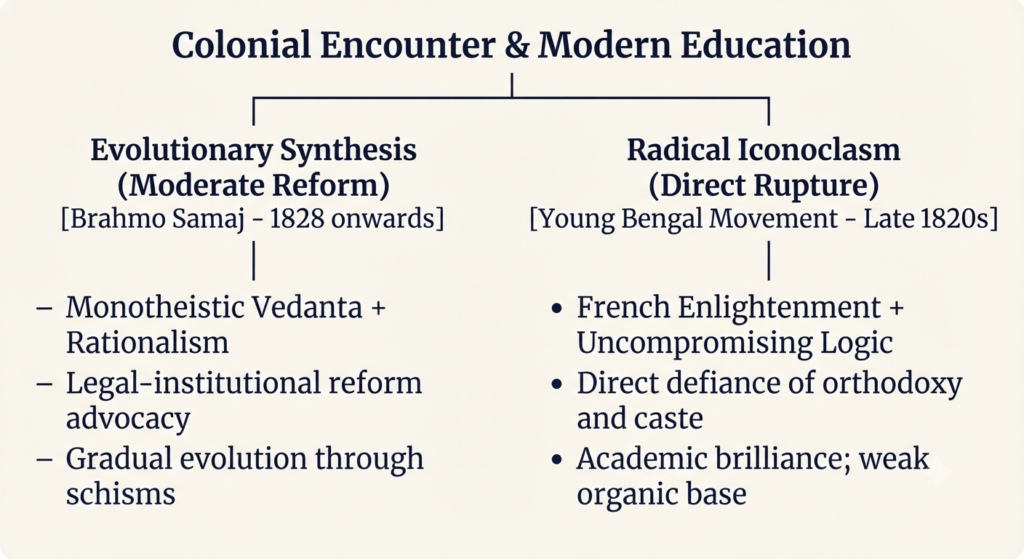
- Catalytic Factors: The introduction of modern print culture, English education through institutions like Hindu College (1817), and the missionary critique of Hinduism exposed deep-seated social malaise, including idolatry, polytheism, Sati, child marriage, and hereditary caste rigidities.
- The Dual Strategic Response: The reform discourse split into two distinct trajectories: one attempting an organic internal renovation grounded in indigenous monotheism (Brahmo Samaj), and the other demanding an uncompromising break with tradition based on pure Enlightenment logic (Young Bengal).
The Brahmo Samaj: Rise, Growth, and Institutional Schisms
1. Foundation and Raja Ram Mohan Roy’s Monotheistic Rationalism (1828–1833)
- Atmiya Sabha (1815) to Brahmo Sabha (1828): Founded to propagate pure monotheism (Vedanta) free from idolatry, meaningless ritualism, and priestcraft. In 1830, the Brahmo Trust Deed institutionalized non-sectarian worship open to all communities without images or animal sacrifices.
- Hermeneutical Method: Ram Mohan Roy did not reject the ancient scriptures; instead, he translated the Upanishads into Bengali and English, demonstrating that foundational Hindu literature condemned polytheism and Sati.
- Socio-Legal Interventions: His persistent anti-Sati petitions and mobilization of rationalist-scriptural arguments directly enabled Lord William Bentinck to enact the Bengal Sati Regulation (Regulation XVII, 1829).
2. Debendranath Tagore and the Consolidation Phase (1840s)
- Tattvabodhini Sabha (1839): Established by Debendranath Tagore, it merged into the Brahmo Samaj in 1842. It established a rigorous intellectual forum through its journal, Tattvabodhini Patrika (edited by Akshay Kumar Dutt), systematically studying India’s past through a rational, nationalist lens.
- Doctrinal Maturation: Tagore distanced the movement from radical Westernization, anchoring it firmly in reformed Upanishadic theism while explicitly rejecting scriptural infallibility in 1850.
3. Keshub Chandra Sen, Expansion, and the Inevitable Schisms
- Pan-Indian Proliferation: Under Keshub Chandra Sen’s charismatic leadership (inducted in 1857), the Samaj broke out of its regional Bengali confines, setting up branches across Bombay (inspiring the Prarthana Samaj in 1867), the North-Western Provinces, and Madras (inspiring the Veda Samaj in 1864).
- First Schism (1866): Radical social advocacy by Sen (inter-caste marriages, abolition of caste distinctions, elevation of female rights, and cosmopolitan Christian-Islamic spiritual syncretism) conflicted with Debendranath’s cultural caution:
- Adi Brahmo Samaj: Retained by Debendranath Tagore (cautious, nationally rooted).
- Brahmo Samaj of India: Headed by Keshub Chandra Sen (universalist, activist).
- The Native Marriage Act (Act III of 1872): Sen’s relentless advocacy led to civil legislation outlawing child marriage and polygamy, and legalizing inter-caste unions for non-orthodox citizens.
- Second Schism (1878) & Sadharan Brahmo Samaj: Sen violated his own principles by marrying his 13-year-old daughter to the minor Maharaja of Cooch Behar with orthodox Hindu rituals. Disillusioned progressives—including Ananda Mohan Bose, Sivanath Sastri, and Dwarakanath Ganguly—broke away to establish the Sadharan Brahmo Samaj, governed by strict democratic, constitutional principles.
Young Bengal Movement: Radical Revolt and Iconoclasm
1. Ideological Genesis and Henry Vivian Derozio (Late 1820s)
- Derozian Spark: Henry Louis Vivian Derozio, an Anglo-Indian teacher at Hindu College from 1826 to 1831, inspired students to question all traditional authority, champion individual liberty, worship truth, and assimilate French Revolutionary ideals (liberty, equality, fraternity).
- Academic Associations: He established the Academic Association (1828), a debating forum that openly interrogated orthodox Hindu conventions, idolatry, and hereditary authority.
2. Character and Forms of Assertion
- Radical Social Defiance: Derozians (e.g., Dakshinaranjan Mukherjee, Ramgopal Ghosh, Krishna Mohan Banerjee, Radhanath Sikdar) enacted deliberate symbolic revolts against orthodoxy—publicly eating beef, drinking wine, and discarding sacred threads.
- Demanding Civil & Gender Liberties: They pioneered demands for modern public education, freedom of the press, trial by jury, peasant protection from zamindari extortion, and the complete emancipation of women.
- Literary Organs: Articulated their ideas through radical periodicals like Hesperus, The Enquirer, and Jnananveshan.
3. Structural Weaknesses and Decline
- Exclusion from the Masses: Their ultra-radical, Western-centric stance lacked an organic connect with indigenous cultural idioms, alienating them from the broader society and provoking a fierce orthodox backlash (resulting in Derozio’s dismissal in 1831 and his untimely death shortly after).
- Lack of Mass Base: While their intellectual brilliance was unmatched, they could not construct a durable mass movement or an enduring institutional network. Sumit Sarkar observed that their radicalism was largely academic, as many Derozians later entered safe administrative jobs under the colonial apparatus.
Comparative Assessment: Brahmo Samaj vs. Young Bengal
| Feature | Brahmo Samaj | Young Bengal Movement |
| Philosophical Anchor | Internal regeneration; Vedanta synthesized with Western Enlightenment. | Absolute rationalism; uncritical adaptation of radical European thinkers (Tom Paine, Voltaire). |
| Methodology | Systematic institutional organizing, legislative petitions, scriptural hermeneutics. | Academic debates, radical individual defiance, symbolic iconoclasm. |
| Attitude to Tradition | Reinterpretive; sought to separate pure monotheism from degenerate rituals. | Rejectionist; viewed traditional customs as irredeemably irrational. |
| Geographical Reach | Pan-Indian (Bengal, Maharashtra, Madras, Punjab). | Confined strictly to Calcutta’s college elite. |
| Long-Term Legacy | Built enduring institutions, triggered progressive laws (1829, 1872), spawned civil reform networks. | Inoculated the Bengali youth with uncompromising intellectual skepticism and civil libertarian thought. |
Conclusion
The Brahmo Samaj and the Young Bengal Movement together defined the perimeter of modern India’s intellectual awakening. While the Derozians served as the explosive avant-garde that introduced uncompromising rational skepticism and civil liberties into the colonial public sphere, the Brahmo Samaj supplied the structural endurance, institutional scaffold, and vernacular bridge necessary to sustain societal reform. By transitioning Indian thought from unquestioning orthodoxy to evidence-based civic discourse, they laid the ideological foundations that directly powered the subsequent anti-colonial national movement.
Q.23 Mahatma Jotirao Phule’s writings and efforts of social reforms touched issues of almost all subaltern classes. Discuss. (2025, 15 Marks)
महात्मा जोतीराव फुले के समाज सुधार प्रयासों और लेखन ने समाज के लगभग सभी उपेक्षित तबकों की समस्याओं को छुआ है। चर्चा कीजिए।
Introduction
Mahatma Jotirao Phule (1827–1890) pioneered an anti-hegemonic social revolution in 19th-century Western India, shifting the discourse of social reform from internal Brahmanical orthodoxy to an inclusive, bottom-up mobilization of the oppressed. His formulation of the Bahujan Samaj conceptualized the subaltern not as a monolith, but as a broad coalition of Shudras (peasantry), Ati-Shudras (untouchables), and women systematically marginalized by ritual and economic hierarchies.
Dimensions of Phule’s Interventions for Subaltern Classes
1. Emancipation and Upliftment of Ati-Shudras (Dalits)
- Epistemological Empowerment: In his treatise Gulamgiri (Slavery, 1873), Phule dedicated his work to the American abolitionist movement, equating caste untouchability with systemic racial enslavement. He famously diagnosed lack of education (vidya) as the root of material destitution.
- Radical Social Institutions: Established the Satyashodhak Samaj (1873) to dismantle the need for Brahmin priestly mediation in rites of passage, introducing simplified, priest-free wedding ceremonies (Satyashodhak Vivah).
- Direct Access to Public Commons: Opened his personal water reservoir to Mahars and Mangs in Pune (1868), directly challenging untouchability decades before the Mahad Satyagraha. He established dedicated schools for Dalit girls and boys at Bhidewada (1848) and Nanapeth with Savitribai Phule and Fatima Sheikh.
2. Reforming Agrarian Subalterns (Shudra Peasantry)
- Critique of Rural Indebtedness: In Shetkaryacha Asud (The Cultivator’s Whip-cord, 1881), he analyzed the structural nexus between corrupt colonial revenue bureaucracy and money-lending moneylenders (sawkars), which disenfranchised Kunbi cultivators.
- Technological and Ecological Demands: Advocated modern agrarian infrastructure, demanding state-funded canal irrigation, check-dams, scientific cattle breeding, and agricultural education for ryots.
- Advocacy during the Deccan Riots (1875): Provided moral and intellectual backing to peasant uprisings in Sirur and Bhimthadi talukas, articulating agrarian discontent against exploitative land-revenue assessments.
3. Gender Justice and the Intersection of Caste and Patriarchy
- Pioneering Female Education: Recognized that women across all varnas suffered patriarchal subjugation. Alongside Savitribai Phule, he founded the first indigenous school for girls in Pune (1848).
- Institutional Support for Destitute Women: Founded the Balhatya Pratibandhak Griha (Infanticide Prohibition Home, 1863) to protect upper-caste widows from forced abortions and honour killings, later adopting Yashwantrao, the son of a Brahmin widow.
- De-brahmanization of Marriage: Satyashodhak marriage vows explicitly mandated men to guarantee equal rights and autonomy to wives, challenging patriarchal rituals codified in the Manusmriti.
4. Nascent Working-Class Advocacy
- Urban Labor Mobilization: Phule inspired his associate Narayan Meghaji Lokhande to establish the Bombay Mill-Hands Association (1884), India’s first organized trade union body.
- Welfare of Migrant Labor: Instrumental in presenting factory workers’ grievances to the First Factory Commission (1884), securing demands for a mandatory weekly day of rest (Sunday), limited hours, and compensation for industrial injuries.
5. Institutional Reform and Subaltern Political Representation
- Hunter Commission Testimony (1882): Demanded free, compulsory primary education for the masses, arguing that British educational subsidies disproportionately benefited higher castes through the “Downward Filtration Theory.”
- Civic Accountability: As a nominated member of the Poona Municipal Corporation (1876–1883), he opposed elite vanity spending and fought for sanitation, primary schools, and health infrastructure in subaltern settlements.
Conclusion
Phule transformed 19th-century Indian social reform from elite, sanskritized revivalism into a radical subaltern critique that integrated caste, class, and gender hierarchies. By bridging intellectual discourse (Gulamgiri, Sarvajanik Satya Dharma) with grassroots praxis, his legacy directly laid the ideological and structural groundwork for Dr. B.R. Ambedkar’s constitutional vision and modern affirmative-action frameworks in India.