
World War I (Home Rule and Ghadar Movement) served as a major catalyst in transforming India’s struggle against British colonial rule. Economic distress, forced recruitment, and international political shifts broke the political dormancy in the country, fostering renewed agitation. The war years witnessed dynamic developments, from militant revolutionary activities led overseas by the Ghadar Party to constitutional mass campaigns like the Home Rule Movement guided by Annie Besant and Bal Gangadhar Tilak. Analysing these thematic UPSC questions provides crucial clarity on India’s wartime political transition towards the Gandhian era.
Q.1 Describe briefly the impact of the The Great War of 1914-18 on India.
The First World War (1914–18) was a major turning point in modern Indian history. While India contributed over 1.3 million soldiers and laborers alongside roughly £100 million in direct imperial war contributions, the multi-dimensional impact of the war shattered the socio-economic and political status quo, accelerating the transition to mass nationalism.
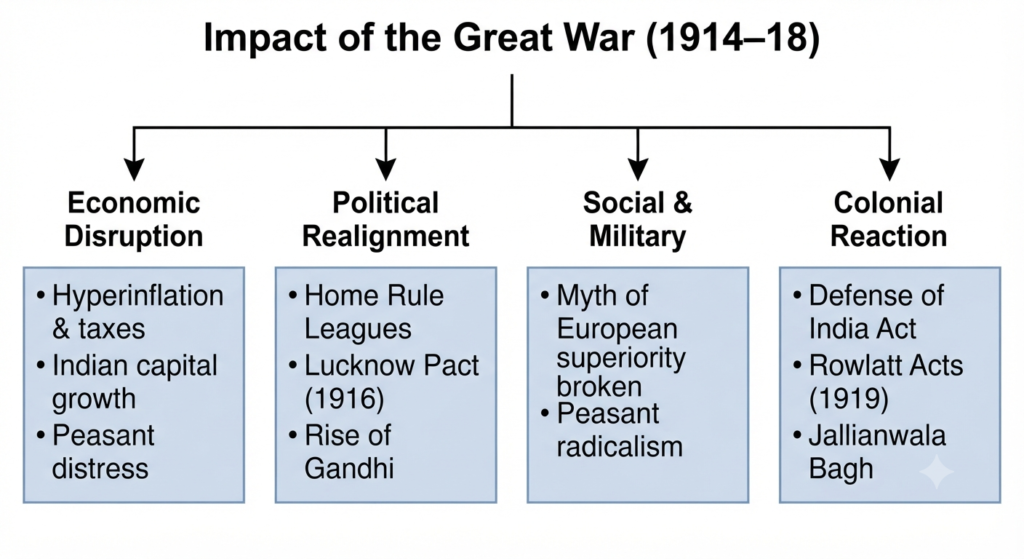
1. Economic Ramifications: Distress and Industrial Realignment
- Severe Inflation and Shortages: War financing triggered steep inflation; prices of essential food grains and manufactured goods nearly doubled between 1914 and 1919, severely hitting urban workers, fixed-income earners, and landless laborers.
- Aggressive Taxation: The colonial state raised customs duties, enhanced land revenue assessments, and reintroduced the Income Tax in 1916 to fund imperial military expenditures abroad.
- Stimulus for Indigenous Capital: Disruption of shipping lanes and the diversion of British manufacturing toward war supplies created an import vacuum. This provided major protection to indigenous industries—most notably Indian-owned cotton textiles and the nascent Tata Iron and Steel Company (TISCO)—fostering a politically conscious Indian capitalist class.
2. Social and Human Costs
- Forced Recruitment and Casualties: Coercive recruitment drives—especially in rural Punjab and the United Provinces—created deep peasant resentment. Over 70,000 Indian troops died on the battlefields of Mesopotamia, Gallipoli, and the Western Front.
- Post-War Epidemic and Famine: Famine conditions in 1918–19 coincided with the catastrophic 1918 Influenza Pandemic, which claimed roughly 12 to 14 million Indian lives, exposing the inadequacy of colonial public health machinery.
- Dismantling Racial Myths: Indian soldiers serving on European fronts witnessed intra-European savagery firsthand, dismantling the psychological myth of the “White Man’s inherent superiority” and boosting national self-respect.
3. Political Catalysts and Radicalization
- Home Rule Movement (1916): Capitalizing on wartime imperial vulnerability, Bal Gangadhar Tilak and Annie Besant launched their respective Home Rule Leagues, demanding self-governance (Swaraj) on the model of British white dominions.
- The Lucknow Pact (1916): The war facilitated the historic rapprochement between the Moderates and Extremists, alongside a joint constitutional scheme between the Indian National Congress and the All-India Muslim League.
- Global Revolutionary Upsurge: Revolutionary bodies utilized international wartime logistics: the Ghadar Party attempted armed insurrection in Punjab, while the Berlin Committee (under Virendranath Chattopadhyaya) pursued the Indo-German Conspiracy.
- Rise of Muslim Alienation: Britain’s war against the Ottoman Empire placed Indian Muslims in an emotional conflict regarding the Ottoman Caliph (Khalifa), laying the direct groundwork for the pan-Indian Khilafat Movement.
4. Constitutional Concessions vs. State Repression
- The Montagu Declaration (August 1917): To preserve Indian wartime cooperation, Secretary of State Edwin Montagu made a historic declaration promising the “progressive realization of responsible government in India,” which shaped the Government of India Act 1919 (Dyarchy).
- The Repressive Backlash: While promising constitutional devolution, the British entrenched emergency powers through the Defense of India Act 1915, subsequently institutionalized via the draconian Rowlatt Acts (1919).
The Great War stripped British rule of its moral and administrative prestige while uniting peasants, industrial workers, urban elites, and returnee soldiers under a common matrix of distress. This collective political consciousness was mobilized by Mahatma Gandhi, turning post-war disillusionment into the nationwide Rowlatt Satyagraha and the Non-Cooperation-Khilafat Movement (1920–22).
Q.2 Explain briefly the importance of the Ghadar Party (1987)
ग़दर पार्टी के महत्व को संक्षेप में समझाइए
Founded in 1913 in San Francisco (originally as the Pacific Coast Hindustan Association) by leaders like Lala Har Dayal, Sohan Singh Bhakna, Taraknath Das, and Kartar Singh Sarabha, the Ghadar Party represented an international, armed revolutionary strand of Indian anti-colonialism.
Key Importance and Contributions
1. Uncompromising Secularism and Egalitarian Ethos
- Overcoming Communal Fissures: Composed predominantly of Punjabi Sikh immigrants, along with Hindu and Muslim exiles, the party operated on strict secular principles.
- Democratic Inclusivity: Leaders explicitly warned cadres that communal politics played into British hands; religion was treated strictly as a personal matter, making Ghadar a model of cross-community solidarity in the freedom struggle.
2. Early Demand for Complete Sovereign Independence
- Beyond Dominion Status: Long before the Indian National Congress adopted Purna Swaraj (1929), the Ghadarites declared complete independence through armed revolution as their non-negotiable objective.
- Republican Vision: Drawing inspiration from the American Revolution, they envisioned post-colonial India as a secular, democratic republic rather than a constitutional dominion under the British Crown.
3. Transnational Anti-Imperialist Alliances
- Global Networking: Established bases across North America, East Asia (Shanghai, Manila, Singapore), and Europe.
- Capitalizing on Imperial Vulnerability: During World War I, they allied with Germany and Indian revolutionaries abroad (the Berlin Committee / Indo-German Conspiracy) to coordinate an armed mutiny inside India by mobilizing returnee diaspora soldiers.
4. Mobilization of Expatriate and Working-Class Migrants
- Diaspora Political Consciousness: Politicized Indian ex-soldiers and laborers facing racial discrimination on the North American Pacific Coast (highlighted by the Komagata Maru incident, 1914).
- Weekly Paper Ghadar: Published in Urdu, Gurmukhi, and other languages, the party journal carried radical anti-colonial propaganda worldwide under the masthead slogan: “Angrezi Raj ka Dushman” (Enemy of British Rule).
5. Inspiring Future Revolutionary Vanguard
- The Mutiny Effort (1915): Though their planned all-India armed revolt in February 1915 was foiled due to state intelligence penetration and betrayal, their willingness to sacrifice life and property left a lasting imprint on the nationalist imagination.
- Martyrdom as Ideological Fuel: The executions of young revolutionaries like Kartar Singh Sarabha (who was hanged at age 19) served as a direct inspiration to Bhagat Singh and the Hindustan Socialist Republican Association (HSRA).
- Legacy in Left-Wing Politics: Returning Ghadar cadres laid the grassroots organizational foundations for the Kirti Kisan Party, peasant unions, and the communist movement in Punjab during the 1920s and 1930s.
While the Ghadar Party failed operationally due to inadequate secret underground machinery, superior British intelligence, and a lack of domestic preparedness, its significance lies in pioneering transnational, secular, working-class militancy that expanded the horizon of Indian nationalism well beyond constitutional reformism.
Q.3 Explain the role played by Annie Besant in the Home Rule Movement. (94/10)
होमरूल आंदोलन में एनी बेसेंट द्वारा निभाई गई भूमिका की व्याख्या करें।
Annie Besant played an instrumental role in reviving the Indian national movement during World War I by launching the All-India Home Rule League in September 1916 at Madras. Drawing on her Irish background and familiarity with the Irish Home Rule agitation, she transformed the political landscape from post-Surat lethargy into an active, year-round constitutional campaign.
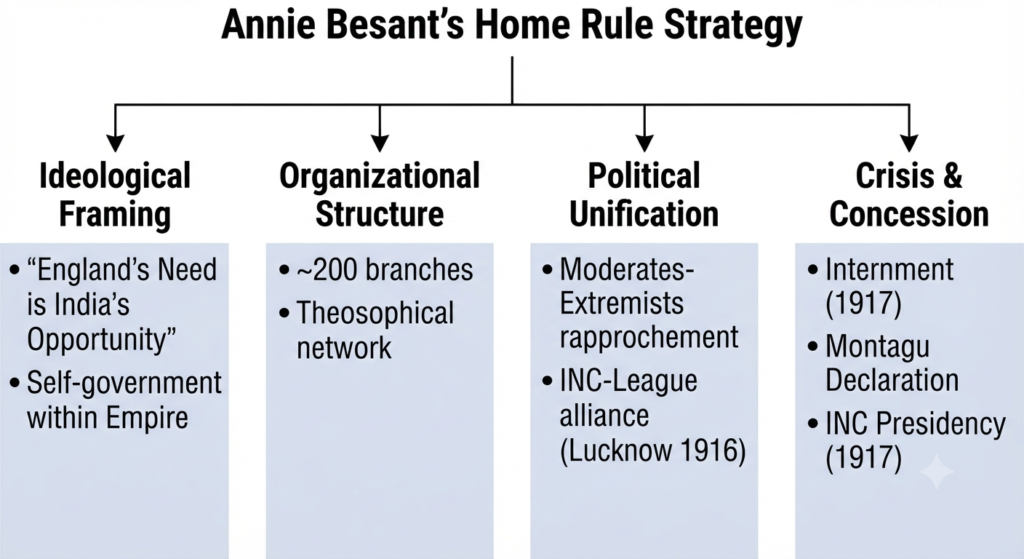
1. Ideological Conception and Agitational Framing
- The Irish Template: Besant popularized the concept of self-government (Home Rule) on the model of British white dominions (Australia, Canada), arguing that India was entitled to equal partnership within the British Commonwealth.
- Capitalizing on Wartime Vulnerability: She articulated the famous strategic maxim: “England’s need is India’s opportunity,” urging Indian nationalists not to put political demands on hold during the Great War.
2. Organizational Infrastructure and Mass Propaganda
- Loose, All-India Network: While Bal Gangadhar Tilak concentrated his League in Maharashtra (excluding Bombay city), Karnataka, Central Provinces, and Berar, Besant’s League took charge of the rest of India. It established roughly 200 branches, drawing heavily on her existing Theosophical Society network in South India, Gujarat, UP, and Bihar.
- Press and Print Campaign: Through her two influential publications—the daily newspaper New India and the weekly journal Commonweal—she politicized the educated middle class and youth with articles on self-governance, administrative abuse, and civic rights.
- Grassroots Political Education: Organized discussion groups, reading rooms, public libraries, and distributed vernacular pamphlets to ensure continuous, year-round political engagement, moving past the Congress tradition of meeting only three days a year.
3. Architect of Nationalist Re-unification (1914–1916)
- Bridging the Factional Divide: Upon joining the Congress in 1914, Besant worked to bring the Extremists back into the mainstream party fold, facilitating Tilak’s formal re-entry at the 1915 Bombay session.
- Catalyzing the Lucknow Pact (1916): Besant and Tilak coordinated the joint session of the Indian National Congress and the All-India Muslim League at Lucknow, creating a united constitutional front that demanded self-government and council expansion.
4. Internment as the Emotional Tipping Point (June 1917)
- Colonial Repression: Alarmed by the spread of the movement in Madras, Governor Lord Pentland ordered the internment of Annie Besant along with her associates George Arundale and B.P. Wadia in Ootacamund (Ooty).
- Nationwide Backlash: The internment ignited an all-India political uproar:
- Moderates who had stayed aloof—such as Jawaharlal Nehru, Mohammad Ali Jinnah, and Tej Bahadur Sapru—joined her League in protest.
- Renowned jurist Sir S. Subramania Aiyar renounced his knighthood.
- Tilak advocated passive resistance and civil disobedience if she was not released.
5. Extraction of Historic Constitutional Concessions
- The Montagu Declaration (August 1917): Confronted by unified nationwide agitation, Secretary of State Edwin Montagu announced in Parliament that the goal of British policy was the “increasing association of Indians in every branch of the administration, and the gradual development of self-governing institutions with a view to the progressive realization of responsible government in India.”
- Culmination and Recognition: Besant was released in September 1917 and elected President of the Calcutta Session of the Indian National Congress (December 1917), becoming the first woman to hold the office.
Limitations and the Ebbing Phase
Besant’s influence waned quickly after 1918:
- Constitutional Gradualism: Satisfied with Montagu’s announcement, she accepted the Montagu-Chelmsford Reforms (1919) as a major step forward, alienating radicalized youth who demanded immediate Dominion Status.
- Rejection of Gandhian Direct Action: She opposed Mahatma Gandhi’s extra-constitutional methods of mass civil disobedience and non-cooperation, labeling them a descent into “mobocracy,” which caused her to step back from the forefront of the national movement.
Annie Besant bridged the critical transitional gap between the post-Surat political slump and the Gandhian mass era. By institutionalizing year-round political agitation, building an all-India organizational network, and popularizing the demand for Home Rule, she transformed Indian politics into a continuous, active struggle that prepared the country for mass non-cooperation.
Q.4 Trace the growth of the Indian Home Rule Movement in Britain. (2002)
ब्रिटेन में भारतीय होमरूल आंदोलन के विकास का पता लगाएं।
The Indian Home Rule Movement was not confined to the subcontinent; its leaders recognized that influencing the imperial political core in London was vital to extract constitutional concessions. Between 1914 and 1919, both Annie Besant and Bal Gangadhar Tilak established organizational apparatuses, mobilized British political parties, and engaged the British public to advocate for self-government on the dominion model.
1. The Precursor and Early Impetus (1914–1916)
- The 1914 Congress Delegation: In early 1914, an Indian National Congress delegation—including Bhupendranath Basu, Lala Lajpat Rai, and M.A. Jinnah—visited Britain to lobby on the reform of the Council of the Secretary of State. Annie Besant joined them in London and delivered public addresses emphasizing the necessity of an organized movement for Indian self-government within the empire.
- The Irish Template: Drawing on her connections with British radicals and Irish Home Rulers, Besant argued that Indian demands must be directly articulated in the British press and Parliament, just as Irish nationalists had done through Westminster.
2. Establishment of the Home Rule for India League in London (1916–1918)
- The British Auxiliary (June 1916): Even before launching her All-India Home Rule League in Madras, Besant’s associates in London founded the “Home Rule for India League” (often referred to as the British Auxiliary).
- Key Organizers: The London branch was spearheaded by British supporters of Indian autonomy, notably George Lansbury (a prominent socialist and future Labour Party leader), John Scurr, and Muriel Countess of De La Warr.
- Theosophical and Socialist Networks: The League functioned out of central London, utilizing both the Theosophical Society’s branches and independent working-class socialist clubs to circulate pamphlets, hold lectures, and pass resolutions demanding that the war for “global democracy” include self-determination for India.
3. Tilak’s Direct Intervention and Mobilization (1918–1919)
Bal Gangadhar Tilak arrived in London in October 1918 primarily to pursue his libel suit against Sir Valentine Chirol (author of Indian Unrest). Tilak stayed for over a year and used this period to turn London into an active campaign ground for Indian Home Rule:
- Founding the Indian Home Rule League in England: Tilak consolidated the London work by formally opening the British office of his Indian Home Rule League at Fleet Street, appointing D.V. Gokhale and later Joseph Baptista to manage its affairs.
- Public Lecture Circuit: Tilak addressed gatherings across Britain—in London, Manchester, Bristol, and Edinburgh—explaining the Indian economic drain, wartime contributions, and the justice of Swaraj.
- Pamphlet and Media Campaign: His League published and distributed tens of thousands of leaflets, including Self-Determination for India, sending copies to every Member of Parliament, trade union leader, and major newspaper editor.
4. Strategic Alliance with the British Labour Party
Tilak realized that the ruling Conservatives and traditional Liberals were unsympathetic to immediate devolution, prompting a deliberate alliance with the rising British Labour Party:
- Financial and Political Backing: Tilak donated approximately £2,000 to £3,000 to the Labour Party’s election fund ahead of the 1918 British General Election, helping them print literature in exchange for incorporating Indian Home Rule into their party platform.
- Labour Party Conferences: Tilak attended the 1919 Labour Party Annual Conference at Southport as a fraternal delegate, securing resolutions supporting the principle of self-determination for India.
- Key Parliamentary Allies: Prominent Labour figures—such as Arthur Henderson, Ramsay MacDonald, Josiah Wedgwood, and George Lansbury—became vocal advocates for the Indian cause on the floor of the House of Commons.
5. Deputations to the Joint Select Committee on the 1919 Bill
The activity peaked in the summer of 1919, when the British Parliament formed the Joint Select Committee under Lord Selborne to take evidence on the Montagu-Chelmsford Reforms (the Government of India Bill):
- Multiple Indian Delegations in London: London hosted delegations from different factions:
- Tilak’s Home Rule League (Tilak, G.S. Khaparde, B.C. Pal).
- Besant’s Home Rule League and National Home Rule League (Annie Besant, Jamnadas Dwarkadas, B.P. Wadia).
- The Moderate / Liberal deputation (Surendranath Banerjea, Tej Bahadur Sapru).
- Testimonies on Dyarchy: Appearing before the Parliamentary Committee, both Tilak and Besant submitted detailed evidence arguing that the proposed dyarchy in the provinces was unworkable, demanding immediate provincial autonomy and substantial fiscal control at the Centre.
Significance and Assessment
- Internationalizing the Freedom Struggle: The movement in Britain shifted the Indian question from an internal imperial administrative issue into an open matter of international self-determination during the post-WWI Versailles negotiations.
- Laying the Foundation for Future Lobbies: The working relationships Tilak and Besant forged with the British Labour Party in 1918–19 paid long-term dividends, creating the pro-independence parliamentary lobby that later facilitated the dispatch of the Cabinet Mission and the Indian Independence Act of 1947 under Clement Attlee’s Labour government.