
Lord Curzon’s decision to partition Bengal in 1905 served as a watershed moment in India’s national movement, transforming elite politics into mass anti-colonial resistance. The resulting Swadeshi and Boycott movements fostered indigenous enterprise and cultural revival while catalyzing militant and revolutionary activities across Bengal, Maharashtra, and Punjab. Analyzing these UPSC Mains 30 Years PYQs: Partition of Bengal and Swadeshi Movement provides vital conceptual clarity on colonial motivations, mass mobilization patterns, and the socio-political factors that led to the eventual annulment of the partition in 1911.
Q.1 What were the motives which led to the partition of Bengal? What were its consequences? Why was it annulled? (1988)
वे कौन से कारण थे जिनके कारण बंगाल का विभाजन हुआ? इसके परिणाम क्या थे? इसे क्यों रद्द किया गया? (लगभग 250 शब्द)
Announced in July 1905 by Viceroy Lord Curzon and implemented on October 16, 1905, the Partition of Bengal was a watershed event in the Indian national movement.
Motives Behind the Partition
- Official Administrative Pretext: The colonial government cited that the Bengal Presidency—comprising Bengal, Bihar, and Orissa with a population of roughly 78 million—was administratively unwieldy for a single lieutenant-governor.
- Real Political Motive (Divide and Rule):
- Curtailing the Nerve Center of Nationalism: As Home Secretary H.H. Risley noted in 1904, “Bengal united is a power; Bengal divided will pull several different ways.” The core motive was to weaken the politically advanced Bengali intelligentsia.
- Engineering Communal and Linguistic Divisions:
- Religious: Creating a Muslim-majority province (Eastern Bengal and Assam) and a Hindu-majority province (Western Bengal, Bihar, and Orissa), deliberately playing one community against the other.
- Linguistic: Reducing Bengalis to a linguistic minority in their own home province by grouping them with Hindi and Odia speakers.
Consequences of the Partition
- Launch of the Swadeshi and Boycott Movement (1905): Mobilized unprecedented mass participation through the boycott of British goods, promotion of indigenous industry, national education, and passive resistance.
- Widening of Social Base: Students, urban women, and lower-middle classes actively entered active agitational politics for the first time.
- Radicalization of Nationalist Politics: The failure of Moderate methods discredited constitutionalism, propelling the rise of the Extremists (Lal-Bal-Pal, Aurobindo Ghosh) and culminating in the Surat Split (1907).
- Genesis of Revolutionary Terrorism: State suppression pushed radical youth toward secret societies (e.g., Anushilan Samiti, Jugantar).
- Institutionalization of Communalism: British encouragement of communal separateness directly aided the formation of the All-India Muslim League (1906) and the communal provisions in the Morley-Minto Reforms (1909).
Why the Partition Was Annulled (1911)
Lord Hardinge II annulled the partition at the Delhi Durbar of 1911 primarily because:
- Failure to Stem Nationalist Ferment: Rather than extinguishing nationalism, the partition supercharged it into widespread boycott, labor strikes, and revolutionary activities.
- Administrative Conciliation: The British aimed to appease mainstream Congress nationalists while simultaneously shifting the imperial capital from Calcutta to Delhi to isolate the central administration from militant Bengali politics.
- Restructuring on Linguistic Lines: Bihar and Orissa were carved out, and Assam was made a separate province, effectively defusing the linguistic grievances while maintaining administrative feasibility.
Q.2 Discuss the growth of revolutionary terrorism with special reference to its ramifications in Maharashtra, Bengal and Punjab till the first decade of the twentieth century. (1991)
बीसवीं सदी के पहले दशक तक महाराष्ट्र, बंगाल और पंजाब में इसके प्रभावों के विशेष संदर्भ में क्रांतिकारी आतंकवाद के विकास की चर्चा कीजिए।
The first phase of revolutionary terrorism (roughly 1897–1910) emerged as an offshoot of militant nationalism. Disillusioned by the constitutional “mendicancy” of the Moderates and reacting to the state suppression that followed the Swadeshi Movement, educated youth turned to the cult of the bomb and the gun to shatter the psychological aura of British invincibility.
1. Maharashtra: The Pioneer of Militant Direct Action
Maharashtra was the cradle of early revolutionary activities, heavily drawing emotional inspiration from Bal Gangadhar Tilak’s Ganapati and Shivaji festivals.
- Early Precursor (Ramosi Peasant Force): In 1879, Vasudev Balwant Phadke organized the Ramosi peasant force, launching armed dacoities to disrupt British communication and finance famine-stricken peasants.
- The Chapekar Brothers (1897): Damodar and Balkrishna Chapekar assassinated W.C. Rand, the Chairman of the Special Plague Committee in Poona, whose military plague-inspection operations were notorious for entering private homes and desecrating places of worship. This marked the first political assassination of a British official in modern Indian history.
- Abhinav Bharat Society (1904):
- Founded by Vinayak Damodar Savarkar and his brother Ganesh Savarkar (evolving out of the Mitra Mela formed in 1899).
- Operated as a secret network of cadres trained in bomb-making and guerrilla tactics.
- In 1909, Anant Laxman Kanhere, an Abhinav Bharat operative, assassinated Arthur Jackson, the District Magistrate of Nasik (the Nasik Conspiracy Case), which resulted in the sentencing and deportation of V.D. Savarkar to the Cellular Jail in the Andamans.
2. Bengal: Systematic Underground Organizing and the Cult of Shakti
In Bengal, revolutionary terrorism grew directly out of the state’s brutal suppression of the anti-Partition (Swadeshi) agitation. Frustrated by the lack of an active program after the movement ebbed, urban youth established secret societies (Samitis).
- Anushilan Samiti (1902):
- Founded by Promotha Mitter, with ideological backing from Aurobindo Ghosh, Barindra Kumar Ghosh, and Sister Nivedita.
- Operated through two main wings: the Calcutta Anushilan Samiti and the highly disciplined Dhaka Anushilan Samiti led by Pulin Behari Das.
- The Jugantar Group (1906):
- An inner circle of Anushilan, led by Barindra Kumar Ghosh and Bhupendranath Dutta, established the weekly journal Jugantar, preaching that “force must be stopped by force.”
- Alipore Bomb Conspiracy Case (1908):
- Khudiram Bose and Prafulla Chaki threw a bomb at a carriage in Muzaffarpur aiming to kill Douglas Kingsford, a magistrate infamous for handing out corporal floggings to nationalist youths.
- The subsequent police raid on a clandestine bomb factory at Manicktollah garden in Calcutta led to the arrest of the entire core leadership, including Aurobindo Ghosh (defended brilliantly by C.R. Das) and Barindra Ghosh.
- Narendra Goswami Assassination (1908): Inside Alipore Jail, Satyendranath Bose and Kanailal Dutt shot dead the police approver Narendra Goswami, preventing state prosecution from securing sweeping convictions.
3. Punjab: Intersection of Agrarian Grievances and Radical Politics
In Punjab, revolutionary sentiment was fueled by recurring famines, plague, and rural economic distress rather than purely ideological revivalism.
- Agrarian Catalysts (1906–1907):
- Colonial authorities passed the Punjab Colonisation Bill (1906) and levied steep hikes in canal water rates and land revenue, sparking widespread rural discontent in the Chenab Colony and Bari Doab.
- Bharat Mata Society:
- Founded by Sardar Ajit Singh (Bhagat Singh’s uncle), Sufi Amba Prasad, and Kishan Singh.
- They launched the popular agitation with the war cry “Pagri Sambhal Jatta” (led by Banke Dayal), successfully forging an alliance between the rural peasantry and urban educated youth.
- Lala Lajpat Rai provided broad political backing to the rural agitation, leading to the deportation of both Rai and Ajit Singh to Mandalay in 1907 without trial.
- Subsequent Underground Networks:
- Following state crackdowns, revolutionary activity went underground, sustained by dynamic organizers like Lala Har Dayal, who later relocated abroad to lay the foundations for the Ghadar Movement in North America.
Significant Ramifications and Assessment
- Erosion of British Invincibility: Targeted assassinations and daring courtroom declarations shattered the psychological myth of unchallenged colonial dominance, inspiring self-respect among educated youth.
- Radicalizing the National Discourse: Revolutionary daring pushed mainstream politics forward; the fear of violent insurrection repeatedly compelled the colonial state to grant constitutional concessions (such as the Morley-Minto Reforms of 1909) to keep the Moderates engaged.
- Structural Limitations:
- Lack of Mass Base: Early revolutionaries operated as heroic individual vanguards rather than mobilizing peasants and factory workers, making them vulnerable to police crackdowns.
- Religious Symbolism: In Bengal and Maharashtra, secret societies frequently relied on Hindu oaths (sworn before Kali or the Gita), which inadvertently discouraged Muslim participation and contributed to communal friction.
Despite these tactical limitations, this early wave established an enduring tradition of revolutionary patriotism, creating the networks, organizational experience, and ideological defiance that would later culminate in the Hindustan Socialist Republican Association (HSRA) during the 1920s.
Q.3 How far was the Swadeshi Movement linked with Boycott? Analyse the nature of mass participation in the Movement. (1992)
स्वदेशी आंदोलन बहिष्कार से कहाँ तक जुड़ा था? आंदोलन में जनभागीदारी की प्रकृति का विश्लेषण कीजिए।
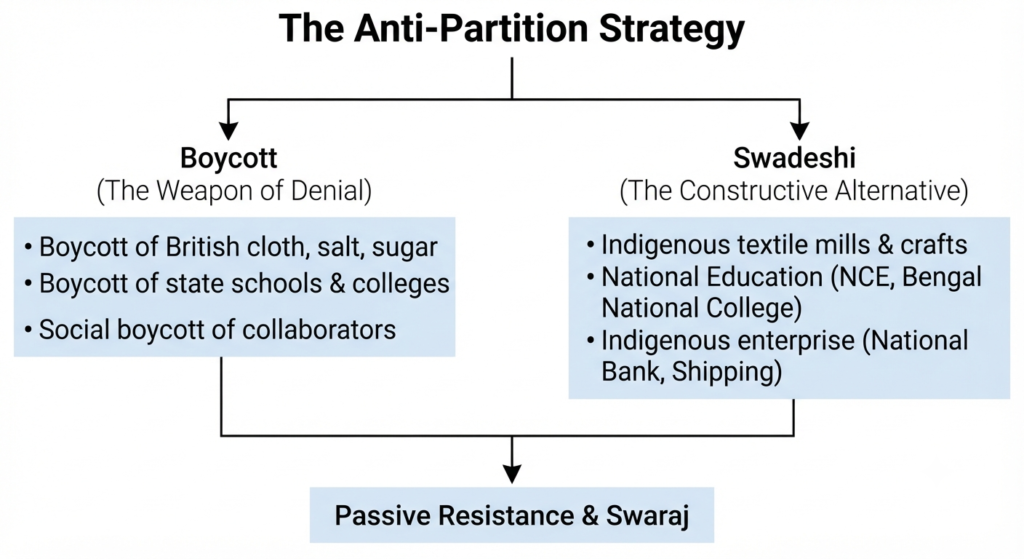
The Swadeshi Movement (1905–1908), sparked by Lord Curzon’s decision to partition Bengal, marked the transition of the Indian national movement from elite petitioning to mass agitational politics. At its operational core lay an inseparable organic relationship between Swadeshi (constructive self-reliance) and Boycott (negative economic and political resistance).
Organic Link Between Swadeshi and Boycott
1. Two Sides of the Same Coin (Economic Symbiosis)
- Complementary Dynamics: Boycott was the negative sanction that created market room for domestic goods, while Swadeshi was the positive constructive effort to supply that market. As Bipin Chandra Pal observed, without Swadeshi, Boycott was impossible; without Boycott, Swadeshi could not survive colonial competition.
- Material Disruption: The boycott targeted Manchester cloth, Liverpool salt, and foreign sugar. The resulting vacuum stimulated indigenous enterprises:
- Textile & Heavy Industry: The Banga Lakshmi Cotton Mills were set up; J.N. Tata laid the groundwork for Tata Iron and Steel Company (TISCO, 1907).
- Shipping & Chemicals: V.O. Chidambaram Pillai launched the Swadeshi Steam Navigation Company in Tuticorin, while Acharya P.C. Ray founded the Bengal Chemical and Pharmaceutical Works.
2. Ideological and Programmatic Expansion
- Under Extremist leadership (Tilak, B.C. Pal, Aurobindo Ghosh), the linkage expanded beyond consumer goods into Passive Resistance:
- Boycott of Colonial Schools: Met with the creation of National Education (e.g., National Council of Education, Bengal National College headed by Aurobindo Ghosh).
- Boycott of Colonial Courts: Replaced by indigenous arbitration committees (salishi) run by local samitis.
- Social Boycott: Washermen refused to wash foreign garments, priests refused to solemnize marriages where foreign utensils were exchanged, and shoemakers refused to mend foreign footwear.
Nature and Extent of Mass Participation
The Swadeshi Movement transformed the demographic profile of the freedom struggle, breaking the exclusive monopoly of urban barristers and zamindars.
| Social Group | Nature of Participation | Key Manifestations & Leaders | Limitations / Weaknesses |
| Students & Youth | Vanguard and Enforcers | Picketed foreign cloth shops, burned foreign goods, organized volunteer corps; defied the repressive Carlyle Circular (1905) which threatened loss of grants/scholarships. | Repression through expulsions, rustications, and police beatings drove many underground into secret revolutionary societies (Anushilan Samiti). |
| Women | Breakers of Purdah | Urban, middle-class women stepped out of domestic seclusion to picket shops, donate jewelry to the National Fund, and refuse to use foreign cooking utensils. | Participation remained confined primarily to urban, upper/middle-caste Hindu households; rural and peasant women were largely untouched. |
| Labor & Working Class | Industrial Agitation | Strike waves swept colonial enterprises: strikes at the Government Press in Calcutta, Burn Company, East Indian Railway, and Tuticorin Coral Mills (led by V.O. Chidambaram Pillai and Subramania Siva). | Working-class mobilization was episodic and tied to immediate wage issues rather than a permanent political alliance. |
| Muslims | Divided & Largely Estranged | Prominent nationalist Muslims actively led: Liaqat Hussain, Abdul Rasul, and Ghaznavi. | The majority of Bengali Muslim peasantry remained indifferent or hostile, influenced by Nawab Salimullah of Dacca and official colonial propaganda that Eastern Bengal would secure Muslim economic advancement. |
| Peasantry | Localized & Episodic | Mobilized effectively in select districts through constructive work by samitis (e.g., Ashwini Kumar Dutta’s Swadesh Bandhab Samiti in Barisal). | The movement failed to integrate agrarian demands (such as rent reduction and anti-zamindari reforms) due to the Congress leadership’s close ties with the landed Bhadralok. |
Critical Bottlenecks in Mass Mobilization
- Use of Traditional Religious Symbolism: The frequent invocation of religious oaths (swearing before Kali), Ganga-snan (holy dip on partition day), and Tilak’s Shivaji/Ganapati festivals alienated the Muslim peasantry and sharpened communal polarization, which culminated in the Mymensingh and Comilla communal riots of 1906–1907.
- Absence of a Sustained Cadre Organization: The movement relied heavily on emotional fervor rather than an institutional, year-round party structure. When British repression intensified (deportations, bans on public meetings) and internal fissures caused the Surat Split (1907), the mass energy dissipated.
The Swadeshi Movement forged an indissoluble link between Boycott and Swadeshi, transforming a regional administrative grievance into a national anti-imperialist campaign. While it suffered from a fragile social base and communal vulnerabilities, it broadened the sociological scope of Indian politics, pioneered passive resistance, and created the strategic playbook that Mahatma Gandhi later adapted into mass nationwide Satyagraha.
Q.4 Why was Bengal partitioned in 1905? How did it lead to the growth of extremist and terrorist schools of nationalism? Why was it annulled and with what consequences? (1993)
1905 में बंगाल का विभाजन क्यों हुआ? इसने राष्ट्रवाद के गरमदल और आतंकवादी संस्थानों के विकास को कैसे आगे बढ़ाया? इसे क्यों रद्द किया गया और इसके क्या परिणाम हुए?
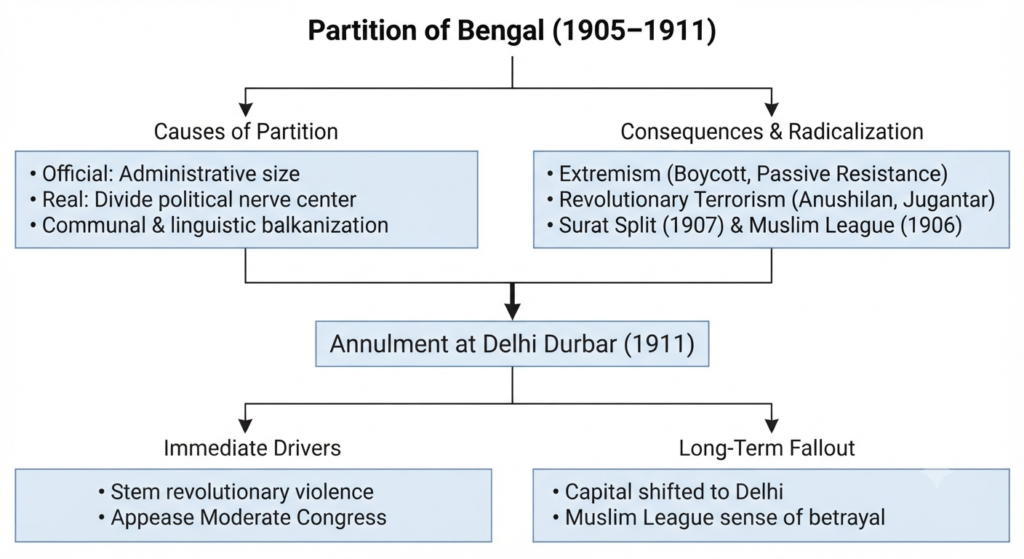
The Partition of Bengal, announced in July 1905 by Viceroy Lord Curzon and enforced on October 16, 1905, transformed Indian nationalism from elite constitutionalism into militant mass politics and underground revolutionary resistance.
Why Bengal Was Partitioned in 1905
1. The Official Pretext: Administrative Convenience
- The colonial government argued that the Bengal Presidency—encompassing Bengal, Bihar, and Orissa with a population of nearly 78 million—was too sprawling and populous for a single Lieutenant-Governor to govern efficiently, resulting in neglected eastern districts and poor communications.
2. The Real Political Objective: Subverting the Nationalist Vanguard
- Weakening the Epicenter of Nationalism: Bengal was the intellectual and political powerhouse of Indian anti-colonialism. As Home Secretary H.H. Risley stated in his official confidential minutes (1904): “Bengal united is a power; Bengal divided will pull several different ways.”
- Linguistic Demotion: By merging western Bengal with Bihar and Orissa, Bengalis were reduced to a linguistic minority in their own homeland (17 million Bengalis against 37 million Hindi and Odia speakers).
- Communal Balkanization (Divide and Rule): Curzon created a Muslim-majority province of Eastern Bengal and Assam (capital at Dacca) and a Hindu-majority province of Western Bengal. Curzon openly wooed elite Muslims (e.g., Nawab Salimullah of Dacca), asserting that the new province would provide them a unity unseen since the days of old Muslim viceroys.
Growth of the Extremist and Terrorist Schools of Nationalism
1. Catalyst for Extremist Nationalism
- Discrediting the Moderate Strategy: Between 1903 and 1905, Moderates used petitions, press articles, and speeches to prevent partition, all of which Curzon brushed aside. This proved the futility of “political mendicancy.”
- Expansion of Goals and Methods: The Extremist triumvirate (Lal-Bal-Pal) and Aurobindo Ghosh wrested leadership of the agitation, broadening it from an anti-partition campaign into a wider push for Swaraj (self-rule).
- Pioneering Direct Action: They introduced innovative forms of struggle—Boycott of British cloth, salt, and schools; promotion of Swadeshi industries; setting up National Schools; and calling for civil non-cooperation (Passive Resistance).
- The Surat Rupture (1907): Ideological friction over extending Swadeshi and Boycott nationwide culminated in the Surat Split of 1907, isolating the Moderates and provoking state crackdowns on Extremists (e.g., Tilak’s 6-year deportation to Mandalay).
2. Genesis of Revolutionary Terrorism (“The Cult of the Bomb”)
- Reaction to State Violence: The colonial state unleashed severe repression—the Carlyle Circular (penalizing student protesters), bans on meetings, police assaults on peaceful delegates at the Barisal Conference (1906), and mass arrests.
- Underground Militarism: Concluding that peaceful mass agitation was throttled by state force, educated radical youth formed secret societies to wage armed struggle:
- Anushilan Samiti (1902): Established by Promotha Mitter, Aurobindo Ghosh, and Pulin Behari Das, training youth in physical culture and revolutionary theory.
- Jugantar Group (1906): Led by Barindra Kumar Ghosh and Bhupendranath Dutta, declaring through their journal Jugantar that “Force must be stopped by force.”
- Direct Actions: In 1908, Khudiram Bose and Prafulla Chaki attempted to assassinate Magistrate Kingsford at Muzaffarpur, leading to the Alipore Bomb Conspiracy Case. This established targeted political assassinations as a new, radicalized strand of Indian resistance.
Annulment of the Partition (1911) and Its Consequences
At the Imperial Delhi Durbar of December 1911, King George V formally announced the revocation of the partition.
Why It Was Annulled:
- Failure to Quell Militancy: Rather than pacifying Bengal, the partition had sparked boycotts, industrial strikes, and revolutionary violence that spread to Maharashtra and Punjab.
- Administrative Conciliation: Lord Hardinge II recognized that appeasing the mainstream Bengali Hindu intelligentsia was necessary to restore public order and defuse political unrest.
- Reorganization along Linguistic Lines: Administrative viability was preserved without communal separation by excising Bihar and Orissa into a separate province and placing Assam under a Chief Commissioner.
Consequences of the Annulment:
| Dimension | Significant Historical Fallout |
| Alienation of Muslims | Elite Muslims viewed the reversal as a betrayal of imperial promises. It demonstrated that constitutional loyalty brought fewer results than agitational defiance, pushing leaders like the Ali Brothers and later M.A. Jinnah toward anti-imperialist alignments (eventually leading to the 1916 Lucknow Pact). |
| Shift of Capital to Delhi (1911) | The British moved the imperial capital from Calcutta to Delhi to isolate the central government from militant Bengali political pressure and rule from the historic seat of Mughal power. |
| Validation of Direct Action | The rollback confirmed that mass mobilization and militant defiance could force the colonial state into major concessions, weakening the credibility of Moderate constitutionalism. |
| Consolidation of Communal Politics | Although the territorial partition was undone, the communal divide cultivated during the agitation endured, strengthening the All-India Muslim League (founded in Dacca, 1906) and laying groundwork for the eventual 1947 partition. |
The Partition of Bengal acted as a crucible for 20th-century Indian politics. Though conceived by Curzon to divide the national movement, it shattered the myth of British benevolence, pioneered the techniques of mass boycott and passive resistance, and created an undercurrent of revolutionary patriotism that shaped the Indian freedom struggle up to 1947.
Q.5 Bengal was partitioned in 1905 not for administrative reasons but for political purposes. Elucidate. (1996)
बंगाल का विभाजन 1905 में प्रशासनिक कारणों से नहीं बल्कि राजनीतिक उद्देश्यों के लिए किया गया था। स्पष्ट करें।
Announced by Viceroy Lord Curzon in July 1905 and implemented on October 16, 1905, the Partition of Bengal was officially justified on grounds of administrative efficiency. However, confidential official records, the territorial design of the scheme, and the prevailing political landscape demonstrate that the true driving force was a calculated imperial strategy to undermine the emerging nationalist movement.
The Official Pretext: Administrative Convenience
The colonial administration argued that the undivided Bengal Presidency was geographically and demographically unmanageable:
- It spanned over 189,000 square miles with a population of nearly 78 million under a single Lieutenant-Governor.
- Eastern Bengal suffered from poor infrastructure, geographical isolation across river networks, and administrative neglect compared to the industrial core surrounding Calcutta.
While administrative decentralization was a legitimate logistical necessity, the nature and boundary lines chosen for the reorganization exposed its underlying political motives. Alternatives suggested at the time—such as separating non-Bengali speaking Bihar and Orissa from Bengal proper—were deliberately bypassed.
The Political Objectives Behind the Partition
1. Weakening the Epicenter of Indian Anti-Colonial Politics
- Bengal was the intellectual nerve center of early Indian nationalism, producing influential newspapers, articulate legal professionals, and political platforms like the Indian Association.
- The British administration perceived the Calcutta-based Bhadralok (educated middle class) as the chief threat to imperial authority.
- This political calculation was explicitly recorded by Home Secretary H.H. Risley in his confidential minutes (1904):“Bengal united is a power; Bengal divided will pull several different ways… One of our main objects is to split up and thereby weaken a solid body of opponents to our rule.”
2. Linguistic Balkanization (Reducing Bengalis to a Minority)
- The scheme split the Bengali-speaking heartland into two administrative units:
- In the newly configured Western Bengal (with Bihar and Orissa), Bengalis were reduced to a linguistic minority—roughly 17 million Bengalis against 37 million Hindi and Odia speakers.
- By stripping the Bengali intelligentsia of their numerical and political dominance within their home province, the administration aimed to curb their influence in provincial governance.
3. Communal Balkanization: Operationalizing “Divide and Rule”
- The territorial boundaries were drawn to engineer a clean communal divide:
- Eastern Bengal and Assam: Designed as a Muslim-majority province (capital at Dacca), with approximately 18 million Muslims and 12 million Hindus.
- Western Bengal: Maintained as a Hindu-majority province (capital at Calcutta).
- Curzon actively wooed elite Muslim leaders to drive a wedge between religious communities. Touring East Bengal in February 1904, Curzon delivered speeches in Dacca promising Muslims that the new province would “invest the Mohammedans in Eastern Bengal with a unity which they have not enjoyed since the days of the old Musalman Viceroys and Kings.”
- This communal engineering laid the foundation for the creation of the All-India Muslim League in Dacca (1906) under Nawab Salimullah, directly countering the secular claims of the Indian National Congress.
4. Curtailing the Centrality of Calcutta
- Calcutta served as the commercial, legal, and intellectual hub of British India. By elevating Dacca as a rival administrative capital, Curzon aimed to dilute the reach of the Calcutta High Court, Calcutta University, and the nationalist vernacular press.
- As Curzon candidly recorded in his dispatches to the Secretary of State, St. John Brodrick, the partition was intended to “dethrone Calcutta from its position as the center from which the Bengal press and politicians conduct their operations.”
Historical Assessment
The political architecture of the 1905 partition proved counterproductive for the colonial state. Rather than defusing nationalism, the move triggered the Swadeshi and Boycott Movement, forged cross-class urban mobilization, popularized passive resistance, and laid the ideological groundwork for militant nationalism. The British government was ultimately compelled to annul the partition in 1911 at the Delhi Durbar, reuniting Bengal on linguistic lines while carving out Bihar, Orissa, and Assam—proving that the 1905 boundaries had been drawn to serve political sabotage rather than administrative logic.
Q.6 How did the Swadeshi Movement in Bengal influence the nationalist politics? (1998)
बंगाल में स्वदेशी आंदोलन ने राष्ट्रवादी राजनीति को कैसे प्रभावित किया?
The Swadeshi Movement (1905–1908), triggered by Lord Curzon’s partition of Bengal, marked a watershed transformation in the Indian national movement. It shifted anti-colonial struggle from elite, mendicant constitutionalism to mass-based agitational politics, redefining the goals, methods, leadership, and ideological grammar of Indian nationalism.
1. Paradigm Shift in Political Goals: From Devolution to ‘Swaraj’
- Redefining the Objective: The movement rendered the Moderate demand for piecemeal administrative reforms obsolete. In the historic Calcutta Session (1906) under Dadabhai Naoroji, the Congress officially declared Swaraj (self-government) as its ultimate goal.
- Radicalizing Political Rights: Extremist leaders like Bal Gangadhar Tilak and Aurobindo Ghosh framed self-rule not as an imperial favor, but as an inalienable birthright, fundamentally altering how Indians articulated their relationship with the colonial state.
2. Evolution of New Techniques of Mass Resistance The movement moved beyond petitions and established the operational toolkit that later defined the Gandhian mass struggles:
- Economic Boycott and Swadeshi: Boycott of British-manufactured cloth, sugar, and salt hit Manchester imports directly, turning consumer choices into an everyday act of anti-colonial defiance.
- Passive Resistance & Non-Cooperation: Formulated systematically by Aurobindo Ghosh in his 1907 articles (The Doctrine of Passive Resistance), the movement advocated the refusal to pay taxes, boycott of state-aided schools, and abandonment of colonial courts in favor of local arbitration committees (salishi sabhas).
- Voluntary Mobilization via Samitis: Bodies like Ashwini Kumar Dutta’s Swadesh Bandhab Samiti in Barisal organized mass political education, physical training, and famine relief, pioneering cadre-based grassroots politics.
3. Broadening the Social Base of the Freedom Struggle
- Active Entry of Youth and Students: Despite the penal Carlyle Circular, students formed the vanguard of picketing, rallies, and propaganda, breaking the monopoly of elite urban lawyers.
- Emancipation of Women: Upper- and middle-class women discarded purdah to attend meetings, smash foreign bangles, cook with domestic salt, and donate personal jewelry to the National Fund.
- Labor Mobilization: For the first time, nationalist politics aligned with industrial labor through organized strikes across the Calcutta Tramways, Government Press, Burn Company, and the Coral Mills in Tuticorin (led by V.O. Chidambaram Pillai).
4. Institutionalization of National Education and Self-Reliance (Atmashakti)
- Severing Colonial Hegemony: The movement challenged British ideological control by creating independent indigenous institutions:
- Formation of the National Council of Education (1906) and the Bengal National College, with Aurobindo Ghosh as its first principal.
- Establishment of the Bengal Technical Institute to foster technical self-sufficiency.
- Indigenous Enterprise: Prompted the rise of swadeshi banks (Punjab National Bank), insurance firms, textile mills (Banga Lakshmi Cotton Mill), and indigenous research bodies (P.C. Ray’s Bengal Chemical and Pharmaceutical Works).
5. Internal Political Realignments and Structural Fissures
- Ascendance of Extremism & Surat Split (1907): Ideological conflict over extending the boycott nationwide and broadening its scope beyond foreign goods fractured the Indian National Congress at Surat in 1907, paralyzing mainstream moderate politics for nearly a decade.
- Genesis of Revolutionary Underground Networks: Faced with severe police crackdowns (e.g., the Barisal conference lathi-charge) and the political vacuum post-1907, radical youth gravitated toward armed struggle. Secret societies like the Anushilan Samiti and the Jugantar group emerged, introducing the “cult of the bomb.”
6. Emergence of Institutionalized Communal Politics
- The colonial state weaponized the anti-partition agitation by dangling the promise of a Muslim-majority province in East Bengal.
- Concurrently, the extensive use of upper-caste Hindu imagery by nationalists (Ganga-snan, vows before Goddess Kali, Shivaji festivals) alienated large sections of the Muslim peasantry. This polarization directly expedited the founding of the All-India Muslim League (1906) in Dacca and the subsequent introduction of separate electorates in the Morley-Minto Reforms (1909).
The Swadeshi Movement transformed Indian nationalism from an elite drawing-room dialogue into an assertive, culturally rooted movement. By introducing the methods of economic boycott, voluntary mass cadres, constructive self-reliance, and passive resistance, it established the structural foundations that Mahatma Gandhi later refined into the nationwide Non-Cooperation and Civil Disobedience movements.
Q.7 Trace the origin of the Swadeshi Movement. How did it involve the masses? (2000)
स्वदेशी आंदोलन की उत्पत्ति का पता लगाएं। इसमें जनता को कैसे शामिल किया गया?
The Swadeshi Movement (1905–1908) marked a decisive watershed in modern Indian history, transforming the anti-colonial struggle from an elite constitutional dialogue into an active, multi-class political campaign.
Origin of the Swadeshi Movement
1. Early Ideological Foundations (Pre-1903)
- The concept of Swadeshi (indigenous self-reliance) had roots in 19th-century economic nationalism—promoted by Gopalrao Deshmukh (Lokahitawadi), the Poona Sarvajanik Sabha, and the Hindu Mela in Bengal.
- However, these early expressions were economic experiments rather than mass political weapons.
2. The Immediate Trigger: The Partition Scheme (1903–1905)
- In December 1903, Viceroy Lord Curzon made public the scheme to partition the Bengal Presidency, ostensibly for administrative convenience, but primarily to weaken the politically active Bengali intelligentsia.
- The Constitutional Phase (1903–mid 1905): Moderate leaders like Surendranath Banerjea, Krishna Kumar Mitra (editor of Sanjivani), and K.K. Mitra launched extensive press campaigns, submitted petitions, and held over 500 protest meetings across Bengal.
- Formal Launch (August 7, 1905): Despite overwhelming public opposition, the government formally announced the partition in July 1905. On August 7, 1905, a historic meeting at the Calcutta Town Hall passed the formal Boycott Resolution, officially inaugurating the Swadeshi Movement.
- Day of National Mourning (October 16, 1905): When the partition took effect, it was observed across Bengal as a day of fasting (Arandhan), barefoot processions, singing of Vande Mataram, and the tying of Rakhi (popularized by Rabindranath Tagore) as a symbol of the unbreakable unity of Bengal.
How the Movement Involved the Masses
The movement broke the traditional boundaries of elite politics by inventing novel methods of mass outreach and drawing diverse demographic segments into the political arena.
1. Institutional Mobilization: The Corps of Volunteers (Samitis)
- Volunteer bodies (Samitis) emerged as the primary vehicle for mass contact, political education, and rural outreach.
- Ashwini Kumar Dutta’s Swadesh Bandhab Samiti in Barisal established 175 village branches, mobilized peasants, settled disputes through rural arbitration courts (Salishi), and distributed indigenous goods.
- Other prominent samitis included the Anti-Circular Society and Brati Samiti, which carried political training directly to the mofussil towns.
2. Active Vanguard: Students and Youth
- Students formed the frontline of the agitation: picketing foreign cloth shops, organizing bonfires of imported goods, and collecting funds for Swadeshi ventures.
- When the colonial state retaliated with the Carlyle Circular (October 1905)—threatening expulsion and withdrawal of grants—nationalists set up parallel educational institutions under the National Council of Education (1906) and the Bengal National College, headed by Aurobindo Ghosh.
3. Historic Entry of Women
- For the first time, urban middle-class women stepped out of domestic seclusion (purdah) to attend political rallies, participate in picketing, boycott foreign bangles and cooking utensils, and donate family jewelry to the National Fund.
4. Mobilization of Industrial Labor
- Mass unrest spread to the working class through coordinated strikes in foreign-owned enterprises:
- Strikes broke out at the Government Press in Calcutta, the East Indian Railway, and jute mills across Bengal.
- In Tamil Nadu, V.O. Chidambaram Pillai and Subramania Siva led the Coral Mills strike in Tuticorin, tying labor grievances directly to the nationalist campaign.
5. Cultural and Traditional Idioms
- Vernacular Literature and Music: Patriotic songs by Rabindranath Tagore (Amar Sonar Bangla), Dwijendralal Ray, and Mukunda Das’s folk theatre (Jatras) politicized the rural masses through familiar cultural forms.
- Festivals and Melas: Leaders used traditional public festivals to convey political messages, most notably Bal Gangadhar Tilak’s Ganapati and Shivaji festivals in Maharashtra, which spread the Swadeshi message beyond Bengal to western and northern India.
6. Social Boycott as an Instrument of Enforcement
- The community weaponized social ostracism to compel compliance: washermen refused to wash imported cloth, priests declined to conduct marriage ceremonies where foreign goods were exchanged, and shoemakers refused to mend foreign shoes.
Limitations of Mass Participation
Despite broadening the social base, the movement’s mass reach had structural gaps:
- The Peasantry: While mobilized in specific districts (such as Barisal), the broader peasantry remained largely uninvolved because the movement did not champion agrarian demands (like rent reduction or anti-landlord reforms) out of deference to landed Bhadralok interests.
- Communal Divergence: The heavy reliance on Hindu symbolism (Kali temple vows, Ganga-snan) was exploited by the colonial administration and conservative leaders like Nawab Salimullah of Dacca, causing the majority of Bengali Muslims to stay aloof and contributing to communal friction.
The Swadeshi Movement marked the structural shift from elite mendicancy to collective direct action. By testing the mechanisms of Boycott, Passive Resistance, and National Institutions, it created the organizational and tactical template that Mahatma Gandhi later refined into nationwide mass satyagraha.
Q.8 How did the terrorist movement gather strength in countries other than India? (2000)
भारत के अलावा अन्य देशों में आतंकवादी आंदोलन ने कैसे ताकत जुटाई?
The external wing of the Indian revolutionary movement (often referred to in colonial records as “revolutionary terrorism”) gathered momentum between 1905 and the end of the First World War. Driven abroad by severe British crackdowns after the Swadeshi Movement, Indian revolutionaries established safe havens, printed seditious literature, secured modern weaponry, and cultivated international diplomatic and military alliances to overthrow British rule from the outside.
1. London and Paris: The Pioneering Western European Centers
Before the outbreak of WWI, Britain and France served as the initial intellectual and logistic hubs for Indian radicals.
- India House, London (1905–1910):
- Founded by Shyamji Krishna Varma, who instituted fellowships to bring radical Indian students to Britain. He published The Indian Sociologist to advocate anti-colonial ideas.
- Under Vinayak Damodar Savarkar, India House evolved into a clandestine operational center for the Abhinav Bharat Society. Savarkar authored The Indian War of Independence of 1857, which was smuggled into India wrapped in dummy covers.
- In July 1909, Madan Lal Dhingra shot dead Curzon Wyllie (political aide-de-camp at the India Office) in London, marking the first high-profile Indian revolutionary assassination in the imperial capital.
- The Paris Group and Continental Links:
- Facing imminent arrest, leaders like Madame Bhikaji Cama, Shyamji Krishna Varma, and Sardar Singh Rana shifted base to Paris.
- Madame Cama unfurled the first version of the Indian National Flag at the International Socialist Congress in Stuttgart, Germany (1907), bringing Indian self-determination to the international stage.
- Revolutionaries published and smuggled radical journals (Bande Mataram edited by Cama; The Talwar edited by Virendranath Chattopadhyaya from Berlin). They also acquired bomb-making manuals from Russian nihilists and smuggled Browning pistols inside hollowed-out book covers to revolutionaries in Bengal and Maharashtra.
2. North America: The Ghadar Movement (United States and Canada)
The movement gained its largest, most potent mass cadre among Punjabi immigrant laborers and ex-soldiers on the Pacific Coast of the United States and Canada.
- Socio-Economic Triggers: Indian immigrants faced severe racial discrimination, physical assaults, and discriminatory legislation, notably Canada’s “Continuous Journey Regulation” designed to block Indian immigration.
- Foundation of the Ghadar Party (1913):
- Organized by Lala Har Dayal, Sohan Singh Bhakna (President), Kanshiram, and Kartar Singh Sarabha, headquartered at the Yugantar Ashram in San Francisco.
- Published the weekly paper Ghadar (in Urdu, Gurmukhi, and Hindi), bearing the masthead “Angrezi Raj ka Dushman” (Enemy of British Rule) and issuing an explicit call for armed insurrection.
- The Komagata Maru Incident (1914):
- The chartered ship Komagata Maru, carrying 376 passengers led by Gurdit Singh, was turned back by Canadian authorities at Vancouver. Upon forced return to Calcutta (Budge Budge), British police opened fire, killing over 20 passengers.
- This galvanized thousands of overseas Indians to sell their land, abandon their livelihoods, and board ships back to India to launch a military rebellion.
- Armed Mutiny Plans (1915): Guided by Rash Behari Bose and Sachindra Nath Sanyal in India, Ghadarites coordinated with native Indian regiments (notably the 23rd Cavalry) for a coordinated rebellion on February 21, 1915. Though foiled by British intelligence infiltration (Kirpal Singh’s betrayal), the attempt underscored the organizational reach of overseas networks.
3. Germany: The Berlin Committee and the Hindu-German Conspiracy
With the onset of World War I (1914), revolutionaries leveraged the principle that “Britain’s difficulty is India’s opportunity” by partnering directly with the German Empire.
- The Berlin Committee for Indian Independence (1915):
- Organized by Virendranath Chattopadhyaya (“Chatto”), Bhupendranath Dutta, and Lala Har Dayal under the patronage of the German Foreign Office and Kaiser Wilhelm II.
- The Zimmermann Plan:
- Germany agreed to finance, arm, and transport modern rifles (via ships such as the SS Maverick and Henry S.) to revolutionaries on the coasts of Bengal and Orissa.
- Jatin Mukherjee (“Bagha Jatin”) waited at Balasore to receive the shipments to arm rural militias and cut railway networks between Calcutta and Madras, dying in a heroic trench gunfight against British police in September 1915.
4. Pan-Asian Centers and the Middle East
- Provisional Government of Free India, Kabul (December 1915):
- Formed by Raja Mahendra Pratap (President), Maulana Barkatullah (Prime Minister), and Maulana Obeidullah Sindhi.
- Formally allied with the Amir of Afghanistan, sending diplomatic missions to Tsarist Russia, Ottoman Turkey, and Germany to secure military recognition for Indian independence.
- The “Silk Letter Conspiracy” (Reshmi Rumaal Tehrik): Deobandi scholars, including Mahmud Hasan and Obeidullah Sindhi, wrote coded revolutionary letters on yellow silk cloth to coordinate an Ottoman-Afghan military intervention into British India.
- Japan and Southeast Asia:
- Rash Behari Bose escaped to Japan in 1915 disguised as P.N. Tagore. Operating with the support of pan-Asian societies (such as the Black Dragon Society), he laid the institutional base in East Asia.
- Southeast Asian centers (Singapore, Bangkok, Batavia) served as operational transit hubs, triggering the 1915 Singapore Mutiny, where Indian sepoys of the 5th Native Light Infantry revolted and briefly held the city.
Significance and Strategic Impact
- Internationalizing the Freedom Struggle: Revolutionary activity abroad disrupted British diplomatic narratives, forcing the “Indian Question” into European, American, and socialist forums.
- Logistics and Ideological Modernization: These networks supplied the domestic movement with modern weapons, explosives technology, and secular, anti-imperialist political theory, stripping away religious regionalism.
- Precursor to the Indian National Army (INA): The diaspora networks, political infrastructure, and Pan-Asian alliances built by Rash Behari Bose, Barkatullah, and the Ghadar movement between 1905 and 1918 provided the operational apparatus that Subhas Chandra Bose later mobilized into the Azad Hind Fauj during the Second World War.
Q.9 What led to the partition of Bengal in 1905? (2004)
1905 में बंगाल का विभाजन किस कारण हुआ?
The Partition of Bengal (1905), conceptualized and enforced by Viceroy Lord Curzon, was the culmination of long-standing administrative arguments combined with a deliberate colonial strategy to undercut the rising tide of Indian nationalism.
1. The Official Pretext: Administrative Compulsions
- Unwieldy Size and Demography: The undivided Bengal Presidency covered an area of roughly 189,000 square miles with a population of nearly 78 million (encompassing modern Bengal, Bangladesh, Bihar, and Odisha). The administration argued that governing this vast region under a single Lieutenant-Governor was practically impossible.
- Underdevelopment of Eastern Bengal: The eastern districts were geographically isolated by difficult river networks, plagued by poor communications, and lacked adequate administrative infrastructure and law enforcement compared to the industrial core of Calcutta.
- Historical Precedents: Territorial reshuffling had historical precedents—Assam was separated from Bengal as early as 1874 to ease administrative pressure, and proposals to further partition the province had circulated within the British bureaucracy since the 1890s.
2. The Core Political Motives: Curtailing Nationalism
While administrative re-organization was a legitimate need, the specific borders drawn exposed a clear political agenda. The administration deliberately chose not to separate non-Bengali areas (Bihar and Odisha) from Bengal proper, opting instead to split the Bengali-speaking heartland.
- Dismantling the Epicenter of Nationalism:
- Bengal was the intellectual vanguard of Indian anti-colonialism, producing articulate lawyers, journalists, and active political forums like the Indian Association.
- Home Secretary H.H. Risley explicitly outlined the political calculation in his December 1904 official minute:“Bengal united is a power; Bengal divided will pull several different ways… One of our main objects is to split up and thereby weaken a solid body of opponents to our rule.”
- Linguistic Balkanization:
- By amalgamating Western Bengal with Bihar and Odisha, the British reduced Bengali speakers to a numerical minority within their own home province—roughly 17 million Bengalis against 37 million Hindi and Odia speakers.
- This was intended to dilute the political dominance of the Calcutta-based Bhadralok (educated middle class) in provincial decision-making.
- Communal Engineering (“Divide and Rule”):
- The boundary created two distinct religious majorities:
- Eastern Bengal & Assam (capital at Dacca): Muslim-majority (~18 million Muslims to 12 million Hindus).
- Western Bengal (capital at Calcutta): Hindu-majority.
- Curzon actively played on communal sentiments to cultivate a loyalist counterweight to the Congress. In his February 1904 Dacca tour, he told Muslim leaders that the new province would “invest the Mohammedans in Eastern Bengal with a unity which they have not enjoyed since the days of the old Musalman Viceroys and Kings.”
- The boundary created two distinct religious majorities:
- Dethroning Calcutta’s Primacy:
- Calcutta was the commercial and political nerve center of British India. By elevating Dacca as a competing provincial capital, Curzon sought to undermine the reach of Calcutta’s High Court, Calcutta University, and the influential nationalist press (The Bengalee, Amrita Bazar Patrika).
3. Immediate Triggers
- Curzon’s Authoritarian Ideology: Lord Curzon viewed the Indian National Congress with open hostility (declaring in 1900 his desire to “assist it to a peaceful demise”). He bypassed Indian public opinion, rejecting hundreds of petitions, press articles, and memorandums submitted during the moderate phase of protests between December 1903 and mid-1905.
- Final Implementation: On July 19, 1905, the government formally announced the partition scheme, enforcing it on October 16, 1905.
Rather than resolving administrative hurdles, Curzon’s politically motivated division backfired on the colonial state—triggering the Swadeshi and Boycott Movement, radicalizing the national movement through the rise of Extremist leaders (Lal-Bal-Pal), and forcing the British to annul the partition in 1911.