
The formative era of the Indian national movement laid the structural and ideological bedrock of India’s fight against colonial rule. From the founding objectives of the Indian National Congress to the ideological fault lines between the Moderates and Extremists, this period reflects a vital transition from constitutional agitation to mass mobilisation. Analysing UPSC Modern Indian History 30 Years PYQs with Solutions highlights recurring core themes: the limitations of early petitions, Surat Split dynamics, and the Lucknow Pact, providing candidates with high-yield perspectives essential for scoring well in UPSC Mains.
Q.1 Discuss briefly the basic aims with which the Indian National Congress was founded. When and under what circumstances did it decide to have Purna Swaraj from the British rule as its goal? (200 words) (1985)
संक्षेप में उन मूल उद्देश्यों की चर्चा कीजिए जिनके साथ भारतीय राष्ट्रीय कांग्रेस की स्थापना की गई थी। ब्रिटिश शासन से पूर्ण स्वराज को अपने लक्ष्य के रूप में कब और किन परिस्थितियों में लेने का निर्णय लिया? (200 शब्द)
Answer
Founded in December 1885 under the presidency of W.C. Bonnerjee, the Indian National Congress (INC) marked the institutional beginning of the organized national movement in India.
Basic Aims Behind the Foundation of INC
- Pan-India National Integration: To promote friendly relations among nationalistic political workers across diverse regions, religions, and castes, fostering a unified national identity.
- National Political Platform: To consolidate public opinion and formulate common political demands on vital issues confronting the nation.
- Political Education and Mobilization: To train and propagate modern democratic politics, constitutional agitation, and civic rights among the educated middle class.
- Eradicating Sectional Prejudices: To systematically dispel provincial, communal, and ethnic animosities to create a secular national consciousness.
Adoption of ‘Purna Swaraj’
The goal of Purna Swaraj (Complete Independence) was formally adopted at the Lahore Session of the INC in December 1929, presided over by Jawaharlal Nehru.
The circumstances leading to this shift included:
- Failure of Dominion Status Offer: The Nehru Report (1928) had stipulated a one-year ultimatum to the British government to accept Dominion Status, which expired without meaningful response.
- Outrage Against the Simon Commission (1927): The all-white commission triggered nationwide protests and state repression (e.g., fatal lathi-charge on Lala Lajpat Rai), destroying faith in gradual constitutional reforms.
- Vagueness of the Irwin Declaration (1929): Lord Irwin promised Dominion Status as the ultimate goal, but at the Delhi Meeting (December 1929), he refused to assure immediate implementation or set a timeline.
- Rise of Left-Wing Youth Leadership: Leaders like Jawaharlal Nehru and Subhas Chandra Bose mounted immense pressure inside the Congress, rejecting Dominion Status within the British Commonwealth.
The declaration culminated in the unfurling of the Tricolour on the banks of the Ravi on December 31, 1929, and the celebration of January 26, 1930, as the first Independence Day, launching the Civil Disobedience Movement.
Q.2 What were the attitudes of the Moderates and the Extremists towards the Freedom Movement in India? What led to their show-down in Surat? (1986)
भारत में स्वतंत्रता आंदोलन के प्रति नरमदल और चरमदल के दृष्टिकोण क्या थे? सूरत में उनके प्रदर्शन के कारण क्या हुआ?
The early phase of the Indian national movement witnessed an ideological and strategic divergence between the Moderates (1885–1905) and the Extremists/Radicals (1905–1917), representing two distinct stages in the evolution of anti-colonial consciousness.
| Dimension | Moderates (Gokhale, Naoroji, Mehta) | Extremists (Tilak, Pal, Rai, Ghosh) |
| View on British Rule | Believed British rule was providential; sought gradual reform within the imperial framework. | Saw British rule as fundamentally exploitative; rejected the idea of imperial benevolence. |
| Ultimate Goal | Administrative reforms, self-government within the Empire (Dominion Status). | Complete Swaraj (Self-rule); political freedom as an inalienable right. |
| Methods & Agitation | Constitutional agitation using the 3 Ps (Prayers, Petitions, Protests), press, and legislative councils. | Direct political action: Boycott, Swadeshi, national education, and passive resistance. |
| Social Base & Mass Faith | Restricted to educated elites and professionals; lacked faith in mass political mobilization. | Reached lower-middle classes, students, and workers; deeply trusted mass capacity for struggle. |
| Source of Inspiration | Western liberal philosophy, British constitutionalism, and European democratic ideas. | Indian heritage, traditional symbols (e.g., Shivaji/Ganapati festivals), and spiritual nationalism. |
Factors Leading to the Show-Down at Surat (1907)
The ideological friction intensified during the anti-Partition (Swadeshi) movement and culminated in a formal split at the Surat Session (1907):
- Divergence over Swadeshi Scope:
- Extremists wanted to extend the Boycott and Swadeshi movement across India and broaden it from foreign goods to educational institutions, courts, and civil administration.
- Moderates insisted on restricting the agitation strictly to Bengal and confined boycott to foreign cloth and goods to avoid confrontation with the colonial state.
- Compromise of the Calcutta Session (1906):
- Dadabhai Naoroji managed to avert an immediate crisis by declaring Swaraj as the Congress goal and passing four compromise resolutions: Swadeshi, Boycott, National Education, and Self-Government.
- Both groups differed fundamentally in interpreting these resolutions, creating lingering mistrust.
- Venue and Presidential Dispute (1907):
- Extremists wanted the 1907 session at Nagpur (an Extremist stronghold) with either Tilak or Lala Lajpat Rai as President.
- Moderates shifted the venue to Surat (part of Bombay presidency, Mehta’s bastion, where a local leader like Tilak could not preside as per convention) and nominated Rashbehari Ghosh.
- Rumors of Resolution Dilution:
- Extremists believed Moderates planned to drop the four radical resolutions passed in Calcutta. Refusal by the session organizers to grant Tilak the floor to address the session triggered chaos, chappal-throwing, and physical confrontation.
- Colonial Subversion (“Policy of the Carrot and Stick”):
- The British actively wooed Moderates with prospective legislative council expansions (which materialized as the Morley-Minto Reforms of 1909) while isolating and repressing the Extremists.
The Surat split severely weakened the nationalist movement: the Moderates lost mass appeal, while the Extremists faced harsh state repression (Tilak was deported to Mandalay), stalling mainstream agitation until the Lucknow Pact of 1916.
Q.3 Analyse briefly the contribution of religious reform movements to the growth of extremist nationalist movement. (1989)
चरमपंथी राष्ट्रवादी आंदोलन के विकास में धार्मिक सुधार आंदोलनों के योगदान का संक्षेप में विश्लेषण करें।
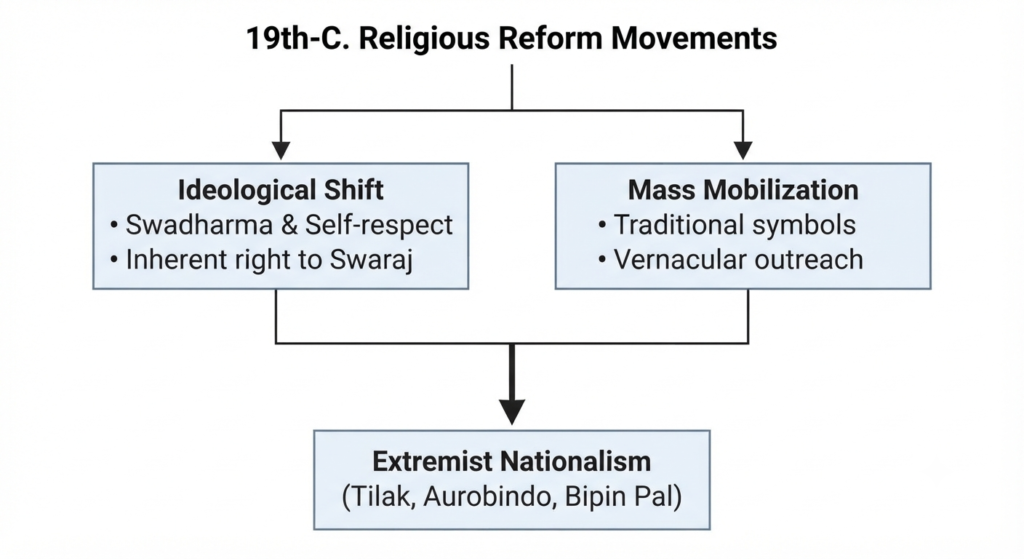
The 19th-century socio-religious reform movements—represented by the Arya Samaj, Ramakrishna Mission, and Theosophical Society—served as an ideological crucible for the rise of Extremist (Militant) Nationalism at the turn of the 20th century.
1. Dismantling the Myth of Western Hegemony and Rebuilding Self-Confidence
- Overcoming Cultural Subjugation: Reformers shattered the imperial narrative of the “White Man’s Burden.” Swami Vivekananda’s address at the Chicago Parliament of Religions (1893) and Dayanand Saraswati’s assertion of Vedic supremacy replaced colonial inferiority complexes with profound cultural pride.
- Pride as a Springboard for Politics: Militant leaders like Bal Gangadhar Tilak and Bipin Chandra Pal argued that a civilization with such an illustrious heritage was inherently capable of, and entitled to, self-governance.
2. Redefining the Nature of Patriotism: Nationalism as a Religion
- Spiritualization of Politics: The reform movements blurred the lines between religious devotion and political duty. Bankim Chandra Chatterjee’s Anandamath and the hymn Vande Mataram personified the motherland as the Divine Mother (Bharat Mata), transforming political agitation into a sacred duty.
- Aurobindo Ghosh’s Concept of Nation: Directly drawing on Vedantic philosophy, Aurobindo declared that “Nationalism is not a mere political programme; nationalism is a religion that has come from God.” This raised the freedom struggle above the pragmatic bargaining of the Moderates into an article of absolute faith and self-sacrifice (atmasamarpan).
3. Direct Source of Core Political Concepts
- The Concept of Swaraj: Dayanand Saraswati was the first to assert that “good government is no substitute for self-government” and used the term Swaraj, which the Extremists subsequently elevated from mere administrative devolution into complete political liberation.
- Swadeshi and Self-Reliance (Atmashakti): Arya Samaj’s emphasis on indigenous education (DAV institutions, Gurukul Kangri) and cow-protection laid the conceptual groundwork for the constructive Swadeshi, national education, and boycott programs launched in 1905.
4. Popular Symbols and Vernacular Mobilization
- Breaking the Elite Monopoly: Unlike the Brahmo Samaj’s elite, rationalist discourse, revivalist movements communicated in the vernacular idiom. Extremists weaponized this by instituting religious-cultural festivals—notably Tilak’s Ganapati and Shivaji festivals (1893–1895) and the public vows taken at Kali temples during the anti-Partition agitation in Bengal.
- Cult of Physical Prowess and Valor: Reformist calls to shed weakness (Vivekananda’s plea for “muscles of iron and nerves of steel”) directly inspired the formation of Akharas, gymnasiums, and physical culture societies (Samitis), which later formed the cadre base for both Extremists and revolutionary groups like the Anushilan Samiti.
Critical Limitations and the Communal Fallout
While these movements democratized the nationalist appeal, their heavy reliance on ancient Hindu imagery had severe structural drawbacks:
- Alienation of Minorities: Glorification of ancient India as the “Golden Age” and characterization of the medieval era as one of foreign tyranny alienated Indian Muslims.
- Communal Polarization: Religious mobilization directly fueled suspicions, which the colonial state exploited through separate electorates (1909), ultimately aiding the foundation of sectarian organizations like the All-India Muslim League (1906) and the Hindu Mahasabha (1915).
Religious reform movements provided militant nationalism with its emotional vocabulary, ideological conviction, and willingness to embrace suffering; however, anchoring anti-imperialism in religious revivalism simultaneously sowed the seeds of communal friction in the broader national movement.
Q.4 “The Lucknow Pact of 1916 was signed without regard for its consequences.” Elucidate. (1993)
“1916 के लखनऊ समझौते पर इसके परिणामों की परवाह किए बिना हस्ताक्षर किए गए थे।” स्पष्ट करें।
The Lucknow Pact of December 1916 was a historic joint declaration between the Indian National Congress and the All-India Muslim League. While celebrated as a pinnacle of Hindu-Muslim unity that compelled the British to issue the Montagu Declaration of 1917, it prioritized short-term tactical unity over long-term secular nation-building—laying institutional foundations for political communalism.
Short-Term Strategic Gains (The Immediate Rationale)
- United Front Against Colonial Rule: Jointly presented the “Congress-League Scheme” demanding self-government (Dominion Status), expansion of legislative councils, and an executive responsible to the legislature.
- Momentum for Home Rule Agitation: Enabled Tilak’s and Annie Besant’s Home Rule Leagues to mobilize public opinion without fear of cross-community friction.
- Extraction of Constitutional Concessions: The united front directly pressured the colonial government into conceding that the ultimate goal of British policy was the progressive realization of responsible government (August 1917).
Why the Pact Was Signed “Without Regard for Its Consequences”
1. Institutionalization and Legitimation of Separate Electorates
- By formally accepting separate electorates for Muslims, the Congress abandoned its foundational secular principle of common citizenship.
- It surrendered the moral ground to oppose separate communal representation in future constitutional developments (e.g., Montagu-Chelmsford Reforms of 1919, Communal Award of 1932).
2. Recognition of the Muslim League as the Sole Spokesperson of Muslims
- The Congress treated the Muslim League—then a small body of conservative, upper-class elites—as the sole representative of Indian Muslims.
- This alienated nationalist Muslims within the Congress and legitimized the two-entity framework that Mohammad Ali Jinnah later exploited to formulate the “Two-Nation Theory.”
3. Flawed Mechanism of Weightage and Minoritism
- The pact introduced artificial weightage—granting Muslims more seats than their population proportion in minority provinces (e.g., 33% in UP where they formed ~14% of the population, 15% in Madras).
- In return, Muslim representation in majority provinces was curtailed below their demographic strength: 40% in Bengal (where Muslims formed ~52.6%) and 50% in Punjab (where they formed ~54.8%).
- Long-Term Fallout:
- It stoked resentment among Bengali and Punjabi Muslims, who felt disenfranchised by elite leaders from minority provinces.
- It alienated the Hindu minority in Punjab and Bengal, fueling the rise of aggressive Hindu revivalist politics and organizations like the Hindu Mahasabha (1915).
4. Top-Down Elite Bargain vs. Organic Mass Integration
- The alliance was negotiated exclusively between English-educated urban elites and landlords in conference halls, completely bypassing the masses.
- Because it failed to build grassroots inter-community solidarity through shared socio-economic struggles (peasant issues, labor rights, anti-feudal mobilization), the unity collapsed as soon as elite political interests diverged.
5. Creation of a Veto on Legislation
- The pact included a clause specifying that no bill or resolution affecting a community could be passed if three-fourths of that community’s members in the council opposed it.
- This introduced a functional communal veto into Indian constitutional discourse, deadlocking future legislative consensus.
The Lucknow Pact achieved an immediate tactical victory by breaking the post-Surat political deadlock, but its architectonic flaws proved disastrous. In the words of historian Bipan Chandra, the Lucknow Pact was based on an erroneous assumption that a secular nation could be built through an alliance of communities rather than an integration of citizens. By trying to secure freedom quickly through communal horse-trading, the nationalist leadership unwittingly institutionalized the communal principle that culminated in Partition.
Q.5 What were the contributions of the Moderates in the formative stage of the Indian National Congress? (1994)
भारतीय राष्ट्रीय कांग्रेस के प्रारंभिक चरण में नरमपंथियों का क्या योगदान था?
The formative phase of the Indian National Congress (1885–1905), guided by leaders like Dadabhai Naoroji, Gopal Krishna Gokhale, Pherozeshah Mehta, Dinshaw Wacha, and Surendranath Banerjea, laid the institutional and ideological bedrock of the Indian National Movement. Operating in a hostile colonial environment with nascent political consciousness, their contributions were foundational to modern Indian nationalism.
Key Contributions of the Moderates
1. Formulation of the Economic Critique of Colonialism
- Drain of Wealth Theory: Economists among them—notably Dadabhai Naoroji (Poverty and Un-British Rule in India), Romesh Chunder Dutt (Economic History of India), and Dinshaw Wacha—exposed the exploitative fiscal mechanisms draining India’s surplus to Britain via Home Charges, unrequited exports, and guaranteed interest on railway capital.
- De-industrialization & Agrarian Distress: Documented the systematic destruction of indigenous handicrafts, exorbitant land-revenue assessments, and tariff barriers manipulated to favor Lancashire textiles over local mills.
- Impact: Shattered the colonial myth of the “providential, benevolent British Raj,” undermining its moral legitimacy and providing the foundational intellectual framework for all subsequent phases of struggle.
2. Creation of an All-India Nationalist Consciousness
- Nurturing a “Nation-in-the-Making”: Recognizing India’s acute regional, linguistic, and religious diversities, they deliberately excluded contentious social and religious issues from Congress platforms, building an inclusive political identity.
- Pan-Indian Political Network: Replaced fragmented provincial bodies (e.g., Poona Sarvajanik Sabha, Indian Association of Calcutta) with a recurring annual convention that unified regional leadership into a collective national voice.
3. Constitutional and Legislative Agitation
- Expansion of Legislative Councils: Sustained constitutional pressure directly forced the enactment of the Indian Councils Act of 1892, which increased non-official members and granted the right to discuss the budget and ask questions.
- Public Finance Scrutiny: Gokhale used the imperial budget debates to systematically expose bureaucratic waste, excessive military spending, and neglect of primary education and irrigation.
4. Administrative Reforms and Indianisation of Services
- Simultaneous ICS Examinations: Fought racial exclusion in the administrative cadre, demanding that Civil Service exams be held simultaneously in England and India and that the entry age limit be raised.
- Separation of Powers: Campaigned relentlessly for separating judicial functions from executive authority to curb police brutality and magisterial despotism.
5. Defense of Democratic Values and Civil Liberties
- Freedom of Speech and Press: Vigorously opposed the Vernacular Press Act (1878) and later championed civil liberties when B.G. Tilak was arrested (1897) and the Natu brothers were deported without trial.
- Political Socialization: Utilized newspapers—The Bengalee (Banerjea), Voice of India (Naoroji), The Hindu (Subramania Iyer)—to introduce modern democratic norms, parliamentary procedures, and representative ideals to the educated middle classes.
6. Mobilization of International Public Opinion
- British Committee of the INC (1889): Established in London to publish the journal India and organize pro-Indian parliamentary lobbies.
- Dadabhai Naoroji in Parliament (1892): Elected to the British House of Commons representing Central Finsbury, using the forum to voice Indian grievances directly to the British electorate.
Limitations of the Moderate Phase
- Narrow Social Base: Confined primarily to urban, English-educated elites (lawyers, doctors, journalists, zamindars), exhibiting skepticism regarding the political capacity of peasants, workers, and women.
- Methodological Inefficacy: Their constitutional approach of the “3 Ps” (Prayers, Petitions, Protests) earned them criticism from younger leaders as “political mendicancy,” failing to secure decisive political concessions or halt aggressive policies under Lord Curzon.
The Moderates operated when mass confrontation would have invited immediate and total state suppression. As historian Bipan Chandra noted, they served as “the seedbed of modern Indian nationalism”—by planting secular, democratic roots and developing a devastating economic critique, they built the indispensable launchpad from which the Extremists and Mahatma Gandhi later mounted mass-based agitations.
Q.6 Trace the emergence of Indian nationalism till the foundation of the Indian National Congress. (1995)
भारतीय राष्ट्रीय कांग्रेस की स्थापना तक भारतीय राष्ट्रवाद के उद्भव का पता लगाएँ।
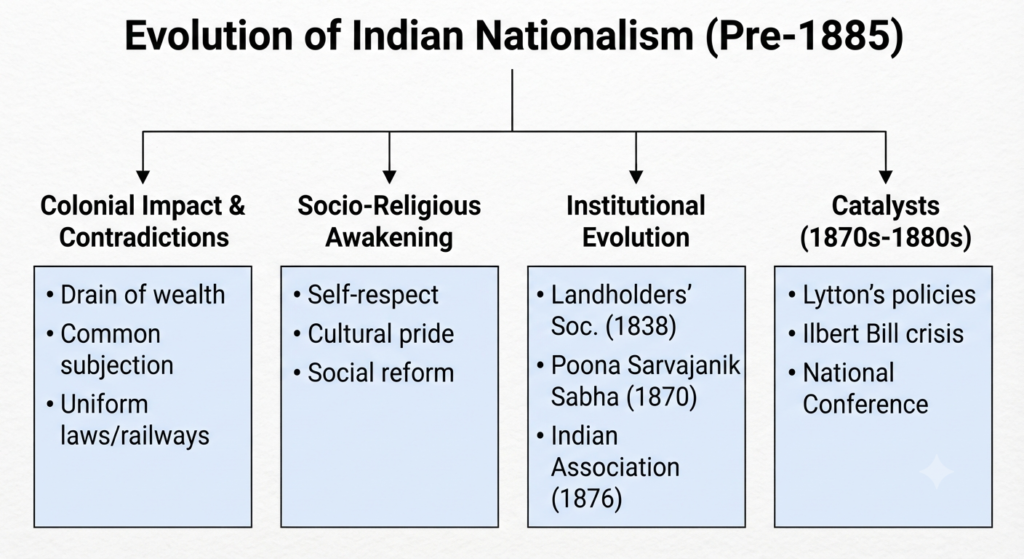
The emergence of modern Indian nationalism in the 19th century was not an isolated event, but an organic historical process born out of the structural contradictions of British colonial rule, socio-religious introspection, and the gradual evolution of political consciousness among the educated intelligentsia.
1. Material and Structural Drivers of Nationalism
- Contradiction of Colonial Interests: British economic policies—drain of wealth, de-industrialization, heavy land revenue assessments, and recurring famines—revealed the fundamental clash between Indian development and imperial exploitation.
- Administrative and Legal Unification: The British introduced a centralized administrative apparatus, codified laws (IPC 1860, CrPC 1861), and an integrated judicial hierarchy, fostering a sense of common subjection across disparate provinces.
- Modern Communications and Infrastructure: The expansion of the Railways (1853), modern postal systems, and the electric telegraph dissolved geographical isolation, enabling leaders and ideas to travel rapidly across regional boundaries.
2. Intellectual and Cultural Catalysts
- Modern English Education & Western Liberalism: Macauley’s English education system unintentionally introduced the educated middle class to Rousseau, Mill, Paine, and European nationalist movements (Italian unification, American Revolution), cultivating ideas of liberty, equality, and constitutional governance.
- Socio-Religious Reform Movements: Reformers like Raja Ram Mohan Roy, Ishwar Chandra Vidyasagar, and Swami Dayanand Saraswati attacked degenerated customs (Sati, caste rigidity) while cultivating pride in indigenous culture, laying the moral foundation of modern identity.
- Role of the Press and Literature: Vernacular and English newspapers (Amrita Bazar Patrika, The Hindu, Som Prakas) alongside patriotic literature (Bankim’s Anandamath, Bharatendu Harishchandra’s plays) acted as national political educators.
3. Evolution of Political Associations: From Landed Interests to All-India Nationalism
The institutional transition progressed from narrow, localized elite bodies toward pan-Indian political platforms:
| Phase / Era | Key Political Association | Nature and Scope |
| Early Elite Phase (1830s–1850s) | Landholders’ Society (1838), British Indian Association (1851) | Dominated by wealthy zamindars; focused on narrow class privileges, revenue remissions, and petitions to the British Parliament. |
| Middle-Class Awakening (1860s–1870s) | East India Association (1866) (Dadabhai Naoroji in London), Poona Sarvajanik Sabha (1870) (M.G. Ranade) | Began serving as a bridge between the government and the people, advocating civic rights and peasant issues. |
| Proto-National Phase (Late 1870s–1880s) | Indian Association of Calcutta (1876) (Surendranath Banerjea & Anandamohan Bose), Madras Mahajana Sabha (1884), Bombay Presidency Association (1885) | Specifically founded to represent the educated middle class, build pan-Indian political solidarity, and organize national agitations on common grievances. |
4. The Immediate Catalysts: Colonial High-Handedness (1870s–1880s)
- Reactionary Regime of Lord Lytton (1876–1880):
- Holding the lavish Delhi Durbar (1877) amid a devastating famine in southern India.
- Lowering the maximum age limit for the Indian Civil Service (ICS) examination from 21 to 19 years to restrict Indian entry.
- Vernacular Press Act (1878) and Arms Act (1878), which codified racial discrimination into law.
- The Ilbert Bill Controversy (1883):
- Lord Ripon’s law member, C.P. Ilbert, proposed giving Indian district magistrates the authority to try European offenders.
- The fierce, racist backlash organized by Anglo-Indians exposed the racial prejudices of the colonial order and demonstrated to Indians the effectiveness of organized collective agitation.
5. Culmination: The National Conference and the Formation of INC (1883–1885)
- National Conference (1883 & 1885): Surendranath Banerjea organized two sessions of the National Conference in Calcutta, bringing together political activists from across India—serving as the direct dress rehearsal for an all-India body.
- Foundation of the INC (December 1885): Retired British civil servant A.O. Hume coordinated with prominent provincial leaders to channel this mature national consciousness into a permanent, pan-Indian forum. Meeting at Gokuldas Tejpal Sanskrit College, Bombay, under W.C. Bonnerjee, the Indian National Congress formally consolidated regional streams into a unified national stream.
The foundation of the Indian National Congress was not an abrupt creation, but the institutional culmination of a half-century-long maturation of intellectual critiques, socio-religious revival, and grassroots political organizing that forged an overarching Indian national identity.
Q.7 Examine the causes and nature of extremism in Indian politics in the early part of the present century. (250 words) (1997)
वर्तमान शताब्दी के प्रारंभिक भाग में भारतीय राजनीति में उग्रवाद के कारणों और प्रकृति का परीक्षण कीजिए। (250 शब्द)
The early part of the 20th century (roughly 1905–1918) witnessed a transformative shift in the Indian national movement from Moderate constitutionalism to militant or Extremist nationalism. Championed by the triumvirate of Lal-Bal-Pal (Lala Lajpat Rai, Bal Gangadhar Tilak, Bipin Chandra Pal) and Aurobindo Ghosh, this phase redefined the goals, methods, and social base of Indian anti-colonial struggle.
Causes of the Rise of Extremism
1. Disillusionment with Moderate Politics and Ideology
- Failure of the “3 Ps”: Nearly two decades of Prayers, Petitions, and Protests yielded nominal concessions. The Indian Councils Act of 1892 failed to grant effective control over finances or representative governance.
- Critique of “Political Mendicancy”: Younger nationalists argued that political rights could not be secured through appeals to British benevolence, as Britain’s colonial interests fundamentally contradicted Indian welfare.
2. Deteriorating Socio-Economic Conditions
- Famines and Plague (1896–1900): Widespread famines and the devastating bubonic plague in the Deccan caused massive loss of life.
- Colonial Insensitivity: Official indifference, heavy-handed plague management (e.g., the high-handed actions of Walter Charles Rand in Poona), and the continued drain of wealth fueled popular outrage.
3. Growth of Education, Unemployment, and Self-Respect
- Educated Unemployed Youth: The spread of modern education created an articulate class of youth who found themselves barred from higher administrative posts due to racial discrimination.
- Intellectual and Cultural Revival: Teachings of Swami Vivekananda, Dayanand Saraswati, and Bankim Chandra Chatterjee dismantled the psychological myth of European racial superiority and instilled pride in India’s ancient heritage.
4. International Influences Demystifying European Invincibility
- Defeat of European Empires: The defeat of Italy by Abyssinia (Ethiopia) in 1896, the Boer War in South Africa, and, crucially, Japan’s decisive victory over Tsarist Russia (1905) proved that an Asian power could defeat a European empire.
- Popular Revolutions Abroad: Nationalist struggles in Ireland, the Russian Revolution of 1905, and the Young Turk movement illustrated the power of mass resistance over constitutional bargaining.
5. Reactionary Regime of Lord Curzon (1899–1905)
- Curzon openly expressed contempt for Indian aspirations and passed a flurry of autocratic legislation:
- Calcutta Corporation Act (1899): Slashed elected Indian representatives.
- Indian Universities Act (1904): Increased official bureaucratic control over higher education.
- Official Secrets Act (1904): Curtailed the freedom of the press.
- The Catalyst — Partition of Bengal (1905): Ostensibly carried out for administrative convenience, the real objective was to divide the political nerve center of nationalism along religious lines. This triggered the Swadeshi and Boycott Movement, providing the immediate launchpad for militant politics.
Nature of Extremism
| Dimension | Key Characteristics | Historical Illustrations |
| Concept of Swaraj (Goal) | Redefined the national objective from administrative reform within the Empire to Swaraj (self-rule/complete freedom) as an inalienable right. | Tilak’s declaration: “Swaraj is my birthright and I shall have it.” Aurobindo Ghosh viewed political freedom as vital for national regeneration. |
| New Methods of Struggle | Transitioned from constitutional agitation to direct political action and Passive Resistance. | • Boycott of foreign goods, government schools, and courts. • Swadeshi (promotion of indigenous enterprise). • Setting up National Schools (e.g., Bengal National College) and arbitration bodies. |
| Widening Social Base | Expanded the movement beyond elite drawing-room lawyers to the lower-middle classes, urban youth, students, and small shopkeepers. | Samitis (e.g., Swadesh Bandhab Samiti led by Ashwini Kumar Dutta) mobilized thousands of volunteers across rural and mofussil towns. |
| Spiritualization of Politics | Infused political struggle with religious devotion and cultural symbolism. Patriotism was treated as an article of faith. | Use of Bankim’s Vande Mataram; veneration of Bharat Mata; organization of Ganapati and Shivaji festivals in Maharashtra. |
| Willingness to Endure Suffering (Atmasamarpan) | Replaced polite resolutions with a readiness to undergo imprisonment, police lathi charges, and deportation. | Tilak’s conviction and 6-year deportation to Mandalay jail (1908); mass student resistance facing colonial expulsions and fines. |
Critical Limitations and Historical Legacy
- Unintended Communal Fallout: Reliance on traditional Hindu symbols, ceremonies (taking vows in Kali temples), and the projection of ancient India as a “Golden Age” alienated large segments of the Muslim population, providing fertile ground for British divide-and-rule tactics (e.g., the formation of the Muslim League in 1906).
- Vulnerability to Repression: Extremists lacked a permanent organizational structure to sustain high-pitched mass enthusiasm. Following the Surat Split (1907), harsh British crackdowns (Seditious Meetings Act, Criminal Law Amendment Act, deportations) left the movement politically dormant until the Home Rule movement.
The Extremist phase shifted the Indian freedom struggle from high-table negotiations to direct collective confrontation. By popularizing Swaraj, developing the techniques of Swadeshi and Boycott, and activating mass cadres, the Extremists laid the functional apparatus that Mahatma Gandhi transformed into an all-India mass movement.
Q.8 Why did the moderates lose appeal with the Indians and failed to elicit desired response from the British? (1993)
नरमपंथियों ने भारतीयों से अपील क्यों खो दी और अंग्रेजों से वांछित प्रतिक्रिया प्राप्त करने में विफल रहे?
The Moderate phase of the Indian National Congress (1885–1905), led by figures like Dadabhai Naoroji, Gopal Krishna Gokhale, Pherozeshah Mehta, and Surendranath Banerjea, laid the intellectual foundation of Indian nationalism. However, by the early 20th century, their influence declined rapidly as they lost political credibility among Indians while failing to extract meaningful concessions from the colonial state.
Why the Moderates Lost Appeal with the Indians
1. Elitist Character and Narrow Social Base
- Drawing-Room Politics: Moderate politics remained largely restricted to an urban, Western-educated upper-middle-class intelligentsia (lawyers, doctors, journalists, and big zamindars).
- Distrust of the Masses: Leaders like Pherozeshah Mehta held that the illiterate masses were not yet politically mature enough to participate in constitutional agitations. This alienation kept the peasantry, industrial working class, and rural artisans entirely disconnected from the Congress.
2. Flawed Ideological Assumptions Regarding British Rule
- Belief in Imperial “Providence”: Moderates genuinely believed that British rule had introduced modernization, the rule of law, and administrative unity to India, viewing the British connection as providential rather than parasitic.
- Appeal to British “Sense of Justice”: They operated under the assumption that imperial exploitation was an administrative anomaly that could be rectified by appealing to the conscience of the British electorate and parliament. As colonial exploitation deepened, this faith appeared naive to younger nationalists.
3. Inefficacy of Methods: “Political Mendicancy”
- The “3 Ps” (Prayers, Petitions, Protests): The younger generation of nationalists—spearheaded by Bal Gangadhar Tilak, Bipin Chandra Pal, and Lala Lajpat Rai—ridiculed these polite memoranda and annual holiday gatherings as “political mendicancy” (begging for rights), arguing that political liberty had to be asserted, not requested.
4. Inability to Respond to Famines, Plagues, and Economic Hardship
- Devastating famines (1896–1897, 1899–1900) and the Deccan bubonic plague killed millions, accompanied by ruthless administrative measures (e.g., the high-handed plague operations in Poona).
- The Moderate strategy of passing polite resolutions inside council chambers seemed utterly detached from the acute physical suffering of the Indian population.
5. Rise of Cultural Confidence and Militant Nationalism
- Reform movements led by Swami Vivekananda, Dayanand Saraswati, and Bankim Chandra Chatterjee dismantled the psychological sense of racial inferiority.
- Educated unemployed youth, inspired by indigenous traditions and overseas developments (e.g., Japan’s victory over Russia in 1905), found the Moderates’ pro-British rhetoric humiliating and outdated.
Why the Moderates Failed to Elicit the Desired Response from the British
1. Contradiction of Core Imperial Interests
- The Moderate demands—fiscal autonomy, protectionist tariffs for indigenous industries, and reduction of military expenditure—struck at the heart of colonial exploitation. Britain could not grant genuine economic autonomy without dismantling the foundational purpose of its empire (capturing markets and draining wealth).
2. Imperial Contempt for “Microscopic Minorities”
- The colonial bureaucracy treated the Moderates with open ridicule:
- Lord Dufferin (1887) dismissed the Congress as representing only a “microscopic minority” of the Indian population.
- Lord Curzon (1900) famously declared: “The Congress is tottering to its fall, and one of my great ambitions… is to assist it to a peaceful demise.”
- Knowing the Moderates lacked mass mobilization capability, the British had no practical compulsion to concede significant power.
3. Cosmetic and Disappointing Reforms (Indian Councils Act of 1892)
- The only substantial constitutional outcome of Moderate agitation was the Indian Councils Act of 1892, which proved to be an empty gesture:
- Non-official members remained a powerless minority.
- Members could discuss the budget but could neither vote on it nor move amendments.
- Questions were allowed only with six days’ prior notice and without the right to ask supplementary questions.
4. British “Policy of the Carrot and the Stick”
- The colonial administration used a calculated three-pronged strategy:
- Repression of the Extremists through sedition laws and deportations.
- Concession (the carrot) of minor reforms to placate Moderates.
- Suppression of the movement as a whole once the factions were divided.
- Rather than partnering with Moderates, the British exploited their moderation to split the national movement, culminating in the Surat Split of 1907.
5. Reactionary Curzonian Policies (1899–1905)
- Lord Curzon enacted a series of aggressive centralizing measures (Calcutta Corporation Act 1899, Indian Universities Act 1904, Official Secrets Act 1904) that directly dismantled the administrative gains Moderates had championed, culminating in the unilateral Partition of Bengal (1905). This exposed the ultimate impotence of Moderate constitutional agitation.
While the Moderates successfully conducted the intellectual groundwork of Indian nationalism through their economic critique and creation of a pan-India platform, their unwillingness to look beyond council walls left them politically stranded—dismissed by the colonial government as powerless petitioners and abandoned by the Indian youth as an elite relic.
Q.9 Discuss the main objectives of the Indian national movement up to 1905. What were its basic weaknesses during this period? (2001)
1905 तक के भारतीय राष्ट्रीय आंदोलन के मुख्य उद्देश्यों की विवेचना कीजिए। इस काल में इसकी मूलभूत कमजोरियाँ क्या थीं?
The period from 1885 to 1905 represents the foundational or Moderate phase of the Indian National Movement, guided by stalwarts like Dadabhai Naoroji, Gopal Krishna Gokhale, Pherozeshah Mehta, Dinshaw Wacha, and Surendranath Banerjea. Operating under severe colonial surveillance, the movement focused on institutional consolidation, political socialization, and intellectual critique rather than open confrontation.
Main Objectives of the Movement (Up to 1905)
1. Nation-Building and Pan-Indian Integration
- Consolidating a “Nation-in-the-Making”: Recognizing India’s acute regional, linguistic, and religious heterogeneity, the primary goal was to forge a common political identity and cultivate an all-India national consciousness.
- Secular Political Consensus: To prevent communal friction, early leaders consciously excluded religious and contentious social reform issues from the Indian National Congress (INC) platform.
2. Intellectual Demystification of Colonial Exploitation
- Formulating the Economic Critique: Exposing the exploitative mechanisms of British rule—popularized via the “Drain of Wealth” theory by Dadabhai Naoroji, R.C. Dutt, and G.V. Joshi.
- Challenging Colonial Hegemony: Subverting the British justification of the “benevolent Raj” and “civilizing mission” by highlighting agrarian distress, de-industrialization, and heavy land revenue assessments.
3. Gradual Constitutional and Legislative Reforms
- Expansion of Legislative Councils: Demanding greater non-official Indian representation, the right to vote on public budgets, and an expansion of the councils’ powers under the slogan “No taxation without representation.”
- Indianisation of Higher Administration: Campaigning for the simultaneous conduct of the Indian Civil Service (ICS) examination in London and India, aimed at reducing the drain of remittances and curbing racial discrimination in civil administration.
4. Defense of Democratic Freedoms and Civil Liberties
- Press Freedom and Free Expression: Championing the defense of vernacular and English presses against statutory muzzling (e.g., protesting the Vernacular Press Act legacy and the imprisonment of Bal Gangadhar Tilak in 1897).
- Rule of Law: Advocating for the separation of the executive from judicial authority to curb magistrate arbitrariness and police brutality.
5. Political Education of the Indian Intelligentsia
- Training the educated middle class in modern democratic politics, constitutional agitation, public debate, and parliamentary norms.
Basic Weaknesses of the Movement (Up to 1905)
| Dimension | Specific Weakness | Impact / Manifestation |
| Social Base | Narrow and Elitist | Confined largely to urban, English-educated professionals—lawyers, doctors, journalists, and big zamindars. Completely bypassed the peasantry, industrial working class, and rural artisans. |
| Faith in the Masses | Lack of Mass Confidence | Early leaders (e.g., Pherozeshah Mehta) believed that the illiterate masses were politically backward and unready for constitutional politics. |
| Ideological Premise | Illusion of British “Providence” | Subscribed to the belief that British rule brought modern enlightenment and justice. They treated colonial misrule as an administrative aberration that could be rectified by appealing to the British conscience. |
| Methodology | “Political Mendicancy” (The 3 Ps) | Relied exclusively on constitutional methods—Prayers, Petitions, and Protests—and annual three-day conferences, which were easily brushed aside by colonial authorities without extracting substantive concessions. |
| Limited Objective | Absence of Complete Freedom | Remained limited to self-government within the British Empire (Dominion Status). The concept of Swaraj as an inalienable right to complete independence was absent. |
| Organizational Reach | Absence of a Year-Round Cadre | The INC functioned as an annual deliberative assembly rather than a structured, grassroots political party with a full-time cadre base. |
Despite its severe organizational and social limitations, the movement up to 1905 cannot be dismissed as a failure. As historian Bipan Chandra emphasized, this phase served as the indispensable “seedbed of modern Indian nationalism”—by constructing the economic critique of imperialism and standardizing a secular, pan-Indian platform, the Moderates laid the intellectual foundations upon which the mass movements of the 20th century were built.
Q.10 Bring out the ideological basis of the Moderate, Extremist divide in Indian National Congress. (2003)
भारतीय राष्ट्रीय कांग्रेस में नरमदल, गरमदल विभाजन के वैचारिक आधार को उजागर करें।
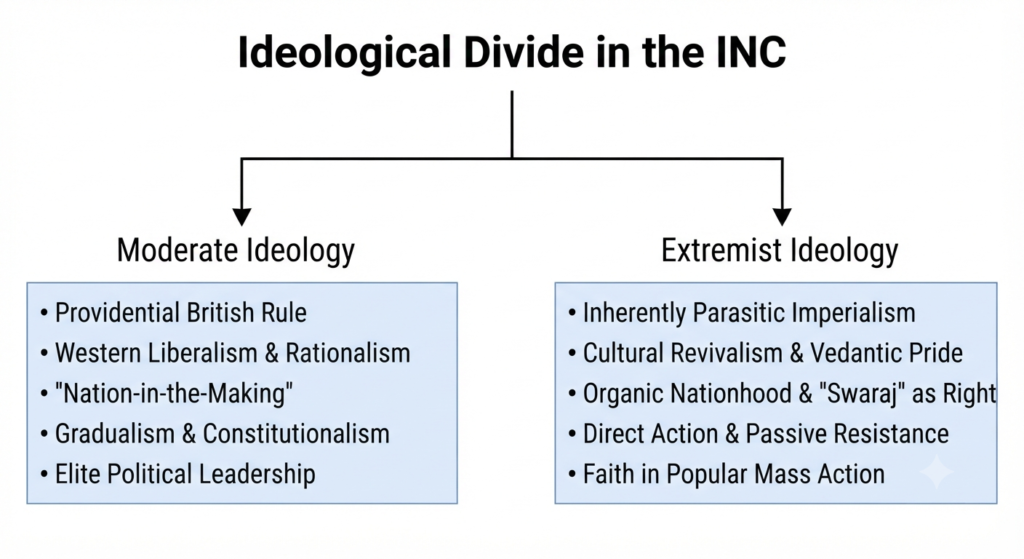
The ideological divergence between the Moderates (led by Dadabhai Naoroji, Gopal Krishna Gokhale, and Pherozeshah Mehta) and the Extremists (led by the Lal-Bal-Pal triumvirate and Aurobindo Ghosh) represented not merely a clash of personalities or tactics, but two fundamentally distinct worldviews regarding colonialism, nationhood, and political agency.
Key Ideological Differences
| Dimension | The Moderate Ideology | The Extremist Ideology |
| Nature of British Rule | Viewed the British connection as providential and historically progressive, introducing administrative unity, modernization, and the rule of law. Exploitation was viewed as an administrative aberration that could be corrected. | Viewed British rule as fundamentally parasitic and irreconcilable with Indian economic, political, and moral progress. Rejected any illusion of imperial benevolence. |
| Philosophical Roots | Rooted in Western liberalism, Utilitarianism, and British constitutional history (Edmund Burke, John Stuart Mill, John Morley). | Rooted in indigenous traditions, Vedantic philosophy, the Bhagavad Gita, and cultural revivalism (Vivekananda, Dayanand Saraswati, Bankim Chandra). |
| Concept of the “Nation” | Conceived India as a “Nation-in-the-making” (Surendranath Banerjea), requiring patient socio-political evolution and modernization before it could claim full sovereignty. | Viewed India as an ancient, organic spiritual civilization personified as Bharat Mata. Nationhood was an innate truth rather than a colonial byproduct. |
| Definition of the Goal (Swaraj) | Limited their goal to administrative reforms and Dominion Status—self-government within the British Empire, achieved incrementally. | Defined Swaraj as complete freedom and self-rule as an inalienable birthright (“Swaraj is my birthright and I shall have it” — Tilak). Aurobindo saw political freedom as essential for national regeneration. |
| Role and Faith in the Masses | Skeptical of the masses, viewing them as politically uneducated and volatile. Believed politics was the preserve of the enlightened intelligentsia. | Had immense faith in the masses, trusting the capacity of peasants, youth, and workers for sustained political struggle and sacrifice. |
| Methods of Agitation | Constitutional gradualism through the “3 Ps” (Prayers, Petitions, Protests), press debates, and legislative council speeches within the bounds of colonial law. | Direct political action and Passive Resistance: Total boycott of foreign goods, promotion of Swadeshi, national education, and refusal to cooperate with colonial institutions. |
| Attitude toward State Repression | Avoided law-breaking or direct defiance to prevent the total suppression of nascent political institutions by the colonial state. | Embraced self-sacrifice (atmasamarpan), civil suffering, and jail-going, arguing that freedom demands a price in suffering and confrontation. |
Concrete Manifestation of the Ideological Clash
- The Scope of Swadeshi (1905–1907): Moderates sought to confine the anti-Partition movement strictly to Bengal and limit boycott to foreign goods to avoid illegal confrontation. Extremists demanded transforming Swadeshi into an all-India political movement targeting schools, courts, and colonial administration.
- The Surat Rupture (1907): The ideological rift made institutional coexistence unviable. The Moderates feared Extremist methods would provoke severe state suppression, while Extremists viewed Moderate tactics as “political mendicancy.”
The Moderate-Extremist divide was a necessary dialectic in the evolution of Indian nationalism. While the Moderates formulated the indispensable intellectual and economic critique of imperialism that de-legitimized colonial rule, the Extremists supplied the emotional fervor, cultural confidence, and mass-mobilization techniques that transformed nationalism from an elite dialogue into a broad-based movement, laying the operational ground for the Gandhian era.
Q.11 Why did the ‘Moderates’ fail to carry conviction with the nation about their proclaimed ideology and political goals by the end of the nineteenth century? (2017)
उन्नीसवीं सदी के अंत तक ‘नरमदल’ अपनी घोषित विचारधारा और राजनीतिक लक्ष्यों के बारे में राष्ट्र के साथ विश्वास रखने में विफल क्यों रहा?
By the late 1890s, the Moderate leadership of the Indian National Congress (1885–1905)—spearheaded by figures like Dadabhai Naoroji, Gopal Krishna Gokhale, Pherozeshah Mehta, and Surendranath Banerjea—faced an acute crisis of credibility. While they pioneered the intellectual foundation of Indian nationalism, their political philosophy, constitutional methods, and strategic goals increasingly failed to resonate with a rapidly radicalizing Indian populace.
Key Reasons for the Loss of Conviction
1. The Inherent Contradiction of Their Ideology
- The Paradox of the “Benevolent Raj”: The Moderates exposed the ruthless economic exploitation of India through the Drain of Wealth theory (Naoroji, R.C. Dutt). Yet, paradoxically, they professed unwavering loyalty to the British Crown, treating colonial rule as a “providential blessing” that brought modern enlightenment and the rule of law.
- Cognitive Dissonance: The educated youth found it impossible to reconcile the economic reality of deliberate impoverishment with the political claim that the British Empire was fundamentally fair and benevolent.
2. Disillusionment with the Methods of “Political Mendicancy”
- Futile “3 Ps”: The strategy of Prayers, Petitions, and Protests produced negligible results after nearly two decades of effort. Memoranda submitted by delegations in London were routinely shelved.
- “Three-Day Annual Tamasha”: Nationalist critics like Bal Gangadhar Tilak, Lala Lajpat Rai, and Aurobindo Ghosh (New Lamps for Old, 1893) ridiculed the annual December sessions of the Congress as elite social gatherings devoid of political seriousness, dismissing their constitutionalism as “begging for rights.”
3. Cosmetic Concessions from the Colonial State
- Hollow Reforms (Indian Councils Act of 1892): The crowning constitutional achievement of Moderate agitation proved largely toothless:
- Non-official Indian members were kept in a minority.
- Members could not vote on the budget or move amendments.
- Supplementary questions were disallowed.
- Imperial Contempt: The British bureaucracy openly mocked the Moderates rather than accommodating them. Lord Dufferin (1887) dismissed the Congress as a “microscopic minority,” while Lord Curzon (1900) expressed his desire to “assist it to a peaceful demise,” showing that constitutional moderation yielded neither respect nor substantive power.
4. Failure to Respond to Acute Human Suffering
- Famines and Deccan Bubonic Plague (1896–1900): Widespread crop failures caused millions of deaths, while colonial authorities managed the plague with heavy-handed arrogance (e.g., W.C. Rand’s conduct in Pune).
- Detached Aristocratic Style: While ordinary Indians starved, the Moderates confined their activism to passing polite resolutions in English inside council chambers. Their refusal to organize grassroots relief or lead direct agitation severed their emotional link with the suffering population.
5. Elitism and Deep Distrust of the Masses
- Drawing-Room Politics: Moderate politics was largely confined to urban, English-educated professionals (lawyers, doctors, journalists, and landed aristocrats).
- Skepticism of Mass Action: Leaders like Pherozeshah Mehta held that the illiterate masses lacked the political maturity required for representative government. This exclusion alienated the rising lower-middle class, students, and working classes, who were seeking active involvement rather than passive spectatorship.
6. The Surge of Cultural Self-Respect and Militant Pride
- Erosion of Cultural Inferiority: Socio-religious revivalists like Swami Vivekananda and Dayanand Saraswati restored pride in Indian heritage, preaching self-reliance (Atmashakti) and fearlessness.
- Rejection of Anglophile Mimicry: The Moderate reliance on British liberal philosophers (Mill, Macaulay, Burke) appeared slavish to a generation eager to ground political action in indigenous metaphors and direct sacrifice.
The Moderates failed to convince the nation because their politics remained fundamentally reformist within the imperial system, whereas the reality of colonial rule was inherently exploitative and irreconcilable with national development. By attempting to negotiate freedom in polite English within council chambers, the Moderates exhausted their historical utility, paving the way for the Extremists to redefine nationalism as an urgent, mass-based struggle for complete self-rule (Swaraj).
Q.12 To what extent did the role of the Moderates prepare a base for the wider freedom movement? Comment. (2021/15 marks, 250 words)
नरमदल की भूमिका ने किस हद तक व्यापक स्वतंत्रता आंदोलन के लिए आधार तैयार किया? टिप्पणी। (2021/15 अंक, 250 शब्द)
The Moderate phase of the Indian National Congress (1885–1905), led by stalwarts like Dadabhai Naoroji, Gopal Krishna Gokhale, Pherozeshah Mehta, and Surendranath Banerjea, is often critiqued for its elitist character and “political mendicancy.” However, viewing this era solely through its immediate tactical limitations overlooks the fact that the Moderates laid the indispensable intellectual, organizational, and political bedrock for the mass-based movements that followed.
How the Moderates Prepared the Base for the Freedom Movement
1. Demystifying the Colonial State: The Economic Critique
- Ideological Delegitimation: Through the Drain of Wealth theory articulated by Dadabhai Naoroji (Poverty and Un-British Rule in India), R.C. Dutt, and Dinshaw Wacha, the Moderates exposed how British rule systematically impoverished India.
- Fuel for Future Movements: By dismantling the myth of the “benevolent Raj” and “Pax Britannica,” they created the anti-imperialist economic framework that both the Extremists (during Swadeshi) and Mahatma Gandhi (during Non-Cooperation and Civil Disobedience) mobilized the masses against.
2. Institutionalizing a Pan-Indian National Platform
- Nurturing a “Nation-in-the-Making”: Before 1885, political consciousness was fragmented into regional bodies (e.g., Poona Sarvajanik Sabha, Indian Association). The Moderates built the Indian National Congress as a permanent, recurring pan-Indian forum.
- Secular and Inclusive Culture: By consciously excluding divisive communal and sectarian issues from annual sessions, they established secular norms and a shared national vocabulary that allowed diverse linguistic and religious groups to unite under one banner.
3. Inculcating Modern Democratic Values and Political Habits
- Establishing Constitutional Culture: They introduced Indians to modern concepts of civic rights, the rule of law, representative institutions, and public criticism of governance.
- Defense of Civil Liberties: Their fierce resistance against colonial curbs—such as defending the press and protesting the arbitrary arrest of Bal Gangadhar Tilak (1897)—turned freedom of speech into a central tenet of the nationalist struggle.
4. Legislative and Institutional Foundations
- Council Politics as Political Training: By securing the Indian Councils Act of 1892, they turned legislative assemblies into platforms of national exposure. Leaders like Gokhale used the imperial budget debates to demonstrate how state revenues were squandered on British militarism rather than primary education and public health.
- Paving the Way for Responsible Governance: The administrative reforms they initiated set the precedent for subsequent constitutional demands, culminating in the Montagu Declaration (1917) and the Government of India Acts of 1919 and 1935.
5. Mentorship and Cadre Evolution
- The Moderate leadership provided the institutional environment that trained the next generation of leadership. Most notably, Gopal Krishna Gokhale served as the political mentor to Mahatma Gandhi, advising him upon his return to India in 1915 to travel the country for a year before taking a political stance.
Inherent Limitations: Where the Foundation Remained Incomplete
- Narrow Social Base: The Moderates confined political activity to urban, English-educated elites (lawyers, doctors, journalists, and zamindars), deliberately sidelining the peasantry and working classes due to skepticism about their political maturity.
- Methodological Stalemate: Their reliance on the “3 Ps” (Prayers, Petitions, Protests) proved toothless against aggressive imperialists like Lord Curzon, failing to build a machinery capable of direct, sustained political confrontation.
- Reluctance for Mass Agitation: Fearing that mass lawbreaking would invite brutal state suppression and wipe out infant democratic institutions, they never built the grassroots organizational cells required to sustain an open revolt.
The Moderates were historical pioneers operating within severe colonial constraints. As historian Bipan Chandra observed, they served as “the seedbed of modern Indian nationalism.” Without the intellectual clarity, institutional unity, and economic critique formulated by the Moderates, neither the militant radicalism of the Extremists nor the mass mobilizations of Mahatma Gandhi would have had an ideological compass or an all-India structure on which to build.