
Unlock the secrets of the cosmos and our planet’s dramatic birth with our meticulously curated study material based on the New NCERT Class 11 Geography Chapter-2: The Origin and Evolution of The Earth Notes Pdf. This essential resource breaks down complex cosmological theories, from the cataclysmic Big Bang to the gradual condensation of nebulae and the formation of earth’s atmosphere and core. Designed to elevate your academic performance, these clear and concise notes provide the ultimate foundation for mastering school exams and competitive tests alike.
EARLY THEORIES
Origin of the Earth
Early cosmological theories focused primarily on explaining how the Earth and the solar system originated. Scientists initially attempted to explain local planetary formation before attempting to model the broader universe.
| Hypothesis / Theory | Key Proponents | Year / Era | Core Mechanism |
| Early Classical Hypothesis | Immanuel Kant | 18th Century | Proposed early philosophical models of planetary origins from rotating celestial matter. |
| Nebular Hypothesis | Pierre-Simon Laplace | 1796 | Planets formed from a slowly rotating cloud of material (nebula) surrounding a youthful sun. |
| Revised Nebular Hypothesis | Otto Schmidt (Russia) & Carl Weizsäcker (Germany) | 1950 | The sun was surrounded by a solar nebula rich in hydrogen, helium, and dust. Particle friction and collision created a disk cloud that formed planets via accretion. |
Key Evolutionary Concepts
- Solar Nebula Composition: Primeval material consisted mainly of light gases like hydrogen and helium alongside microscopic cosmic dust.
- Process of Accretion: Continuous particle collision and gravitational attraction caused dust and gas to clump together into larger bodies called planetesimals.
- Shift to Universal Origin: Later 20th-century scientists moved beyond local planetary models to solve the origin of the entire universe.
Exam Pointer: Early theories treated planetary formation as an isolated local event. Modern cosmology integrates the origin of Earth directly into the broader timeline of universal expansion.
MODERN THEORIES
Origin of the Universe
Modern cosmology relies primarily on the Big Bang Theory, also known as the expanding universe hypothesis. Edwin Hubble confirmed in 1920 that galaxies are moving further apart over time.
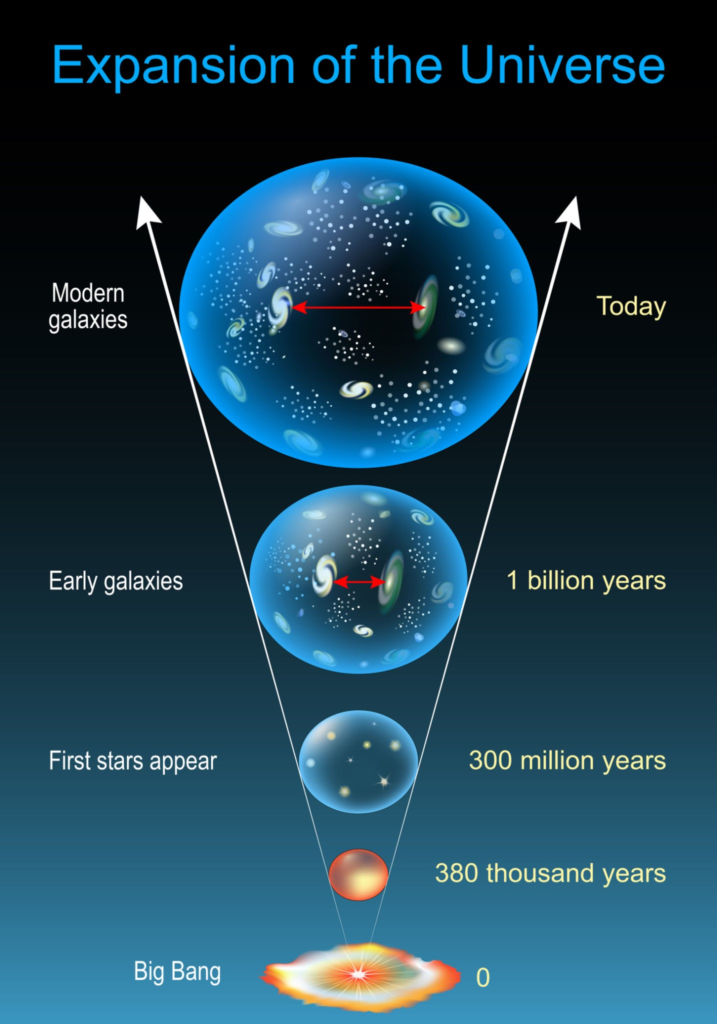
- Proof of Expansion: Observational evidence shows expanding inter-galactic space.
- The Balloon Analogy: Inflating a marked balloon shows points moving apart. Space between galaxies expands, though individual galaxies themselves do not grow.
- Steady State Alternative: Hoyle proposed a static model. Modern observational data rejected it in favor of universal expansion.
Stages of Universal Evolution
- Singularity: All universal matter existed at a single point with infinite density, infinite temperature, and near-zero volume.
- Violent Explosion (13.7 Billion Years Ago): Rapid expansion occurred within fractions of a second, converting raw energy into matter. The first basic atoms formed within three minutes.
- Atomic Matter Formation (300,000 Years Post-Bang): Temperatures cooled to 4,500 K, creating stable atomic matter and making the universe transparent.
The Star Formation
Uneven matter and energy distribution in the early universe created gravitational variances. These density differences caused gas clouds to coalesce, forming the structural bases of galaxies.
| Cosmological Entity | Spatial Dimensions / Attributes | Core Mechanism |
| Galaxy | Spans 80,000 to 150,000 light-years in diameter. | Contains massive clusters of individual stars and gas clouds. |
| Nebula | Vast hydrogen gas cloud accumulators. | Develops localized gas clumps that condense into dense stars. |
| Star Formation Era | Occurred roughly 5 to 6 billion years ago. | Gas accretion creates high-density nuclear ignition cores. |
Key Spatial Metrics
- Light-Year Definition: A unit of distance, not time. It represents the distance light travels in one Julian year.
- Speed of Light: 300,000 km/s.
- 1 Light-Year Value: 9.46 × 10¹² km
- Earth-Sun Mean Distance: 149,598,000 km (equivalent to 8.311 light-minutes).
Formation of Planets
Planetary accretion occurs through three progressive stages within a solar nebula. The process transforms diffuse gas clouds into solid, massive planetary bodies.
[Localized Gas Lump]
▼
[Rotating Disc & Gas Core]
▼
[Condensation & Cohesion]
▼
[Planetesimals (Small Rounded Objects)]
▼
[Gravitational Accretion & Collision]
▼
[Planets]
| Evolutionary Stage | Core Physical Process | Key Characteristics |
| Stage I: Nebula Core | Gravitational Collapse | Localized gas lumps condense to form a central core surrounded by a rotating disk of gas and dust. |
| Stage II: Planetesimal Formation | Cohesion and Collision | Matter condenses into small rounded objects. Gravitational attraction and collision bind these planetesimals into larger bodies. |
| Stage III: Planetary Accretion | Mass Accretion | Countless small planetesimals coalesce under heavy gravitational pull, consolidating into a few large planets. |
EVOLUTION OF THE EARTH
Primordial State vs. Present Earth
- Primordial Earth: A hot, barren, and rocky body surrounded by a thin atmosphere dominated by hydrogen and helium.
- Modern Earth: A dynamic planet with abundant liquid water, a layered interior structure, and a life-sustaining atmosphere.
- Evolutionary Timeline: Took approximately 4,600 million years (4.6 billion years) to transform into its present state.
- Density Stratification: Material density increases progressively from the outermost atmospheric layers down to the core.
Evolution of Lithosphere
Earth existed in a volatile, highly heated state during its early formation. Gravitational compression and radioactive decay increased internal temperatures significantly.
- Density Differentiation: Internal heating allowed Earth’s materials to segregate based on relative density:
- Heavier Materials (e.g., Iron, Nickel): Sank toward the center to form the core.
- Lighter Materials (e.g., Silicates): Rose toward the outer surface to form the early crust.
- Cooling and Solidification: The outer layer cooled over time, condensing into a solid outer crust.
- The Giant Impact (Moon Formation): A massive celestial collision re-heated the Earth, accelerating the process of differentiation.
- Layered Interior Structures: Differentiation established four distinct interior density zones:
- Crust (Outermost, lowest density)
- Mantle
- Outer Core
- Inner Core (Innermost, highest density)
Evolution of Atmosphere and Hydrosphere
The earth’s present atmosphere consists predominantly of nitrogen and oxygen. The transformation from a volatile, toxic primordial environment into a life-sustaining system occurred across three distinct evolutionary stages.
| Evolutionary Stage | Primary Process | Atmospheric Composition / Characteristics |
| Stage I: Stripping of Primordial Atmosphere | Solar Wind Stripping | Solar winds blew away light primordial gases (H2 and He) from Earth and other terrestrial planets. |
| Stage II: Volcanic Degassing | Internal Cooling & Outgassing | Cooling interior released trapped gases via degassing and continuous volcanic eruptions (H2O vapor, N2, CO2, CH4, NH3). |
| Stage III: Photosynthetic Modification | Biological Oxygen Enrichment | Aquatic organisms evolved photosynthesis, saturating oceans with oxygen before flooding the atmosphere. |
Evolution of the Hydrosphere
The cooling of the early Earth triggered massive atmospheric condensation and sustained rainfall cycles.
- Cooling & Condensation: Released water vapor condensed as planetary surface temperatures dropped.
- Carbon Sink Mechanism: Atmospheric CO2 dissolved into falling rainwater, reducing greenhouse trapping and accelerating cooling.
- Ocean Basin Formation: Continuous rainwater accumulated in massive surface depressions, forming oceans within 500 million years of Earth’s formation (~4,000 million years ago).
- Atmospheric Oxygenation: Photosynthesis evolved around 2,500–3,000 million years ago. Oxygen saturated the oceans first and flooded the atmosphere roughly 2,000 million years ago.
Origin of Life
The final evolutionary milestone converted inanimate chemical compounds into self-replicating living organisms.
- Chemical Evolution Model: Life originated through complex chemical reactions that synthesized organic molecules into self-duplicating structures.
- Geological Fossil Evidence: Microscopic structures resembling modern blue-green algae occur in rock formations older than 3,000 million years.
- Timeline of Evolution: Primitive aquatic life first emerged approximately 3,800 million years ago. Life remained confined to oceanic environments for extended geological periods.
UPSC Critical Summary: Earth’s atmosphere evolved from simple gas stripping to internal volcanic degassing, culminating in biologically driven oxygen saturation.