
The Civil Disobedience Movement theme represents one of the most critical turning points in modern Indian history. Sparked by Mahatma Gandhi’s historic Dandi March in 1930, the nationwide agitation paralyzed colonial governance through targeted law-breaking, widespread peasant involvement, and unprecedented female participation. Understanding core developments—from the eleven demands presented to Lord Irwin and the subsequent Gandhi-Irwin Pact to the contentious Communal Award and Poona Pact—provides aspirants with high-value analytical frameworks essential for crafting impactful answers in the UPSC Mains General Studies Paper 1.
Q.1 Analyse Mahatma Gandhi’s main demands presented to Irwin. How did Salt emerge as the central issue for launching the Satyagraha? (1988/15)
इरविन को प्रस्तुत महात्मा गांधी की मुख्य मांगों का विश्लेषण करें। सत्याग्रह शुरू करने के लिए नमक केंद्रीय मुद्दे के रूप में कैसे उभरा?
Following the declaration of Purna Swaraj at the Lahore Congress (December 1929), Mahatma Gandhi presented an ultimatum to Viceroy Lord Irwin on January 31, 1930, through his historic letter published in Young India. Gandhi placed Eleven Demands before the British Raj, stating that if these demands were accepted, the call for civil disobedience would be stayed.
1. Analysis of Gandhi’s Eleven Demands to Irwin
Gandhi strategically categorized his eleven demands into three distinct sociopolitical tiers, designed to build a broad cross-class consensus encompassing the peasantry, the indigenous bourgeoisie, and general democratic civil society:
A. Issues of General Democratic and National Interest
- Reduction of Administrative Overhead: A 50% reduction in military spending and civil service salaries, exposing the economic drain and high costs of colonial bureaucracy.
- Moral and Social Reform: Total prohibition of intoxicants and alcohol, addressing working-class domestic welfare while undermining state excise revenues.
- Civil Liberties:
- Release of all political prisoners not convicted of violent crimes and withdrawal of political prosecutions.
- Reform of the Criminal Investigation Department (CID) to eliminate political surveillance.
- Amendment of the Arms Act to allow citizens to bear firearms for self-defense.
B. Specific Peasant Demands
- Agrarian Relief: A 50% reduction in land revenue and placing its assessment under legislative oversight, directly appealing to rural smallholders hit hard by the Great Depression (1929) and falling commodity prices.
- Abolition of the Salt Tax: Immediate abolition of the regressive tax on salt and liquidation of the government salt monopoly.
C. Demands of the Indigenous Bourgeoisie / Capitalist Class
- Currency and Exchange Reform: Lowering the exchange ratio of the Indian Rupee from 1s 6d to 1s 4d, making domestic exports competitive and halting the artificial overvaluation favoring British imports.
- Protectionist Trade Policy: Imposition of a protective customs tariff against foreign cloth imports to safeguard the domestic textile industry.
- Coastal Shipping Protection: Passage of the Coastal Traffic Reservation Bill to preserve Indian coastal shipping for indigenous operators (championed by business leaders like Walchand Hirachand).
2. How Salt Emerged as the Central Issue for Launching the Satyagraha
When Lord Irwin ignored the ultimatum, Gandhi selected the Salt Law as the fulcrum of civil disobedience. Initially, even Congress colleagues like Jawaharlal Nehru and Sardar Patel were skeptical of making an everyday cooking condiment the centerpiece of an empire-wide struggle. Yet, salt proved to be a stroke of mobilizational genius:
- Universal and Non-Divisive Material Base:
- Salt was an absolute biological necessity consumed equally by every individual regardless of religion, caste, class, or gender.
- Unlike no-rent campaigns (which risked pitching tenant peasants against native landlords) or industrial strikes (which alienated Indian capitalists), defiance of the salt tax created a conflict between the Indian population and the colonial state, without exposing internal class fractures.
- Exposure of Colonial Greed and Moral Illegitimacy:
- Salt was a gift of nature available freely along India’s 5,000+ miles of coastline. Making its private collection illegal and imposing a state monopoly with an exorbitant tax (often over 1,000% of production cost) laid bare the cruelty of colonial taxation on the destitute:
- Symbolic Simplicity and Tactical Replicability:
- Breaking the salt law required no sophisticated weapons or specialized training. Any villager on the coast could boil seawater, while inland activists could sell contraband salt packets in town squares. It democratized civil disobedience into an easily replicated act of everyday defiance.
- Strategic Masterstroke of the Dandi March:
- The 24-day, 240-mile trek from Sabarmati Ashram to Dandi (March 12 – April 6, 1930) with 78 chosen ashramites acted as a rolling visual and political campaign.
- It mobilized hundreds of thousands along the rural route, led hundreds of village headmen (patels) to resign their colonial posts, attracted unprecedented international press attention (e.g., Webb Miller), and brought women like Sarojini Naidu and Kamaladevi Chattopadhyay into the frontlines of direct action.
- Colonial Miscalculation:
- Lord Irwin and the British administration initially ridiculed the idea of a “salt march,” viewing it as trivial and ineffective. This administrative complacency gave Gandhi time to mobilize public momentum across the subcontinent before the state realized that picking up a handful of salt on the beach at Dandi would shake the moral foundations of the British Raj.
By anchoring the struggle to salt, Gandhi transformed an abstract constitutional concept—Purna Swaraj—into a concrete, everyday grievance that resonated across rural and urban India, triggering nationwide defiance through the Civil Disobedience Movement of 1930.
Q.2 What was the Gandhi-Irwin Pact? Why it signed and what were its consequences? (150 words) (1988)
गांधी-इरविन समझौता क्या था? इस पर हस्ताक्षर क्यों किए गए और इसके क्या परिणाम हुए?
The Gandhi-Irwin Pact (formally known as the Delhi Pact) was a political agreement signed on March 5, 1931, between Mahatma Gandhi, representing the Indian National Congress (INC), and Lord Irwin, the Viceroy of India.
It marked the temporary suspension of the Civil Disobedience Movement (CDM) and paved the way for Congress participation in the Second Round Table Conference in London.
Why the Pact Was Signed
1. The Impasse of the Civil Disobedience Movement (1930)
- The Salt Satyagraha and subsequent mass defiance had overwhelmed colonial administration. Over 90,000 satyagrahis were imprisoned, provincial revenues dropped due to no-tax and no-revenue campaigns, and foreign cloth imports plummeted.
- However, the colonial state’s severe repression (ordinances, lathi-charges, bans on Congress committees) caused physical fatigue among the public, indicating that the agitation was nearing an ebbing phase.
2. Failure of the First Round Table Conference (Nov 1930 – Jan 1931)
- The British government organized the First RTC in London to discuss constitutional reforms based on the Simon Commission report.
- Without the participation of the Indian National Congress—the premier representative organization of the country—the conference proved completely hollow. British Prime Minister Ramsay MacDonald acknowledged that no constitutional settlement was workable without Congress.
3. Mediation by Liberal Leaders
- Moderate leaders like Tej Bahadur Sapru and M.R. Jayakar initiated mediation between the jailed Congress Working Committee and the Viceroy, emphasizing that constitutional dialogue was in the national interest.
4. The Gandhian Strategy of “Struggle-Truce-Struggle” (S-T-S)
- As historian Bipan Chandra explains, Gandhian mass movements operated on the principle that the masses cannot sustain struggle at peak intensity indefinitely. A period of truce was vital to consolidate gains, rest the cadre, recover confiscated property, and prepare for the next round of struggle from a higher moral plateau.
Core Provisions of the Pact
| What the British Government Agreed To | What the British Government Refused | What Gandhi / Congress Agreed To |
| • Immediate release of all political prisoners not convicted of violence. • Remission of all uncollected fines. • Return of confiscated lands not yet sold to third parties. • Right of coastal residents to manufacture salt for personal consumption (not for sale). • Right to peaceful, non-aggressive picketing of liquor and foreign cloth shops. • Withdrawal of all emergency repressive ordinances. | • Commutation of the death sentences of Bhagat Singh, Rajguru, and Sukhdev to life imprisonment. • Public inquiry into police excesses and brutalities committed during the movement. | • Suspension of the Civil Disobedience Movement. • Agreement to participate in the Second Round Table Conference on the basis of a federal structure with constitutional safeguards (defense, external affairs, minorities). • Ending boycotts specifically targeted against British goods (retaining only general swadeshi). |
Consequences and Historical Significance
1. Historic Parity of Status
- For the first time in colonial history, the representative of the British Crown was forced to negotiate on terms of equal status with the leader of an anti-colonial movement.
- Winston Churchill famously lamented the spectacle of the:“seditious Middle Temple lawyer, now posing as a fakir… striding half-naked up the steps of the Vice-regal palace… to parley on equal terms with the representative of the King-Emperor.”
2. Intense Youth and Left Discontent
- Gandhi’s inability to save Bhagat Singh, Sukhdev, and Rajguru—who were executed on March 23, 1931, just weeks after the pact—sparked widespread anger among the youth and left-wing nationalists.
- When Gandhi arrived at the Karachi Session of the Congress (March 1931), he was greeted with black-flag demonstrations by the Naujawan Bharat Sabha.
3. Endorsement at Karachi Congress (March 1931)
- Despite the grief over the executions, the Karachi Congress officially endorsed the Delhi Pact.
- To balance this compromise, the session passed the landmark Resolution on Fundamental Rights and the National Economic Programme, drafted by Jawaharlal Nehru, committing the future state to democratic liberties and socialist welfare.
4. Failure of the Second Round Table Conference (Autumn 1931)
- Gandhi traveled to London as the sole representative of the Congress. The conference became bogged down by communal deadlocks, minority vetoes manipulated by the British administration, and opposition from the new Conservative-dominated National Government.
- Gandhi returned empty-handed in December 1931, declaring: “I have returned empty-handed, but I have not compromised the honor of my country.”
5. Resumption of Movement and Severe Repression (1932)
- Upon returning, Gandhi found Lord Willingdon (the new Viceroy) unwilling to negotiate.
- The government pre-emptively banned Congress, arrested the entire leadership under the Civil Disobedience (Penalties) Ordinance, and launched ruthless state suppression, eventually causing the movement to be withdrawn formally in 1934.
The Gandhi-Irwin Pact did not secure immediate Purna Swaraj, but it decisively shattered the myth of British omnipotence. By compelling the Viceroy to sign a negotiated treaty with an open rebel, it established the Indian National Congress as the legitimate representative of the Indian people.
Q.3 Why did Mahatma Gandhi launch Civil Disobedience Movement? Analyse the intensity of the movement in different pans of India. (1992/15)
महात्मा गांधी ने सविनय अवज्ञा आंदोलन क्यों शुरू किया? भारत के विभिन्न हिस्सों में आंदोलन की तीव्रता का विश्लेषण करें।
The launch of the Civil Disobedience Movement (CDM) on March 12, 1930, with the historic Dandi March marked a decisive escalation in the Indian freedom struggle. Unlike the Non-Cooperation Movement (1920–22), which sought to bring administration to a standstill through negative boycotts, CDM aimed to paralyze the colonial apparatus by deliberately violating specific colonial laws.
Why Mahatma Gandhi Launched the Movement
1. The Constitutional Deadlock and Simon Commission Insult
- The appointment of the all-white Simon Commission (1927) sparked universal outrage, uniting disparate political factions.
- The Nehru Report (1928) drafted a dominion constitution, offering the British a one-year ultimatum to accept it. When the colonial government ignored the deadline, the Lahore Congress (December 1929) presided over by Jawaharlal Nehru declared Purna Swaraj (Complete Independence) as the sole goal of the national struggle, authorizing the Congress Working Committee (CWC) to launch civil disobedience.
2. Acute Socio-Economic Crisis of the Great Depression (1929)
- The Wall Street crash triggered a collapse in agricultural commodity prices (wheat, jute, and cotton plummeted by over 50%).
- While peasant incomes evaporated, the colonial state refused to remit land revenue or water rates. Rural unrest grew rapidly across the United Provinces, Bengal, and Gujarat, demanding an organized national platform to prevent uncoordinated peasant uprisings.
3. Irwin’s Rejection of the Eleven Demands
- In January 1930, Gandhi offered Viceroy Lord Irwin an eleven-point compromise combining peasant relief (50% reduction in land revenue, abolition of salt tax), capitalist safeguards (protective textile tariffs, 1s 4d rupee ratio), and civil liberties.
- Irwin’s categorical refusal to negotiate left direct mass confrontation as the only viable political path.
Intensity and Forms of the Movement Across Different Parts of India
The Civil Disobedience Movement was geographically diverse, with different provinces adapting their forms of resistance to local socio-economic realities:
| Region | Primary Form of Struggle | Key Leaders | Distinctive Features |
| Gujarat & Western India | Salt boiling; resignations of village officials; non-payment of land revenue. | Mahatma Gandhi, Sardar Patel, Sarojini Naidu | • Dharasana Salt Works (May 1930): Peaceful raid led by Sarojini Naidu, Imam Saheb, and Manilal Gandhi; unarmed satyagrahis endured brutal lathi-charges reported globally by Webb Miller. • Massive resignations of village headmen (patels and talatis). |
| North-West Frontier Province (NWFP) | Non-violent civil resistance by Pathans; defiance of martial law. | Khan Abdul Ghaffar Khan (“Frontier Gandhi”) | • Led by the Khudai Khidmatgars (“Servants of God” or Red Shirts). • Historic defiance in Peshawar (April 1930), where soldiers of the Royal Garhwal Rifles (led by Chandra Singh Garhwali) refused orders to fire on unarmed Muslim demonstrators. |
| Tamil Nadu & Madras Presidency | Salt marches to coastal extraction sites; picketing foreign cloth. | C. Rajagopalachari | • Organized a march from Tiruchirappalli to Vedaranyam on the Tanjore coast to break the salt law, facing mass arrests and district bans. |
| Kerala & Malabar | Coastal salt satyagrahas; picketing. | K. Kelappan (“Kerala Gandhi”), P. Krishna Pillai | • Led a salt march from Calicut to Payyanur, sparking widespread political consciousness that later fueled the Kerala socialist movement. |
| Bihar & Eastern UP | Anti-Chowkidari Tax campaign; No-Rent protests. | Rajendra Prasad, Ambika Kant Sinha | • Landlocked geography made salt-making unviable; shifted to refusing the Chowkidari tax (funding village police who aided colonial surveillance), accompanied by no-rent agitations against zamindars. |
| Bengal & North-East | Salt defiance, anti-Chowkidari agitation; concurrent revolutionary action. | J.M. Sengupta, Subhas Chandra Bose, Rani Gaidinliu | • Salt making in Midnapore and Contai. • Occurred alongside the Chittagong Armoury Raid (April 1930) under Surya Sen. • In Manipur and the Naga hills, 13-year-old Rani Gaidinliu led the Heraka movement, raising the banner of revolt against British rule. |
| Central Provinces & Maharashtra | Forest Satyagraha; defiance of grazing fees and forest acts. | Local tribal and peasant leadership; M.S. Aney | • Mass defiance of colonial forest restrictions in tribal belts (e.g., Sangamner, Baglan); thousands illegally grazed cattle and cut timber in reserved forests. |
| Industrial Centers (e.g., Sholapur) | Working-class insurrections; strikes. | Textile trade union leaders | • Following Gandhi’s arrest, textile workers in Sholapur (May 1930) burnt liquor shops, police stations, and municipal buildings, establishing a virtual parallel government for several days before martial law crushed it. |
Critical Evaluation
- Broader Regional & Social Reach: CDM surpassed the 1920–22 movement in active rural penetration. Women participated in record numbers on the frontlines of picketing and manufacturing contraband salt, while merchant groups provided sustained financial backing.
- Limitations in Social Base: Muslim participation was generally lower than during the Khilafat-NCM era (with the notable exception of the NWFP), due to political appeals by the Muslim League and communal polarization following the 1928 Nehru Report. Similarly, industrial labor participation remained sporadic outside Bombay and Sholapur.
The Civil Disobedience Movement demonstrated the Indian National Congress’s capacity to mobilize diverse rural and urban populations simultaneously. By forcing the colonial administration to deploy widespread arrests and martial rule, the movement undermined the moral legitimacy of British governance and compelled Viceroy Irwin to negotiate with Gandhi on terms of equal standing in the Gandhi-Irwin Pact of 1931.
Q.4 What was the Macdonald Award? How was it modified and with what results? (1993/15)
मैकडोनाल्ड पुरस्कार क्या था? इसे कैसे संशोधित किया गया और इसके क्या परिणाम हुए?
The MacDonald Award (officially known as the Communal Award) was announced on August 16, 1932, by British Prime Minister Ramsay MacDonald. It was formulated to resolve the communal representation deadlock that had paralyzed the Second Round Table Conference (1931) in London.
1. Features of the MacDonald Award
The Award allocated separate electorates and reserved quotas in provincial legislatures to distinct communal and minority groups:
- Continuation of Existing Separate Electorates: Maintained separate voter lists and seats for Muslims, Sikhs, Europeans, Anglo-Indians, and Indian Christians.
- Classification of Depressed Classes: For the first time, the Depressed Classes (Scheduled Castes) were classified as a separate, distinct minority community entitled to separate electorates.
- Double Voting Privilege: Depressed Class voters were granted two votes:
- One to elect their own representatives in 71 specially reserved constituencies where only members of the Depressed Classes could vote.
- A second vote to participate alongside caste Hindus in general territorial constituencies.
- Special Allocations: Provided reserved legislative quotas for commerce, industry, landholders, universities, and for women in both general and communal categories.
2. Nationalist Reaction and How the Award Was Modified
A. Gandhi’s Opposition and Fast Unto Death
- While Mahatma Gandhi did not oppose political reservations for the Depressed Classes, he strongly resisted separate electorates for them.
- He argued that separate electorates would sever untouchables from Hindu society permanently, entrench caste divisions into law, and divert focus from the moral imperative of caste abolition.
- Confined in Yerwada Central Jail (Poona), Gandhi launched a “Fast Unto Death” on September 20, 1932, declaring he would end his life unless the separate electorate provision for Depressed Classes was withdrawn.
B. The Yerwada Negotiations and the Poona Pact
- Gandhi’s fast triggered nationwide concern. Nationalist and liberal leaders—including Madan Mohan Malaviya, Tej Bahadur Sapru, M.R. Jayakar, C. Rajagopalachari, and G.D. Birla—intervened to broker a settlement between Gandhi and Dr. B.R. Ambedkar, the principal advocate for Depressed Class representation.
- Recognizing the high political stakes, Dr. Ambedkar agreed to compromise on the electoral mechanism in exchange for a significant increase in reserved legislative representation.
- On September 24, 1932, the Poona Pact was signed by Dr. Ambedkar on behalf of the Depressed Classes and by Madan Mohan Malaviya on behalf of caste Hindus (with Gandhi assenting).
- The British Government accepted this agreed modification, amending the Communal Award accordingly.
3. Key Provisions of the Modification (Poona Pact)
| Parameter | MacDonald Award (Original) | Modified by Poona Pact |
| Electoral Mechanism | Separate Electorates: Only Depressed Classes voted for Depressed Class candidates. | Joint Electorates with Reserved Seats: All voters in the constituency voted, but candidate must belong to the Depressed Class. |
| Primary Election System | None; single direct voting. | Two-tier voting: Primary election by Depressed Class voters to panel 4 candidates, followed by final joint election by all voters. |
| Provincial Legislative Seats | 71 seats | 147 seats (more than doubled). |
| Central Legislative Representation | No specific separate quota set. | 18% of the general seats reserved for Depressed Classes. |
| Public Services & Education | General assurances. | Definite share in public services and educational grants guaranteed without discrimination. |
4. Results and Historical Consequences
- Preservation of Social Cohesion: By substituting joint electorates for separate electorates, the pact prevented the legal-constitutional bifurcation of Hindu society.
- Massive Leap in Reserved Representation: The Depressed Classes gained more than double the seats in provincial councils (from 71 to 147) and secured guaranteed representation at the Centre, which was later incorporated into the Government of India Act 1935.
- Catalyst for Gandhi’s Anti-Untouchability Campaign: Following the pact, Gandhi stepped back from mass political agitation to focus on social reform:
- Formed the All India Anti-Untouchability League (later Harijan Sevak Sangh).
- Started the weekly journal Harijan (1933).
- Undertook a 20,000 km pan-India Harijan Tour (1933–34) to promote temple entry and eradicate untouchability.
- Long-Term Frustration for Dalit Autonomy: In later years, Dr. Ambedkar critiqued the working of the Poona Pact in works like What Congress and Gandhi Have Done to the Untouchables (1945). He argued that joint electorates allowed caste-Hindu majorities to elect pliant Dalit candidates who relied on upper-caste party patronage rather than genuine community advocates.
- Constitutional Blueprint: The electoral principle established under the Poona Pact—joint electorates combined with reserved seats—became the foundation for Articles 330 and 332 in the Constitution of India (1950).
Q.5 In what way did the Civil Disobedience Movement affect the different provinces of India? How did it foster peasant movement in India? (250 words) (1995/30)
सविनय अवज्ञा आंदोलन ने भारत के विभिन्न प्रांतों को किस प्रकार प्रभावित किया? इसने भारत में किसान आंदोलन को कैसे बढ़ावा दिया?
The Civil Disobedience Movement (CDM) launched in 1930 broke away from the traditional, centralized forms of agitation. Unlike the Non-Cooperation Movement of 1920–22, which relied primarily on urban institutional boycotts, CDM adapted directly to local geographic and agrarian realities across different provinces, simultaneously triggering a qualitative transformation in Indian peasant politics.
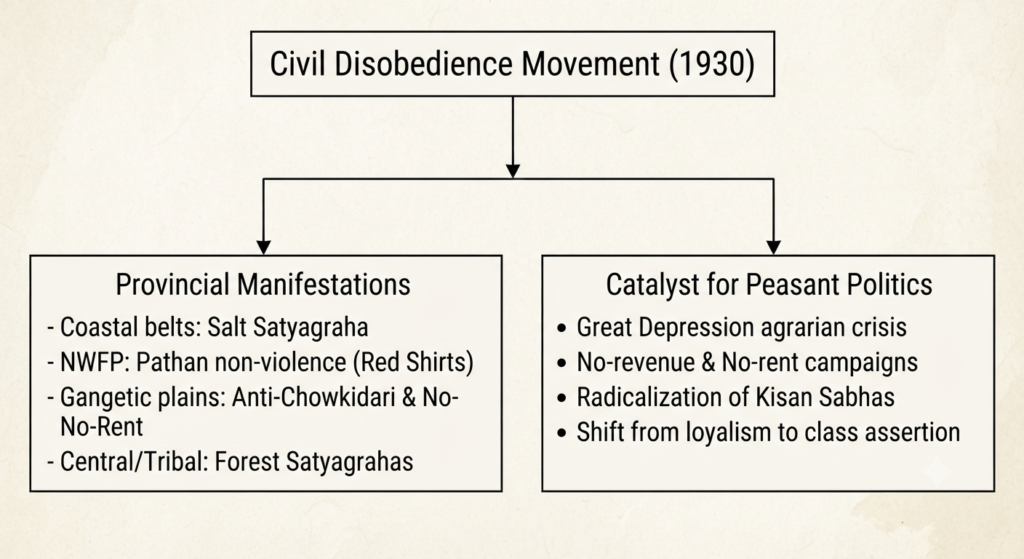
1. Impact Across Different Provinces of India
Because the manufacture of contraband salt was geographically feasible only along maritime boundaries, interior provinces adapted the campaign to target locally oppressive colonial laws:
- North-West Frontier Province (NWFP):
- Under Khan Abdul Ghaffar Khan (“Frontier Gandhi”) and the Khudai Khidmatgars (Red Shirts), the traditionally martial Pathan society adopted disciplined, non-violent mass resistance.
- In the Peshawar uprising (April 1930), soldiers of the Royal Garhwal Rifles under Havildar Chandra Singh Garhwali refused orders to fire on unarmed Muslim demonstrators, marking a rare instance of direct military disobedience.
- Gujarat & Bombay Presidency:
- Salt Satyagraha peaked at Dharasana (May 1930), where unarmed volunteers led by Sarojini Naidu, Imam Saheb, and Manilal Gandhi faced brutal lathi charges.
- In Surat and Kheda, peasants organized extensive no-revenue campaigns, with entire village populations migrating across borders into the princely state of Baroda (Hijrat) to prevent the confiscation of their lands and cattle.
- Bihar and Bengal:
- Being landlocked, Bihar shifted focus to the Anti-Chowkidari Tax campaign under Rajendra Prasad, defying village police levies used to fund colonial intelligence networks.
- In Bengal (Midnapore, Contai, Arambagh), salt defiance combined with anti-chowkidari campaigns and parallel underground armed actions, such as the Chittagong Armoury Raid led by Surya Sen.
- United Provinces (UP):
- UP became the nerve center of a dual No-Revenue and No-Rent campaign. While the Congress leadership initially sanctioned only a “no-revenue” call against the colonial state, it inevitably merged into a “no-rent” agitation by tenants against native taluqdars and zamindars.
- Central Provinces and Maharashtra:
- In tribal and forested tracts (e.g., Sangamner, Baglan), the agitation took the form of Forest Satyagrahas. Tribals and peasants defied British forest laws by grazing cattle in reserved zones and felling timber.
- Madras Presidency & Kerala:
- C. Rajagopalachari led the march from Tiruchirappalli to Vedaranyam on the Coromandel coast, while K. Kelappan (“Kerala Gandhi”) organized the march from Calicut to Payyanur, setting off widespread picketing of foreign goods and toddy shops across the south.
2. How the Movement Fostered the Peasant Movement in India
The Civil Disobedience Movement served as the direct incubator for autonomous peasant mobilization, turning rural India from a passive background into an assertive political force.
A. Intersection with the Great Depression (1929)
- The movement coincided with the global economic collapse, which halved agricultural commodity prices (wheat, cotton, and jute dropped by 50–60%).
- While peasant income plummeted, British revenue collectors and landlords demanded full, rigid cash payments. CDM provided the organizational banner under which bankrupt peasants could actively resist forced evictions and debt recovery.
B. Normalizing the “No-Rent” Weapon
- In the United Provinces and coastal Andhra, peasants advanced beyond the non-payment of state taxes (no-revenue) to withholding rent from intermediaries (no-rent).
- This eroded traditional feudal deference toward rural zamindars, demonstrating that rural tenants could unite and collectively challenge landlord hegemony.
C. Awakening Peasant Class Consciousness
- Although the Gandhi-Irwin Pact (1931) suspended the movement and left agrarian tenancy questions unaddressed, peasants learned the tactical power of collective picketing, social boycotts of land-grabbers, and legal resistance.
- Realizing that the mainstream Congress leadership was hesitant to alienate landowning elites, radical agrarian activists recognized the need for independent class organizations.
D. Institutionalization: Rise of the Kisan Sabhas
- The cadre forged in the CDM rural campaigns spearheaded the institutional peasant movement in the 1930s:
- Bihar Provincial Kisan Sabha (BPKS): Re-energized by Swami Sahajanand Saraswati and Yadunandan Sharma to fight illegal evictions (Bakhasht land agitations).
- Andhra Ryots’ Association: Mobilized by N.G. Ranga, pioneering peasant training schools.
- All India Kisan Sabha (AIKS, 1936): Formed at Lucknow with Swami Sahajanand as President and N.G. Ranga as General Secretary, bringing peasant unions under a single all-India platform.
E. Radicalization of Nationalist Economic Policy
- The sheer scale of rural mobilization during CDM forced the Indian National Congress to pivot leftward on the agrarian question, leading directly to the adoption of the Faizpur Agrarian Programme (1936), which committed the party to radical rent reduction, debt moratoriums, and the abolition of feudal land tenures.
The Civil Disobedience Movement decentralized anti-colonial resistance into the rural hinterlands. By linking the broad political demand for Purna Swaraj with daily material struggles over land, forests, and taxes, it politicized the Indian peasantry and laid the organizational groundwork for the radical peasant movements of the late 1930s and 1940s.
Q.6 What was the Macdonald Award? How was it modified? (About 150 words each) (1996/15)
मैकडोनाल्ड पुरस्कार क्या था? इसे कैसे संशोधित किया गया?
The MacDonald Award (officially known as the Communal Award) was announced on August 16, 1932, by British Prime Minister Ramsay MacDonald. It was an executive determination intended to resolve the deadlock over minority representation that had paralyzed the Second Round Table Conference (1931) in London.
1. Key Provisions of the MacDonald Award
The Award allocated separate electorates and fixed quotas of seats in provincial legislatures across India:
- Continuation of Existing Separate Electorates: Retained separate voter rolls and reserved representation for Muslims, Sikhs, Indian Christians, Anglo-Indians, and Europeans.
- Classification of Depressed Classes: For the first time, the Depressed Classes (Scheduled Castes) were categorized as a distinct, separate minority community rather than part of the Hindu fold.
- Double-Vote System for Depressed Classes: Members of the Depressed Classes were granted two votes:
- One to elect their own representatives in 71 specially reserved constituencies via separate electorates.
- A second vote to cast in general territorial constituencies alongside caste Hindus.
- Special Allocations: Additional reserved seats were created for commercial interests, landholders, universities, and labor, alongside dedicated seats for women divided on communal lines.
2. How the Award Was Modified: The Poona Pact (September 1932)
A. Gandhi’s Fast Unto Death:
- Confined in Yerwada Central Jail (Poona), Mahatma Gandhi strongly opposed separate electorates for the Depressed Classes.
- He argued that while he fully supported political reservations and social uplift for untouchables, separate electorates would legally sever them from Hindu society, entrench untouchability permanently, and stall the moral reform needed to abolish caste barriers.
- On September 20, 1932, Gandhi commenced a fast unto death.
B. The Yerwada Negotiations:
- To avert a national crisis, leaders including Madan Mohan Malaviya, Tej Bahadur Sapru, M.R. Jayakar, C. Rajagopalachari, and G.D. Birla opened direct negotiations with Dr. B.R. Ambedkar, the undisputed representative of the Depressed Classes.
- Dr. Ambedkar agreed to abandon separate electorates in return for a substantial increase in reserved legislative representation under joint electorates.
- On September 24, 1932, the agreement known as the Poona Pact was signed by Dr. Ambedkar on behalf of the Depressed Classes and Madan Mohan Malaviya on behalf of caste Hindus (with Gandhi’s blessing).
- The British administration accepted the agreement and formally amended the Communal Award.
3. Comparison: Original Award vs. Modified Award (Poona Pact)
| Parameter | Original MacDonald Award (1932) | Modified Award via Poona Pact (1932) |
| Electoral System | Separate Electorates: Only Depressed Class voters could vote for Depressed Class candidates. | Joint Electorates with Reserved Seats: All voters in the constituency voted, but candidates had to belong to the Depressed Classes. |
| Primary Screening | Direct election with no primary stage. | Two-Tier System: A preliminary primary election where Depressed Class voters selected a panel of 4 candidates, followed by the general joint vote. |
| Provincial Seats | 71 seats allocated. | 147 seats (more than double the original award). |
| Central Assembly Quota | No specific separate percentage fixed. | 18% of general seats in the Central Legislature reserved for Depressed Classes. |
| State Patronage | General administrative assurances. | Fair share guaranteed in public service recruitment and educational grants. |
Long-Term Significance
- Constitutional Blueprint: The compromise established the framework of joint electorates with reserved constituencies, which was later embedded in the Government of India Act 1935 and subsequently in Articles 330 and 332 of the Constitution of India (1950).
- Reorientation of Gandhian Strategy: Following the pact, Gandhi stepped back from civil disobedience to lead an all-India social crusade, founding the Harijan Sevak Sangh and undertaking the nationwide Harijan Tour (1933–34).
- Subsequent Critique by Ambedkar: In later writings (What Congress and Gandhi Have Done to the Untouchables), Dr. Ambedkar expressed dissatisfaction with the joint-electorate mechanism, noting that caste-Hindu majorities in reserved constituencies often elected candidates submissive to dominant upper-caste party machinery rather than independent Dalit advocates.
Q.7 Write the salient features of Gandhi-Irwin Pact? (1997/15)
गांधी-इरविन समझौते की मुख्य विशेषताएं लिखिए?
The Gandhi-Irwin Pact (officially known as the Delhi Pact) was signed on March 5, 1931, after three weeks of direct negotiations between Mahatma Gandhi and Viceroy Lord Irwin. It marked a temporary truce in the anti-colonial struggle, bringing the first phase of the Civil Disobedience Movement (CDM) to a halt and setting the terms for Congress participation in constitutional negotiations.
Salient Features of the Pact
The provisions of the agreement can be categorized into what the British Government conceded, what Gandhi and the Congress agreed to, and the critical nationalist demands that the British rejected.
1. Concessions Made by the British Government
- Release of Political Prisoners: The Government agreed to immediately release all political prisoners and satyagrahis arrested during the movement, except those convicted of violent acts.
- Remission of Penalties and Fines: All pending fines that had not yet been collected were remitted.
- Restitution of Confiscated Property: Lands and movable properties seized by authorities during no-revenue or no-tax campaigns were to be returned to their original owners, provided they had not already been sold to third parties.
- Right to Manufacture Salt: Coastal residents living near the sea were granted the right to collect and manufacture salt for their own domestic consumption and use, though commercial sale remained prohibited.
- Right to Peaceful Picketing: The government permitted peaceful, non-coercive picketing of liquor, opium, and foreign cloth shops.
- Withdrawal of Repressive Ordinances: All emergency ordinances promulgated to suppress the Civil Disobedience Movement were revoked, and pending prosecutions were withdrawn.
- Treatment of Resigned Officials: Lenient treatment was promised to village headmen (patels, talatis) and government servants who had resigned in solidarity with the movement.
2. Commitments Made by Gandhi on Behalf of Congress
- Suspension of Civil Disobedience: Congress agreed to immediately suspend the Civil Disobedience Movement, including all no-tax and no-rent campaigns.
- Participation in the Round Table Conference: Congress agreed to participate in the upcoming Second Round Table Conference in London to deliberate on constitutional reforms based on three core principles:
- A federal structure for India.
- Responsible government at the Centre.
- Transitory constitutional safeguards for vital subjects like defense, external affairs, and minority protections.
- Cessation of Targeted Boycotts: Congress agreed to discontinue any boycott specifically directed against British goods as a political weapon, retaining only the general promotion of indigenous industries (Swadeshi).
3. Key Demands Rejected by Viceroy Irwin
- Commutation of Death Sentences: Irwin firmly refused Gandhi’s plea to commute the capital sentences of Bhagat Singh, Sukhdev, and Rajguru to life imprisonment (they were executed 18 days later, on March 23, 1931).
- Inquiry into Police Excesses: The Viceroy rejected the demand for an independent judicial inquiry into the brutal lathi-charges and police brutalities committed against peaceful protestors during the movement.
Significance and Strategic Assessment
| Dimension | Critical Insight |
| Parity of Status | Placed the Indian National Congress on an equal negotiating footing with the colonial state for the first time, shattering the aura of British paternal autocracy. |
| Tactical Truce (S-T-S) | Applied Gandhi’s “Struggle-Truce-Struggle” strategy, providing fatigued rural cadres relief to recover confiscated lands and prepare for future mass confrontation. |
| Nationalist Backlash | The failure to prevent the hanging of Bhagat Singh and the abandonment of the inquiry into police violence provoked sharp criticism from youth organizations and the Left at the Karachi Congress (March 1931). |
Q.8 Why did Gandhi launch the Salt Satyagraha in 1930 and with what results? (2001/15)
गांधी ने 1930 में नमक सत्याग्रह क्यों शुरू किया और इसके क्या परिणाम हुए?
On March 12, 1930, Mahatma Gandhi set out from Sabarmati Ashram with 78 chosen companions on the historic 240-mile march to Dandi, inaugurating the Salt Satyagraha and triggering the nationwide Civil Disobedience Movement (CDM).
Why Gandhi Launched the Salt Satyagraha
The decision to launch the movement around salt was both a response to immediate political failures and a masterstroke of mass mobilization strategy:
- The Constitutional Deadlock and Purna Swaraj: Following the boycotted, all-white Simon Commission (1927) and the British refusal to accept the Nehru Report’s deadline for Dominion Status, the Lahore Congress (December 1929) declared Purna Swaraj (Complete Independence) as the sole goal, authorizing Gandhi to initiate civil disobedience.
- Rejection of the Eleven Demands: In January 1930, Gandhi offered Viceroy Lord Irwin an 11-point compromise covering peasant grievances (50% cut in land revenue), capitalist safeguards (textile protection, 1s 4d rupee ratio), and civil liberties. Irwin’s categorical refusal left open defiance as the only viable path.
- Impact of the Great Depression (1929): Agricultural commodity prices crashed by over 50%, devastating the rural economy. Because the colonial government refused to remit land revenue or water rates, widespread agrarian discontent required an organized, non-violent outlet.
- The Strategic Choice of Salt:
- Universal Grievance: Salt was an indispensable biological necessity consumed by every person regardless of religion, caste, or wealth.
- Avoiding Class Friction: Unlike a no-rent campaign (which risked pitting tenant farmers against Indian landlords) or factory strikes (which pitted labor against Indian mill owners), targeting the salt tax united the entire population against the colonial state.
- Exposing Moral Illegitimacy: Taxing a natural gift available freely along India’s extensive coastline, backed by an imperial monopoly, laid bare the exploitative character of colonial taxation.
- Tactical Replicability: Making salt required no complex equipment; any coastal villager could boil seawater, turning civil disobedience into a decentralized, everyday act of defiance.
Results and Consequences of the Salt Satyagraha
1. Nationwide Mobilization and Regional Expressions
- When Gandhi broke the law at Dandi on April 6, 1930, the campaign expanded across the subcontinent:
- Tamil Nadu: C. Rajagopalachari led the march from Tiruchirappalli to Vedaranyam.
- Kerala: K. Kelappan organized the salt march from Calicut to Payyanur.
- Peshawar (NWFP): Khan Abdul Ghaffar Khan’s Khudai Khidmatgars (Red Shirts) maintained non-violent discipline; soldiers of the Royal Garhwal Rifles famously refused orders to fire on unarmed demonstrators.
- Inland Adaptation: Landlocked provinces adapted the campaign into Anti-Chowkidari Tax movements (Bihar, Bengal) and Forest Satyagrahas (Central Provinces, Maharashtra).
2. The Moral Exposure at Dharasana
- In May 1930, after Gandhi’s arrest, Sarojini Naidu, Imam Saheb, and Manilal Gandhi led non-violent raids on the Dharasana Salt Works.
- Unarmed satyagrahis advanced wave after wave without retaliating as police struck them down with steel-tipped lathis. American journalist Webb Miller’s dispatches carried the brutality to hundreds of newspapers worldwide, inflicting lasting damage on Britain’s claims to moral governance.
3. Historic Influx of Women into Public Politics
- The Salt Satyagraha brought thousands of women out of seclusion (purdah) onto the frontlines—manufacturing contraband salt, organizing pickets of foreign cloth shops, and courting arrest. Leaders like Kamaladevi Chattopadhyay, Sarojini Naidu, and Kasturba Gandhi helped establish women as a major force in the freedom movement.
4. Commercial and Administrative Shock
- Boycotts of foreign textiles halved British cloth imports, and government revenues from provincial excise and forest dues fell sharply.
- Over 90,000 satyagrahis were jailed, filling colonial prisons past capacity and demonstrating the state’s inability to govern by consent.
5. Negotiation on Equal Footing: The Gandhi-Irwin Pact (March 1931)
- Recognizing that governance could not continue through emergency ordinances alone, Viceroy Lord Irwin initiated bilateral negotiations with Gandhi.
- The resulting Gandhi-Irwin Pact granted coastal residents the right to manufacture salt for domestic use and secured the release of non-violent political prisoners, placing an Indian nationalist leader on an equal negotiating footing with the British Crown for the first time.
The Salt Satyagraha did not immediately end British rule, but it permanently altered the dynamics of the struggle. By taking an everyday necessity and turning it into an instrument of non-violent defiance, Gandhi shattered the fear of colonial authority, politicized the rural masses, and forced the British Empire to negotiate India’s constitutional future directly with the Indian National Congress.