
The 1920s marked a watershed transformation in India’s freedom struggle, transitioning elite constitutional protests into an organized mass movement. Driven by Mahatma Gandhi’s Non-Cooperation and Khilafat campaigns, alongside council entry strategies by the Swarajists and youth radicalism spearheaded by Bhagat Singh, this decade widened the struggle’s socio-ideological horizon. (Non-Cooperation Movement and 1920s national movement)
Q.1 “Mahatma Gandhi’s succession, during 1916-20, in getting the technique of non-violent Satyagraha accepted by the nation as a weapon of struggle against the British was phenomenal.” Elucidate. (250 words) (1993)
“1916-20 के दौरान महात्मा गांधी की परिपाटी, अहिंसक सत्याग्रह की तकनीक को राष्ट्र द्वारा अंग्रेजों के खिलाफ संघर्ष के हथियार के रूप में स्वीकार करना अभूतपूर्व था।” स्पष्ट करें।
Between 1916 and 1920, the crushing economic distress of World War I, wartime state repression, and the failure of post-war constitutional concessions disillusioned Mahatma Gandhi. This growing sense of estrangement from the “satanic” British Raj transformed him from a collaborator into an uncompromising rebel, leading him to popularize and embed the technique of non-violent Satyagraha across India.
Gandhi’s Concept, Strategy, and Intellectual Influences
- Concept & Strategy: Gandhi defined Satyagraha as soul-force—insistence on Truth (Satya) through active Non-violence (Ahimsa). Unlike passive resistance, it rejected cowardice and hatred, seeking to convert the adversary through self-suffering (tapasya).
- Intellectual Influences:
- John Ruskin’s Unto This Last taught him the dignity of physical labor and the welfare of the collective (Sarvodaya).
- Leo Tolstoy’s writings (including The Kingdom of God Is Within You) and Henry David Thoreau’s Civil Disobedience reinforced his conviction that moral defiance of unjust laws was an individual’s supreme ethical duty.
Testing the Weapon: Regional Laboratories (1917–1918)
Gandhi built national credibility by applying Satyagraha to solve targeted socio-economic grievances:
- Champaran Satyagraha (1917): Challenged European planters over the exploitative Tinkathia indigo system; demonstrated civil disobedience and secured 25% compensation for peasants.
- Ahmedabad Mill Strike (1918): Used his first hunger strike to secure a 35% wage hike for textile workers, introducing moral arbitration between labor and capital.
- Kheda Satyagraha (1918): Mobilized Patidar peasants to withhold land revenue amid crop failure, establishing non-cooperation (non-payment of taxes) as a viable tool.
The Pan-India Crucible (1919–1920)
The betrayal of the Government of India Act 1919 (Dyarchy), the draconian Rowlatt Act, and the brutal Jallianwala Bagh Massacre (1919) caused universal moral outrage. Gandhi channeled this widespread anger into the Rowlatt Satyagraha (India’s first nationwide hartal). Recognizing common anti-imperialist ground, he allied with the Khilafat Movement, uniting Hindus and Muslims on an unprecedented scale and leading the Indian National Congress to formally adopt non-violent Non-Cooperation in 1920.
Through this four-year progression, Gandhi transformed Satyagraha from a regional experimental technique into a pan-Indian political doctrine. By replacing elite constitutionalism and sporadic revolutionary violence with mass moral resistance, he forged an enduring method of struggle that mobilized millions and permanently altered the course of Indian independence.
Q.2 Trace the emergence of Gandhiji in Indian political scene till the Champaran Satyagraha of 1917. What was the basic philosophy of Satyagraha enunciated by him? (1994)
1917 के चंपारण सत्याग्रह तक भारतीय राजनीतिक परिदृश्य में गांधीजी के उद्भव का पता लगाएं। सत्याग्रह का मूल दर्शन उनके द्वारा प्रतिपादित क्या था?
Mohandas Karamchand Gandhi returned to India on January 9, 1915, equipped with two decades of experiential testing of mass resistance against racial discrimination in South Africa. Between 1915 and 1917, he deliberately avoided mainstream nationalist confrontation, systematically observing the ground reality before launching his first historic intervention at Champaran.
Emergence of Gandhiji in the Indian Political Scene (1915–1917)
1. The South African Foundation and Political Capital
- Before arriving in India, Gandhi had already earned widespread domestic respect through his struggle against the Asiatic Registration Act and poll taxes in South Africa.
- Leaders across ideological lines—from Moderates like G.K. Gokhale to Extremists like B.G. Tilak—recognized him as an innovative mass organizer who had unified diverse Indian diaspora communities (indentured laborers, merchants, Hindus, Muslims, and Parsis).
2. Gokhale’s Mentorship and the Year of Silence (1915)
- Upon his arrival in Bombay, his political mentor Gopal Krishna Gokhale advised him not to take immediate political stances on Indian public issues.
- Gandhi pledged to spend a year traveling across the subcontinent by third-class railway carriages to understand the socio-economic conditions, peasant miseries, and grassroots realities of rural India firsthand.
3. Establishing the Organizational Base: Sabarmati Ashram (1915)
- In May 1915, Gandhi founded the Satyagraha Ashram at Kochrab (Ahmedabad), later shifting it to the banks of the Sabarmati River in 1917.
- The ashram served as a training ground for cadres dedicated to vows of truth (Satya), non-violence (Ahimsa), celibacy, non-possession, manual labor, and the eradication of untouchability—forging the moral discipline required for sustained political struggle.
4. The Radical Public Debut: Banaras Hindu University Speech (February 1916)
- Invited to the opening ceremony of the Banaras Hindu University (BHU), Gandhi shared the stage with princes, British dignitaries, and Congress leaders like Annie Besant.
- He delivered a shocking critique of the nationalist elite, stating that there was “no salvation for India unless you strip yourself of this jewelry and hold it in trust for your countrymen.”
- He pointed out that true Indian nationalism could not be represented by urban lawyers and aristocrats while the millions of toiling peasants were neglected.
5. The Catalyst: The Lucknow Congress (December 1916)
- At the Lucknow session of the Indian National Congress, an obscure peasant activist from Bihar, Rajkumar Shukla, approached Gandhi and persistently pleaded with him to visit Champaran to witness the exploitation of indigo farmers under European planters.
- Gandhi agreed to visit, setting the stage for his entry into active Indian politics.
6. Champaran Satyagraha (April 1917): The First Laboratory
- In Champaran, European planters forced ryots under the Tinkathia system to cultivate indigo on 3/20th of their land and extorted illegal cesses (abwabs) when synthetic German dyes made natural indigo unremunerative.
- When ordered by the District Magistrate to leave the district, Gandhi defied the order, offering to undergo imprisonment—marking the first act of modern Civil Disobedience in India.
- Accompanied by young intellectuals like Rajendra Prasad, J.B. Kripalani, Mazhar-ul-Haq, and Mahadev Desai, Gandhi gathered testimonies from thousands of peasants.
- Faced with moral resistance, the government appointed an inquiry committee with Gandhi as a member, leading to the abolition of the Tinkathia system and a 25% refund of illegally extorted money to the ryots.
The Basic Philosophy of Satyagraha Enunciated by Gandhi
Gandhi conceptualized Satyagraha (literally “holding firmly to Truth” or “Truth-force”) as an active, moral method of direct resistance, distinguishing it sharply from passive resistance.
- Truth as the Ultimate Reality (Satya):
- For Gandhi, Truth was God. A Satyagrahi’s cause must be inherently just, moral, and rooted in objective truth, giving the resister unshakable moral authority.
- Non-Violence (Ahimsa) as the Only Valid Means:
- Gandhi maintained that means and ends are organically linked: “The means may be likened to a seed, the end to a tree.” Unjust or violent means could never produce a genuinely free society.
- Ahimsa was not merely refraining from physical injury, but the complete eradication of ill-will, vengeance, or hatred toward the opponent.
- Conversion, Not Coercion (Role of Tapasya):
- The goal of Satyagraha is to transform the wrongdoer, not to defeat or humiliate them.
- By willingly taking suffering upon oneself (self-suffering through imprisonment, lathi charges, or fasting) without retaliation, the Satyagrahi aims to pierce the moral blindness of the oppressor and awaken their conscience.
- A Weapon of the Strong, Not the Weak:
- Gandhi rejected the idea that non-violence was born out of helplessness. He famously declared: “Where there is only a choice between cowardice and violence, I would advise violence.” Non-violence required immense internal courage, fearlessness, and self-restraint.
- Refusal to Cooperate with Evil:
- Drawing on Henry David Thoreau and Leo Tolstoy, Gandhi held that an exploitative colonial state functions only because the colonized cooperate with it. Withdrawing that cooperation—peacefully but resolutely—makes oppression structurally unviable.
Through the crucible of Champaran, Gandhi validated this philosophy in Indian conditions, proving that moral resistance anchored in the specific grievances of the peasantry could defeat colonial coercion.
Q.3 What do you know about Rowlatt Act? (97/2)
रॉलेट एक्ट के बारे में आप क्या जानते हैं?
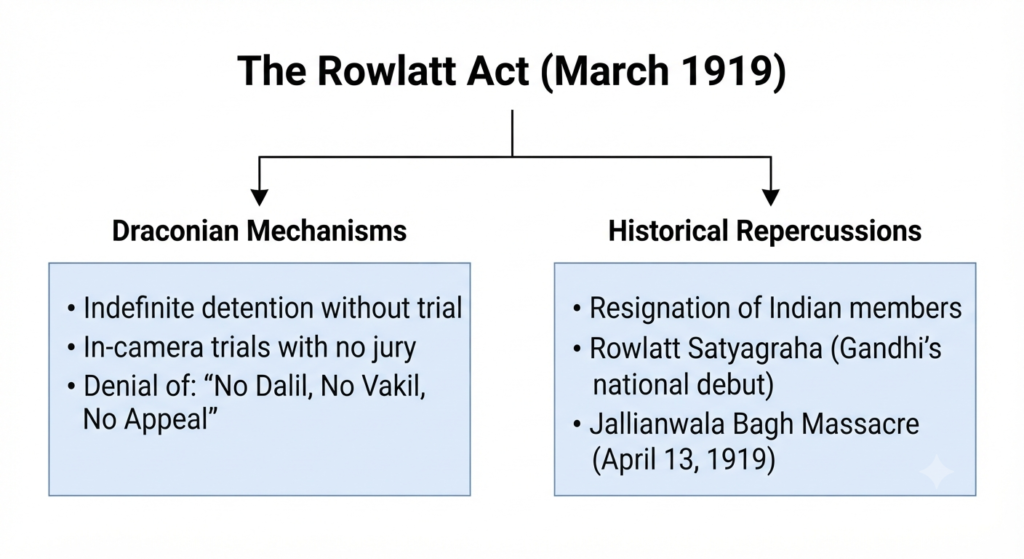
Officially known as the Anarchical and Revolutionary Crimes Act of 1919, the Rowlatt Act was passed in March 1919 by the Imperial Legislative Council. It was named after Sir Sidney Rowlatt, the British judge who chaired the Sedition Committee (1918) tasked with investigating revolutionary conspiracies and recommending measures to suppress anti-colonial agitation.
Background and Genesis
- Wartime Repression: During World War I, the colonial government enforced stringent emergency powers under the Defense of India Act 1915 to control political dissent and revolutionary conspiracies (such as the Ghadar Movement).
- The Post-War Dilemma: As the 1915 Act was due to lapse six months after the conclusion of the war, the colonial administration sought permanent, peacetime legislation to suppress rising nationalist activity.
- Passage Despite Universal Opposition: Every non-official Indian member of the Imperial Legislative Council voted against the bill. Several prominent leaders—including Mohammad Ali Jinnah, Madan Mohan Malaviya, and Mazhar-ul-Haq—resigned their council seats in protest. Jinnah condemned the law, stating that a government that enacts such a law in peacetime “forfeits its claim to be called a civilized government.”
Core Provisions of the Act
The Act suspended fundamental civil liberties and bypassed ordinary principles of criminal jurisprudence:
- Detention Without Trial: Authorized the government to arrest and detain any person suspected of “revolutionary crimes” for up to two years without trial.
- In-Camera Summary Trials: Cases were to be heard by a special panel of three High Court judges in secret (in-camera proceedings) without a jury.
- Denial of Legal Recourse: Suspects were barred from legal representation, denied the right to cross-examine witnesses, and stripped of the right to appeal to higher courts. This led to the famous popular slogan:“No Dalil, No Vakil, No Appeal” (No argument, no lawyer, no right of appeal).
- Surveillance and Restrictions: Allowed provincial authorities to search premises without a warrant, confiscate property, and restrict suspects’ residence, movement, and freedom of expression.
Political Impact and Consequences
1. Gandhi’s National Debut: The Rowlatt Satyagraha
- Recognizing that constitutional petitions were useless, Mahatma Gandhi organized the Satyagraha Sabha in February 1919.
- He called for a nationwide strike (hartal) accompanied by fasting and prayer on April 6, 1919, marking his transition from regional campaigns (Champaran, Ahmedabad, Kheda) to the undisputed leader of a pan-Indian mass movement.
2. The Crucible of Punjab and Jallianwala Bagh
- Agitation was especially intense in Punjab, driven by wartime forced recruitment and inflation.
- On April 10, 1919, the arrest and deportation of local nationalist leaders Dr. Saifuddin Kitchlew and Dr. Satyapal in Amritsar sparked public demonstrations and clashes with police.
- General Reginald Dyer imposed military rule and, on April 13, 1919 (Baisakhi), ordered his troops to fire on an unarmed crowd gathered peacefully at Jallianwala Bagh, killing hundreds.
3. Catalyst for the Non-Cooperation Movement
- The violence, followed by martial law atrocities in Punjab and the whitewash findings of the Hunter Commission, permanently alienated the Indian public from the British administration.
- Rabindranath Tagore renounced his knighthood, and Gandhi transformed from a loyal imperial collaborator into an uncompromising opponent of the Raj, launching the Non-Cooperation Movement in 1920.
In March 1922, recognizing that the legislation was completely unworkable in the face of mass resistance, the colonial government repealed the Rowlatt Act along with several other repressive wartime statutes.
Q.4 What were the effects of the Non-violent Non co-operation Movement in India? When was the Movement suspended and why? (1986)
भारत में अहिंसक असहयोग आंदोलन के क्या प्रभाव थे? आंदोलन को कब स्थगित किया गया और क्यों?
Launched in 1920 under the leadership of Mahatma Gandhi following the Nagpur Congress, the Non-Cooperation Movement (NCM)—merged with the Khilafat issue—was the first truly nationwide mass movement in India’s freedom struggle.
Effects of the Non-Cooperation Movement
1. Politicization of the Masses and the End of Fear
- Dismantling Psychological Subjugation: For the first time, millions of ordinary Indians shed their inherent fear of the colonial state, its police, and prison sentences. Jail-going became an honored badge of patriotism.
- Expanding the Social Base: The movement transcended urban drawing rooms, mobilizing peasants, industrial workers, students, urban lower-middle classes, and women into a shared anti-imperialist front.
2. Economic Impact: Heavy Blow to Colonial Commerce
- Foreign Cloth Boycott: Massive public bonfires of foreign textiles slashed the import of British manufactured cloth from roughly Rs. 102 crore in 1920–21 to Rs. 57 crore in 1921–22.
- Promotion of Swadeshi: Popularization of the spinning wheel (charkha) and khadi provided subsistence employment across rural areas, while picketing of liquor shops caused substantial losses in provincial excise revenues.
3. Creation of Alternative National Infrastructure
- National Education: Boycott of British schools led to the founding of indigenous educational institutions, including Jamia Millia Islamia, Kashi Vidyapeeth, Gujarat Vidyapith, and Bihar Vidyapeeth.
- Parallel Justice System: Lawyers like Motilal Nehru, C.R. Das, and Vallabhbhai Patel boycotted courts; local disputes were settled through Panchayats and arbitration courts.
4. Zenith of Hindu-Muslim Unity
- Aligning the nationalist campaign with the Khilafat grievance forged unprecedented fraternity between Hindus and Muslims, visible in joint processions, shared platforms, and mutual respect for socio-religious sentiments.
5. Radicalization of Regional Sub-Movements
- The anti-colonial momentum triggered autonomous local agitations across India:
- Andhra Pradesh: Alluri Sitarama Raju’s tribal rebellion in the Rampa region; the non-payment of taxes movement in Pedanandipadu.
- Punjab: The Akali Movement to liberate historic Gurdwaras from corrupt, British-backed Mahants.
- Awadh and Bihar: Agrarian insurgencies led by Baba Ramchandra against exploitative taluqdari cesses.
- Assam: Mass walkouts by tea garden laborers and railway strikes led by J.M. Sengupta.
Suspension of the Movement: When and Why
The movement was abruptly suspended by the Congress Working Committee on February 12, 1922, through the Bardoli Resolution, following the violent clash at Chauri Chaura.
1. The Immediate Catalyst: The Chauri Chaura Incident (February 4/5, 1922)
- At Chauri Chaura in the Gorakhpur district of the United Provinces, police fired upon a peaceful procession of Congress-Khilafat volunteers.
- The enraged crowd retaliated by surrounding and setting fire to the local police station, burning 22 policemen alive.
2. The Core Philosophy of Satyagraha
- For Gandhi, Non-violence (Ahimsa) was an absolute prerequisite, not an expedient tactic. He believed that adopting violent means corrupted the moral foundation of Swaraj and that a movement stained with blood lost its ethical right to exist.
- Gandhi acknowledged that he had committed a “Himalayan Blunder” by asking people to embark on mass civil disobedience before they had internalised non-violent self-restraint.
3. Strategic Realism: Preventing Brutal Colonial Repression
- Gandhi understood the tactical mechanics of the colonial state: once a mass movement turns to open violence, the British government can easily justify the use of unrestrained armed force, martial law, and mass terror.
- By calling a strategic halt himself, Gandhi denied the British armed forces an excuse to crush the nationalist organization through military massacres.
4. Movement Exhaustion and Ebbing Phase
- Historians like Bipan Chandra highlight that mass struggles cannot be sustained indefinitely at fever pitch. By early 1922, urban middle-class enthusiasm was flagging, schools and courts were reopening, and fatigue was setting in. An organized tactical retreat was necessary to regroup forces for the next phase.
While the sudden withdrawal frustrated younger and radical leaders—such as Subhas Chandra Bose (who termed it a “national calamity”), Jawaharlal Nehru, and C.R. Das—the Non-Cooperation Movement permanently transformed the Indian National Congress from a deliberative, elite body into a mass-based revolutionary organization, laying the groundwork for the Civil Disobedience Movement of 1930.
Q.5 Why did Gandhiji launch the Non-violent Non-Cooperation Movement on the Khilafat question? How were other issues joined to it later on? Discuss the constructive programme of the Non-cooperation Movement. (89/30)
खिलाफत के मसले पर गांधीजी ने अहिंसक असहयोग आंदोलन क्यों चलाया? बाद में अन्य मुद्दे इससे कैसे जुड़े? असहयोग आंदोलन के रचनात्मक कार्यक्रम की चर्चा कीजिए।
The Non-Cooperation Movement (1920–1922) marked the emergence of full-scale mass nationalism in India. By choosing to launch this confrontation on the Khilafat question, Mahatma Gandhi executed a calculated political masterstroke that transformed sectional grievances into an all-India anti-imperialist campaign.
Why Gandhiji Launched Non-Cooperation on the Khilafat Question
The Khilafat agitation arose from Indian Muslims’ anger over the harsh treatment meted out to the Ottoman Caliph (the Khalifa, spiritual head of global Islam) by the victorious Allies via the Treaty of Sèvres (1920).
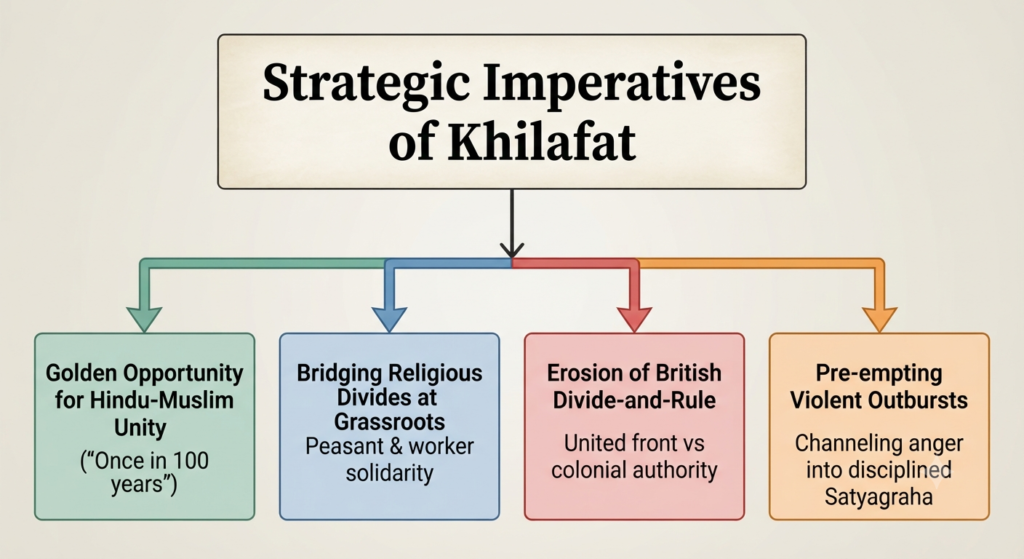
- “Opportunity of a Lifetime”: Gandhi famously observed that an opportunity to unite Hindus and Muslims on a shared political issue “would not arise in a hundred years.” He realized that championing a deeply felt emotional issue for Muslims would earn mutual trust.
- Overcoming Post-1906 Alienation: British policies had systematically fostered communal separateness through separate electorates (1909) and patronage of the Muslim League. Supporting Khilafat offered a direct antidote to imperial divide-and-rule.
- Mass Mobilization of the Muslim Cadre: The Khilafat Committee, guided by the Ali Brothers (Shaukat Ali and Mohammad Ali), Maulana Abul Kalam Azad, and Hasrat Mohani, had built a radical nationwide network that could be immediately integrated into the national struggle.
- Channeling Religious Ferment into Non-Violent Politics: Gandhi feared that if this anti-imperialist rage was not guided along the principles of Ahimsa, it would degenerate into isolated, violent uprisings that the colonial state could easily crush.
How Other Issues Were Joined to It Later On
To build a broad anti-colonial platform, Gandhi and the Congress integrated broader secular and national grievances into a three-fold demand:
| Grievance | Core Issue | Integration with Non-Cooperation |
| 1. The Khilafat Wrong | Dismemberment of the Ottoman Empire; demand to restore the Khalifa’s authority over Islamic sacred sites. | Adopted at the All-India Khilafat Conference (Delhi, Nov 1919) and ratified by the Calcutta Special Session (Sep 1920). |
| 2. The Punjab Wrong | The Jallianwala Bagh massacre (April 1919), martial law brutalities, and the official whitewash by the Hunter Committee. | Evoked universal outrage across communities, turning Punjab into an anti-imperialist stronghold. |
| 3. The Demand for Swaraj | Failure of the Montagu-Chelmsford Reforms (1919) to grant meaningful self-determination. | Added at the Nagpur Congress (Dec 1920), establishing Swaraj within one year (via peaceful means) as the supreme national goal. |
The formal convergence culminated at the Nagpur Session of December 1920, where the Congress constitution was restructured, establishing the 15-member Congress Working Committee (CWC) and Provincial Congress Committees (PCCs) organized along linguistic lines.
Constructive Programme of the Non-Cooperation Movement
Alongside the negative boycotts (boycott of councils, state schools, British courts, titles, and foreign cloth), Gandhi emphasized a positive, self-reliant Constructive Programme designed to build institutional self-sufficiency (Atmashakti).
1. Swadeshi and Khadi (Economic Emancipation)
- The Cult of the Charkha: The spinning wheel (charkha) was popularized in rural households as a tool for economic self-reliance, providing off-season employment to the peasantry.
- Tilak Swaraj Fund: Within months of B.G. Tilak’s demise, the fund was oversubscribed, raising over one crore rupees to finance charkhas, national schools, and full-time organizers.
2. National Education (Intellectual Independence)
- Parallel educational institutions were set up to accommodate students who boycotted colonial schools:
- Jamia Millia Islamia (founded at Aligarh, later moved to Delhi).
- Kashi Vidyapeeth, Bihar Vidyapeeth, and Gujarat Vidyapith.
- Prominent scholars like Acharya Narendra Deva, Dr. Zakir Husain, and Lala Lajpat Rai led these institutions.
3. Indigenous Dispute Resolution (Parallel Justice)
- Boycott of colonial courts led to the creation of Panchayats and arbitration boards to resolve civil and local disputes outside British jurisdiction.
4. Social Emancipation and Inclusivity
- Removal of Untouchability: Eradication of untouchability was made an essential condition for securing Swaraj.
- Temperance Agitation: Vigorous picketing of liquor and toddy shops targeted public vice while wiping out substantial excise revenues for provincial governments.
- Promotion of Communal Harmony: Voluntary inter-faith committees maintained public order and inter-dining during campaigns.
Historical Assessment
The alliance between the Khilafat and Non-Cooperation movements represented the high-water mark of anti-colonial mass mobilization and Hindu-Muslim unity in British India. While the eventual collapse of the Ottoman Caliphate (abolished by Mustafa Kemal Atatürk in 1924) weakened the religious alliance, the movement permanently transformed Indian nationalism from an elite constitutional lobby into an all-India mass struggle anchored in grassroots constructive action.
Q.6 Trace the origin of the Swaraj Party. What was the manifesto of the Swaraj Party? What were the Swarajists demands and the reactions of the British? (1990)
स्वराज पार्टी की उत्पत्ति का पता लगाएं। स्वराज पार्टी का घोषणापत्र क्या था? स्वराजवादियों की क्या मांगें थीं और अंग्रेजों की प्रतिक्रियाएँ क्या थीं?
The formation of the Congress-Khilafat Swarajya Party (popularly known as the Swaraj Party) in early 1923 represented a tactical shift within the Indian National Congress to keep political morale alive during the post-Non-Cooperation lull.
1. Origin of the Swaraj Party
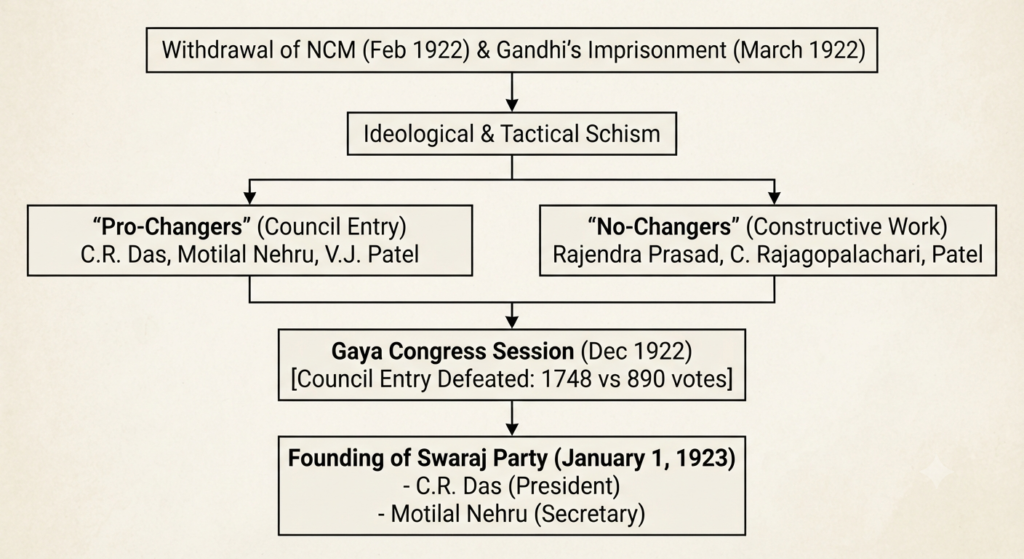
- The Political Vacuum: The abrupt suspension of the Non-Cooperation Movement (NCM) after Chauri Chaura and Gandhi’s 6-year imprisonment in March 1922 caused widespread despondency and an organizational vacuum.
- The Debate over Council Entry:
- Pro-Changers (Swarajists): Leaders like C.R. Das, Motilal Nehru, and Ajmal Khan argued that during a non-active phase of struggle, nationalists should enter the legislative councils created under the Government of India Act 1919 to “end or mend” them, exposing their undemocratic character from within.
- No-Changers: Leaders like C. Rajagopalachari, Vallabhbhai Patel, Rajendra Prasad, and M.A. Ansari opposed council entry, advocating sole focus on Gandhi’s constructive programme (Khadi, anti-untouchability, national schools).
- The Break and Formation: At the Gaya Session of the INC (December 1922), C.R. Das’s proposal for council entry was defeated. Consequently, Das resigned from the Congress presidency and, along with Motilal Nehru, announced the formation of the Congress-Khilafat Swarajya Party on January 1, 1923, operating as a group within the Congress fold to avert a repeat of the damaging 1907 Surat split.
2. Manifesto of the Swaraj Party (Released October 1923)
The Swaraj Party released its election manifesto in October 1923 ahead of the legislative elections, taking an anti-imperialist stand:
- Obstructive Politics (“Uniform, Continuous, and Consistent Obstruction”): Entered councils not to cooperate with the Government of India Act 1919, but to wreck the constitution from within by deadlocking legislative machinery.
- National Self-Determination: Demanded the immediate right of Indians to frame their own constitution through a representative assembly.
- Ultimatum to the Raj: Declared that if the British government rejected their core national demands, Swarajists would resort to uniform civil disobedience and non-cooperation inside and outside the councils.
- Preserving Private Property: Reassured landlords and capitalists that the party did not advocate class war, expropriation of private property, or radical social disruption.
3. Key Demands of the Swarajists
Led by Motilal Nehru in the Central Legislative Assembly, the Swarajists formed a coalition with the Independents (led by M.A. Jinnah) and Liberals, articulating key constitutional demands:
- National Demand for a New Constitution (February 1924): Moved a historic resolution demanding the immediate summoning of a Round Table Conference of all Indian representatives to frame a scheme for full responsible government (Dominion Status).
- Abolition of Dyarchy: Demanded the repeal of the dyarchical system in the provinces, terming it structurally defective and unworkable.
- Fiscal and Legislative Control: Demanded control over the state purse, repeatedly throwing out budgetary demands, imperial customs duties, and rejecting official financial bills.
- Release of Political Prisoners: Demanded the immediate repeal of repressive laws (such as Regulation III of 1818, the Bengal Ordinance) and the unconditional release of all political detenus.
4. Reactions of the British
The colonial administration adopted a multi-track approach to counter and neutralize the Swarajist offensive:
- Executive Autocracy and Certification: Whenever Swarajists successfully voted down budgetary allocations or rejected official bills (e.g., Finance Bills), the Viceroy and Provincial Governors invoked their emergency powers of certification and veto, nullifying the assembly votes and exposing the limits of council power.
- Appointment of the Muddiman Committee (1924): To placate council opposition without conceding real power, the British appointed the Reforms Enquiry Committee under Sir Alexander Muddiman to examine the working of Dyarchy. It was an eyewash that produced a divided report and offered minor administrative adjustments while preserving imperial supremacy.
- State Repression: The British used the Bengal Criminal Law Amendment Ordinance (1924) to arrest prominent Swarajist organizers without trial (including Subhas Chandra Bose and Anil Baran Roy) on the pretext of suppressing revolutionary terrorism.
- Encouraging Internal Fissures (Co-option & Communal Divide):
- The administration offered lucrative executive posts and committee memberships, successfully driving a wedge between orthodox Swarajists and Responsivists (such as N.C. Kelkar, M.R. Jayakar, and B.S. Moonje), who split from the party to accept government offices.
- In the Central Provinces and Bengal, where Swarajists had created legislative deadlocks, Governors suspended the transferred departments and resumed direct bureaucratic rule.
Although the Swarajists suffered from internal factionalism and could not permanently halt colonial administration due to the Viceroy’s veto powers, their agitation successfully exposed the hollowness of the 1919 Montagu-Chelmsford Reforms, prevented political apathy between 1923 and 1928, and laid the parliamentary basis for the Simon Commission’s appointment and the 1928 Nehru Report.
Q.7 What do you know about the Swadeshi Movement? (1991)
स्वदेशी आंदोलन के बारे में आप क्या जानते हैं?
The Swadeshi Movement (1905–1908) was an anti-colonial agitation sparked by Viceroy Lord Curzon’s decision to partition Bengal. It marked a turning point in the Indian national movement, shifting it from elite constitutional petitioning (“Prayers, Petitions, Protests”) to active mass mobilization and economic resistance.
1. Genesis and Historical Context
- The Trigger (Partition of Bengal): In July 1905, Lord Curzon announced the partition of Bengal, ostensibly for administrative efficiency. The real political objective was to weaken the Bengali intelligentsia and create a communal wedge between Hindu-majority Western Bengal and Muslim-majority Eastern Bengal.
- Formal Launch: On August 7, 1905, at the Calcutta Town Hall, the historic Boycott Resolution was passed, formally inaugurating the movement.
- Day of Partition (October 16, 1905): Observed across Bengal as a day of mourning, fasting (Arandhan), and unity. Rabindranath Tagore led processions singing Amar Sonar Bangla, and people tied Rakhis on one another’s wrists as a symbol of an indivisible Bengal.
2. Multi-Faceted Methods of Resistance
| Dimension | Method & Program | Key Institutions / Figures |
| Economic Boycott | Refusal to purchase British textiles, Liverpool salt, and foreign sugar; public bonfires of foreign goods. | Slashed Manchester cloth imports significantly in 1905–1906. |
| Indigenous Enterprise (Swadeshi) | Setting up indigenous industries to meet domestic demand independently of British imports. | • Banga Lakshmi Cotton Mills. • Bengal Chemical and Pharmaceutical Works (Acharya P.C. Ray). • Swadeshi Steam Navigation Company (V.O. Chidambaram Pillai in Tuticorin). |
| National Education | Defiance of the colonial Carlyle Circular (which penalized student agitators) by founding parallel indigenous educational setups. | • National Council of Education (1906). • Bengal National College (with Aurobindo Ghosh as principal). |
| Institutional Outreach | Use of voluntary corps (Samitis) for rural political education, famine relief, and dispute resolution through local arbitration courts (Salishi). | Swadesh Bandhab Samiti of Ashwini Kumar Dutta in Barisal (with 175 village branches). |
| Cultural Revival | Utilization of traditional folk theatre (Jatras), national poetry, and patriotic songs to reach the non-English-speaking public. | Songs by Rabindranath Tagore, D.L. Roy, Mukunda Das; Abanindranath Tagore’s painting of Bharat Mata. |
3. Spread and Regional Reach
Though centered in Bengal, the movement rapidly achieved an all-India character under the Extremist leadership:
- Maharashtra & Western India: Spearheaded by Bal Gangadhar Tilak, who weaponized the Ganapati and Shivaji festivals for political mobilization.
- Punjab: Led by Lala Lajpat Rai and Ajit Singh (Bharat Mata Society).
- Madras Presidency: Led by Chidambaram Pillai and Subramania Bharati.
- Delhi & Northern India: Organized by Syed Haider Raza.
4. Limitations and Reasons for Decline (by 1908)
- Severe Colonial Repression: The government cracked down through the Seditious Meetings Act (1907), Criminal Law Amendment Act (1908), bans on processions, and deportations of leaders like Lala Lajpat Rai and Tilak (sentenced to 6 years in Mandalay).
- The Surat Split (1907): Internal friction between Moderates (who wanted to confine the movement to Bengal and boycott to foreign goods) and Extremists (who wanted nationwide passive resistance) ruptured the Indian National Congress, paralyzing mainstream politics.
- Limited Peasant & Muslim Participation:
- Because the movement was closely tied to the land-owning Hindu Bhadralok, it largely avoided agrarian tenancy reforms, leaving the broader peasantry uninvolved.
- Heavy reliance on Hindu imagery (vows at Kali temples, Ganga-snan) was exploited by the British and elite Muslim leaders (such as Nawab Salimullah of Dacca), paving the way for the formation of the All-India Muslim League (1906).
- Spillover into Revolutionary Terrorism: As mass channels closed due to state suppression, educated youth turned underground, forming secret armed societies like the Anushilan Samiti and Jugantar.
Long-Term Significance
The Swadeshi Movement permanently shattered the myth of the “benevolent British Empire.” By pioneering boycott, swadeshi enterprise, national education, and passive resistance, it expanded the social base of Indian nationalism beyond elite drawing rooms and provided the practical playbook that Mahatma Gandhi later adapted into all-India mass Satyagraha.
Q.8 What do you know about the Khilafat Movement? (1991)
खिलाफत आंदोलन के बारे में आप क्या जानते हैं?
The Khilafat Movement (1919–1924) was a pan-Islamic, anti-imperialist agitation launched by Indian Muslims to pressure the British government into preserving the authority of the Ottoman Sultan as the Caliph (Khalifa) of Islam and protecting Muslim holy places following the defeat of Turkey in the First World War.
When Mahatma Gandhi merged this cause with the national freedom struggle, it formed the joint Khilafat-Non-Cooperation Movement, representing the high-water mark of Hindu-Muslim unity against colonial rule.
1. Origins and Background
- The Religious Significance: The Sultan of Turkey was revered by Sunni Muslims worldwide as the Caliph (Khalifa), the spiritual and temporal custodian of Islamic sacred sites (Jaziratal-Arab—Mecca, Medina, Jerusalem, and Iraq).
- Wartime Broken Promises: During World War I, Indian Muslims supported the British war effort only after Prime Minister David Lloyd George assured them that the integrity of the Ottoman Empire and the Khalifa’s religious sovereignty would be respected.
- The Treaty of Sèvres (August 1920): Following the war, the Allied powers partitioned Turkey, stripped the Sultan of non-Turkish territories, placed Thrace and Smyrna under Greek administration, and established imperial mandates over the Arab heartland. This betrayal sparked outrage among Indian Muslims.
2. Leadership and Core Demands
In early 1919, the All-India Khilafat Committee was formed in Bombay.
- Key Leaders: Maulana Mohammad Ali and Maulana Shaukat Ali (the Ali Brothers), Maulana Abul Kalam Azad, Mukhtar Ahmed Ansari, Hasrat Mohani, and Hakim Ajmal Khan.
- Three Core Demands:
- The Ottoman Caliph must retain sufficient territorial sovereignty to defend the Islamic faith.
- The sacred lands of Islam (Jaziratal-Arab) must remain under exclusive Muslim sovereignty, free from non-Muslim control or mandate.
- The Khalifa must retain control over Muslim holy shrines.
3. Alliance with the Indian National Congress
- Gandhi’s Vision: In November 1919, Gandhi was elected President of the All-India Khilafat Conference in Delhi. He recognized this pan-Islamic sentiment as a rare opportunity to unite Hindus and Muslims on a shared anti-imperialist platform.
- The Three-Pronged Front: Gandhi convinced the Indian National Congress to align the Khilafat grievance with two domestic issues:
- The Punjab Wrongs: The Jallianwala Bagh massacre (1919) and the Hunter Committee’s official whitewash.
- Swaraj: Self-governance for India.
- Formal Launch: In June 1920, the Khilafat Committee at Allahabad unanimously accepted Gandhi’s program of non-violent non-cooperation. It was officially endorsed by the Congress at the Calcutta Special Session (September 1920) and ratified at the Nagpur Session (December 1920).
4. Key Highlights and Mass Dynamics
- Unprecedented Communal Solidarity: Joint anti-colonial demonstrations occurred nationwide. Hindu leaders were invited to address Muslim congregations from religious pulpits—Swami Shraddhanand spoke from the pulpit of Delhi’s Jama Masjid, while Dr. Saifuddin Kitchlew was presented with the keys to the Golden Temple in Amritsar.
- Radical Tactics and Boycotts: The movement promoted boycotts of British goods, renunciation of imperial titles (Gandhi returned his Kaiser-i-Hind medal), walkouts from government schools, and the picketing of liquor and foreign cloth shops.
- The Hijrat Movement (1920): In an extreme manifestation of religious protest, around 20,000 Indian Muslims declared India Dar-ul-Harb (land of war) and undertook a migration (Hijrat) to Afghanistan. The Afghan government turned them back at the border, leading to widespread suffering and disillusionment.
5. Decline and Collapse of the Movement
The movement rapidly lost momentum between 1922 and 1924 due to both internal and external factors:
- Suspension of Non-Cooperation (February 1922): Following the Chauri Chaura violence, Gandhi abruptly called off the Non-Cooperation Movement. This unilateral withdrawal left Khilafat leaders and cadres frustrated, fracturing the political alliance.
- Communal Divergence: The communal fraternity eroded rapidly, exacerbated by the Moplah Rebellion (1921) in Malabar, which began as an anti-landlord and anti-British peasant rebellion but took on a violent communal dimension. The mid-1920s saw a wave of communal riots across northern India.
- The Turkish Revolution (The Decisive Blow): The fundamental premise of the movement was shattered by the Turks themselves. Under Mustafa Kemal Atatürk, the Turkish National Assembly:
- Overthrew the Sultanate in November 1922.
- Declared Turkey a secular republic in 1923.
- Formally abolished the Caliphate in March 1924, exiling the last Caliph, Abdulmejid II.With the institution abolished from within, the Khilafat issue ceased to exist.
Significance and Historical Legacy
- Mass Mobilization: The Khilafat agitation brought the urban and rural Muslim masses directly into the anti-colonial struggle, expanding the national movement far beyond Western-educated elites.
- Nationalist Leadership: It elevated a generation of nationalist Muslim leaders, most notably Maulana Abul Kalam Azad, who remained committed to secular, composite Indian nationalism throughout the freedom struggle.
- Limitations: Critics note that by mobilizing people around an extra-territorial, religious symbol rather than secular socio-economic grievances, the movement inadvertently legitimized religious consciousness in Indian politics, which reactionary and communal forces later exploited during the late 1920s and 1930s.
Q.9 What were the reasons that changed Gandhiji’s attitude of responsive cooperation to Non-Cooperation in 1920? What were its consequences? (1996)
वे कौन से कारण थे जिन्होंने गांधीजी के प्रतिक्रियाशील सहयोग के दृष्टिकोण को 1920 में असहयोग बदल दिया? इसके परिणाम क्या थे?
Up to late 1919, Mahatma Gandhi maintained faith in the British sense of justice. At the Amritsar Congress (December 1919), he advocated for working the Montagu-Chelmsford Reforms (Government of India Act 1919) through an attitude of “responsive cooperation.” However, within months, a sequence of betrayals and moral shocks transformed him from an imperial loyalist into an uncompromising non-cooperator, leading to the launch of the Non-Cooperation Movement (NCM) in 1920.
Reasons That Changed Gandhiji’s Attitude in 1920
1. The Betrayal of the Rowlatt Act and Jallianwala Bagh (1919)
- Instead of wartime rewards or constitutional devolution, the British enacted the Rowlatt Act (March 1919), suspending basic civil liberties (“No Dalil, No Vakil, No Appeal”).
- The Jallianwala Bagh Massacre (April 13, 1919) and the subsequent imposition of martial law in Punjab—where citizens were subjected to public floggings and forced crawling orders—shattered Gandhi’s belief in the moral legitimacy of the British Empire.
2. The Hunter Committee’s “Whitewash” Report (May 1920)
- The official Disorders Inquiry Committee (Hunter Committee) exonerated the Punjab government, treated General Dyer’s actions as merely an “error of judgment,” and imposed no legal penalty.
- When the British House of Lords praised Dyer and the British public raised a purse of £26,000 honoring him as the “Savior of the Empire,” Gandhi recognized that the colonial system lacked any internal moral conscience, declaring that:“Cooperation in any shape or form with this satanic government is sinful.”
3. The Khilafat Betrayal and the Treaty of Sèvres (August 1920)
- British Prime Minister Lloyd George had pledged during the war that the Ottoman Empire would retain its territorial integrity and control over Islamic sacred shrines (Jaziratal-Arab).
- The Treaty of Sèvres repudiated these promises, dismembering Turkey. Gandhi realized that constitutional cooperation was futile against imperial duplicity and allied with the Khilafat Committee to build a united anti-colonial struggle.
4. Flaws of the Government of India Act 1919
- The institutionalization of Dyarchy in the provinces—leaving real purse and police powers in the hands of non-elected British executive councilors while transferring resource-starved subjects to Indian ministers—convinced Gandhi that the reforms were cosmetic and designed to entrench imperial control.
Consequences of the Shift to Non-Cooperation
The shift from constitutionalism to extra-parliamentary mass action produced multi-dimensional consequences across the subcontinent:
1. Transformation of the Indian National Congress (Nagpur Session, Dec 1920)
- From Elite Club to Mass Organization: The goal of Congress shifted from “self-government within the Empire through constitutional means” to the attainment of Swaraj through peaceful and legitimate means.
- Structural Overhaul: Under Gandhi’s new constitution, the Congress formed a 15-member Congress Working Committee (CWC), established Provincial Congress Committees (PCCs) on linguistic lines, and opened membership to anyone paying a nominal 4-anna fee, institutionalizing a year-round cadre base.
2. Psychological Emancipation: Shattering the Fear of the Raj
- Millions of ordinary Indians overcame their submissive fear of colonial law, prisons, and police violence. Courting arrest and wearing coarse hand-spun Khadi became symbols of self-respect and national honor.
3. Economic and Commercial Shock to British Trade
- The nationwide boycott of foreign textiles caused the value of British cloth imports to drop from approximately Rs. 102 crore in 1920–21 to Rs. 57 crore in 1921–22.
- Indigenous handloom production surged via the popularization of the Charkha, and the Tilak Swaraj Fund collected over one crore rupees within months.
4. Zenith of Hindu-Muslim Fraternity
- The joint Khilafat-Non-Cooperation campaign forged unprecedented inter-faith solidarity. Muslim leaders shared platforms with Hindu reformers, and joint picketing closed liquor shops and foreign cloth marts nationwide.
5. Awakening of Sub-Movements and Regional Agitations
- The anti-colonial impulse triggered localized movements across India:
- Punjab: The Akali Movement to free Gurdwaras from corrupt, pro-British Mahants.
- Andhra: The Rampa Rebellion of Alluri Sitarama Raju and no-tax campaigns in Pedanandipadu.
- Awadh & Bihar: Peasant mobilizations against landlord extractions led by Baba Ramchandra.
Gandhiji’s transition from “responsive cooperation” to “non-cooperation” marked the true watershed of modern Indian history. By trading council debates and legal petitions for non-violent mass defiance, he mobilized peasants, workers, students, and women under a single banner, fundamentally transforming the national movement into a mass struggle for complete independence.
Q.10 Trace the formation of the Swaraj Party. What were its demands? (1999)
स्वराज पार्टी के गठन का वर्णन कीजिए। इसकी क्या मांगें थीं?
The establishment of the Congress-Khilafat Swarajya Party (popularly known as the Swaraj Party) on January 1, 1923, was a response to the political vacuum created by the sudden suspension of the Non-Cooperation Movement (NCM) following the Chauri Chaura incident in February 1922 and the subsequent imprisonment of Mahatma Gandhi in March 1922.
1. Tracing the Formation of the Swaraj Party
- The Post-NCM Despondency: The abrupt withdrawal of mass agitation left the nationalist ranks demoralized. A strategic debate emerged on how to maintain anti-colonial pressure during an ebbing phase of the struggle.
- The Pro-Changers vs. No-Changers Divide:
- Pro-Changers (Council Entry): Led by Chittaranjan Das, Motilal Nehru, and Hakim Ajmal Khan, they argued that nationalists should contest elections to the legislative councils established under the Government of India Act 1919. Their goal was to enter the councils to “end or mend” them, wrecking the colonial machinery from within by exposing its autocratic character.
- No-Changers (Constructive Programme): Led by C. Rajagopalachari, Vallabhbhai Patel, Rajendra Prasad, and M.A. Ansari, they advocated strict adherence to the Gandhian boycott of councils, focusing entirely on grassroots constructive work (spinning khadi, national education, and eradicating untouchability).
- Defeat at Gaya Session (December 1922): Presiding over the Gaya Congress, C.R. Das put forward the council-entry resolution, but the No-Changers defeated it decisively (1,748 to 890 votes).
- The Break and Formation (January 1, 1923): Refusing to remain inactive, C.R. Das resigned as Congress President. Along with Motilal Nehru, he announced the formation of the Congress-Khilafat Swarajya Party, with Das as President and Nehru as General Secretary.
- Averting a Surat-style Split: To avoid repeating the costly 1907 Surat split, both factions compromised. At the Delhi Special Session (September 1923) presided over by Maulana Abul Kalam Azad, Congress allowed Swarajists to contest the upcoming November 1923 elections while remaining within the parent organization. This dual strategy was formally ratified by Gandhi after his release in 1924 through the Gandhi-Das Pact.
2. Core Demands and Strategy of the Swarajists
Led by Motilal Nehru in the Central Legislative Assembly, the Swarajists formulated a coherent program combining constitutional demands with legislative obstruction:
- National Demand for Self-Government (Dominion Status):
- In February 1924, Motilal Nehru introduced the historic “National Demand” resolution in the Central Assembly, demanding that the British Government convene a Round Table Conference of all Indian representatives to frame a constitution providing full responsible government (Dominion Status).
- Immediate Scrapping of Dyarchy:
- Demanded the complete abolition of the Dyarchical structure in the provinces under the 1919 Act, exposing it as an administrative sham where ministers held responsibility without purse or administrative power.
- Fiscal and Budgetary Control:
- Demanded parliamentary control over the imperial budget. In 1924 and 1925, the Swarajists successfully threw out the official budget and rejected customs bills, forcing the Viceroy to repeatedly resort to his special powers of certification and veto, thereby demonstrating that the Raj was governed by executive fiat rather than democratic consensus.
- Repeal of Repressive and Wartime Laws:
- Demanded the immediate abrogation of draconian legislation, including Regulation III of 1818, the Bengal Criminal Law Amendment Act, and the Press Acts, alongside the unconditional release of all political prisoners and detenus.
- Protection of Indigenous Industry:
- Demanded preferential tariffs and state subsidies for domestic manufacturing, opposing currency and exchange-rate manipulations that favored British sterling over the Indian rupee.
- Uniform, Continuous, and Consistent Obstruction:
- Their manifesto declared that if the colonial government refused their core constitutional demands, the party would pursue a policy of total obstruction within the councils, rejecting all government-sponsored bills and bringing administration to a standstill.
Historical Significance
While the Swarajists’ strategy of continuous obstruction faced limitations due to the Viceroy’s certification powers and internal ideological rifts (such as the rise of the Responsivists in 1925), they successfully kept national morale alive between 1923 and 1927. By electing Vithalbhai Patel as the first Indian Speaker of the Central Legislative Assembly in 1925 and systematically blocking official legislation, the Swarajists transformed the colonial council chambers into high-visibility platforms of anti-imperialist resistance.
Q.11 Discuss the aims and objects of the Khilafat Movement. To what extent was it successful? (2001)
खिलाफत आंदोलन के लक्ष्यों और उद्देश्यों की विवेचना कीजिए। यह किस हद तक सफल रहा?
The Khilafat Movement (1919–1924) was an anti-imperialist agitation launched by Indian Muslims under the leadership of the Ali Brothers (Mohammad Ali and Shaukat Ali), Maulana Abul Kalam Azad, Hasrat Mohani, and Hakim Ajmal Khan. Alarmed by the dismemberment of the Ottoman Empire following World War I, Indian nationalists allied with Mahatma Gandhi to fuse the Khilafat grievance with the struggle for Indian self-determination.
Aims and Objectives of the Khilafat Movement
1. Preservation of the Ottoman Caliphate (Khilafat)
- The primary objective was to ensure that the Sultan of Turkey retained his position as the Caliph (Khalifa)—the spiritual and temporal head of the Sunni Islamic world—with sufficient territorial integrity and sovereign power to defend the faith.
2. Custody of Islamic Holy Shrines (Jaziratal-Arab)
- The movement demanded that the sacred territories of Islam—encompassing Arabia, Syria, Iraq, and Palestine—remain under undisputed Muslim suzerainty and not be placed under European colonial mandates or non-Muslim control.
3. Resistance to the Imperialist Partition of Turkey
- It aimed to compel the British government to honor wartime pledges made by British Prime Minister David Lloyd George, who had assured Indian Muslims that Britain was not fighting to deprive Turkey of its historical homelands in Asia Minor and Thrace. The imposition of the punitive Treaty of Sèvres (August 1920) directly provoked the agitation.
4. Anti-Imperialist Convergence and Swaraj
- Under Gandhi’s guidance (elected President of the All-India Khilafat Conference in November 1919), the objective broadened to channel religious anti-British grievances into a secular anti-colonial struggle, demanding redressal of the Punjab Wrongs (Jallianwala Bagh) and the attainment of Swaraj.
To What Extent Was the Movement Successful?
The success of the Khilafat Movement must be evaluated on two distinct planes: its immediate religious-diplomatic goals and its broader national-political impact.
1. In Terms of Immediate Religious Demands: A Complete Failure
- The Treaty of Sèvres Was Enforced: Britain and the Allied powers proceeded with dismantling the Ottoman territories, establishing British and French mandates in the Middle East regardless of Indian protests.
- Internal Demise in Turkey: The movement’s core demand was rendered obsolete by the Turkish people themselves. Under Mustafa Kemal Atatürk, the Turkish National Assembly overthrew the Sultanate (1922), declared Turkey a secular republic (1923), and abolished the Caliphate outright in March 1924, exiling the last Caliph.
- The Hijrat Catastrophe (1920): An offshoot initiative where roughly 20,000 Indian Muslims sold their properties to migrate (Hijrat) to Afghanistan as a religious protest ended in humanitarian disaster when the Afghan government turned them back at the border.
2. In Terms of Indian Anti-Colonial Mass Politics: A Major Breakthrough
- Unprecedented Hindu-Muslim Fraternity: The joint Khilafat-Non-Cooperation campaign forged the highest level of communal harmony in modern Indian history. Leaders of both communities shared sacred platforms—Swami Shraddhanand addressed Muslims from the pulpit of Delhi’s Jama Masjid, while Dr. Saifuddin Kitchlew was given the keys to the Golden Temple in Amritsar.
- Democratization and Deepening of the Mass Base: It brought millions of urban artisans, peasants, students, and orthodox ulema (via bodies like the Jamiat Ulema-e-Hind) into active agitational politics, stripping Indian nationalism of its elite, English-educated exclusivity.
- Radicalization of Nationalist Methods: The movement validated the efficacy of non-violent boycotts, surrender of titles, picketing of foreign cloth and liquor shops, and mass jail-going.
3. Long-Term Negative Ramifications
- Legitimization of Religious Consciousness in Politics: By mobilizing the masses around an extra-territorial, pan-Islamic theological issue rather than modern socio-economic grievances, the movement inadvertently legitimized religious idioms in political discourse.
- Communal Backlash Post-1922: When Gandhi abruptly suspended the Non-Cooperation Movement after the Chauri Chaura incident (February 1922), the alliance collapsed. The pent-up political energy, devoid of a constitutional outlet, soured into disillusionment and catalyzed a violent wave of communal riots across northern India (e.g., the Kohat riots) and the Moplah Rebellion (1921) in Malabar.
The Khilafat Movement failed completely in preserving the Ottoman Caliphate, as external geopolitical realities made the institution unsustainable. However, as an anti-imperialist campaign within India, it was a watershed success: it dismantled the fear of British authority, mobilized the Muslim masses into the mainstream freedom struggle, and proved that a united pan-Indian front could challenge the foundations of the colonial state.
Q.12 Form a critical assessment of the Non-Cooperation Movement. (2004)
असहयोग आंदोलन का आलोचनात्मक मूल्यांकन करें।
The Non-Cooperation Movement (1920–1922), launched under Mahatma Gandhi’s leadership following the Nagpur Congress Session (1920), represented India’s first genuine pan-Indian mass struggle against colonial rule. A critical assessment requires examining its historic achievements against its structural limitations and abrupt termination.
Historic Achievements and Transformative Impact
1. Psychological Emancipation: Shattering the Fear of the Raj
- Demystification of British Authority: The movement stripped colonial law, courts, and prison sentences of their coercive terror. Courting arrest (Jail Bharo) and donning coarse handspun Khadi were transformed into badges of honor and patriotic sacrifice.
- Mass Politicization: It brought politics out of the drawing rooms of English-educated barristers and into the rural hinterlands, mobilizing peasants, urban artisans, students, and women on an unprecedented scale.
2. Institutional Transformation of the Freedom Movement
- Restructuring the Congress (Nagpur, 1920): Under Gandhi’s new constitution, the Congress transformed into a mass, year-round operational body:
- Established a 15-member Congress Working Committee (CWC) to direct continuous action.
- Formed Provincial Congress Committees (PCCs) on linguistic lines, democratizing vernacular outreach.
- Reduced the membership fee to 4 annas, opening participation to the working classes.
- Alternative National Infrastructure: National schools and universities (Jamia Millia Islamia, Kashi Vidyapeeth, Gujarat Vidyapith) provided intellectual autonomy, while indigenous arbitration courts (Panchayats) replaced colonial litigation.
3. Economic Disruption of Colonial Commerce
- Collapse of Textile Imports: The nationwide boycott and public bonfires of foreign cloth reduced the value of imported British textiles from Rs. 102 crore in 1920–21 to Rs. 57 crore in 1921–22.
- Financial Self-Reliance: The Tilak Swaraj Fund collected over one crore rupees within months, financing the distribution of spinning wheels (charkhas) and sustaining full-time cadres.
4. Awakening Autonomous Regional Sub-Movements
- The anti-imperialist impulse triggered localized struggles:
- Andhra: The Rampa Rebellion of Alluri Sitarama Raju and no-tax campaigns in Pedanandipadu.
- Punjab: The Akali Movement to wrest control of historic Gurdwaras from corrupt, British-backed Mahants.
- Awadh and Bihar: Peasant mobilizations against landlord extractions led by Baba Ramchandra.
Critical Limitations and Strategic Shortcomings
| Dimension | Critical Limitation | Real-World Impact |
| Unrealized Core Goal | “Swaraj in One Year” proved unachievable. | Gandhi’s promise raised expectations; its failure created widespread post-movement demoralization and cynicism among the youth. |
| Fragile Foundation of Communal Unity | Alliance built on the pan-Islamic Khilafat issue rather than secular socio-economic integration. | When the movement collapsed and Mustafa Kemal Atatürk abolished the Caliphate (1924), pent-up political energy devolved into communal riots across northern India (e.g., Kohat riots) and the Moplah Rebellion (1921) in Malabar. |
| Uneven Social Mobilization | Big industrial capitalists remained ambivalent; big zamindars actively opposed the movement. | Fearing class radicalism, the Congress Working Committee explicitly reassured landlords (Bardoli Resolution) that it did not endorse non-payment of rent, keeping peasant radicalism constrained. |
| The Shock of Abrupt Suspension | Called off unilaterally after the Chauri Chaura violence (February 1922). | Stunned top leaders (Subhas Bose called it a “national calamity”; Motilal Nehru and C.R. Das formed the Swaraj Party in protest), revealing the fragility of top-down command over mass outbursts. |
Strategic Realism Behind the Withdrawal
While critics from Subhas Chandra Bose to contemporary Marxists argued that Gandhi arrested a developing mass revolution just as it reached a peak, modern historians like Bipan Chandra offer a realistic reappraisal:
- The Dynamics of Mass Movements: Mass movements cannot remain at peak intensity indefinitely; fatigue was already evident by early 1922, with middle-class attendance dropping and schools reopening.
- Averting State Terror: Open violence at Chauri Chaura provided the colonial state with the pretext to deploy unrestrained military force. By executing a disciplined retreat, Gandhi denied the British armed forces an excuse to crush the infant nationalist organization.
The Non-Cooperation Movement did not deliver immediate Swaraj, but it achieved something more lasting: it permanently shifted the nationalist struggle from constitutional reformism within the Empire to active mass confrontation. By forging a cadre-based party, building indigenous institutions, and mobilizing the masses across class and regional divides, the movement laid the essential foundation for the Civil Disobedience Movement of 1930 and the eventual dismantlement of British rule.
Q.13 Do you think Mahatma Gandhi’s support to Khilafat Movement had diluted his secular credentials? Give your argument based on the assessment of events. (2007)
क्या आपको लगता है कि खिलाफत आंदोलन को महात्मा गांधी के समर्थन ने उनकी धर्मनिरपेक्ष साख को कमजोर कर दिया था? घटनाओं के आकलन के आधार पर अपना तर्क दीजिए।
Mahatma Gandhi’s decision to champion the Khilafat cause (1919–1922) is one of the most debated episodes in modern Indian historiography. Critics argue that by championing an extraterritorial, theological issue, Gandhi inadvertently legitimized religious idioms in politics. Conversely, defenders argue that his intent was rooted in composite nationalism (Sarva Dharma Sambhava), aiming to forge an anti-imperialist mass alliance.
Assessing whether this diluted his secular credentials requires evaluating his philosophical framework alongside the historical outcomes of the movement.
Arguments That Gandhi’s Stance Diluted Secular Principles
Historians such as B.R. Ambedkar, contemporary critics like Mohammad Ali Jinnah, and later nationalist commentators pointed out several secular vulnerabilities in Gandhi’s strategy:
- Legitimizing Pan-Islamic and Extra-Territorial Identity: The movement mobilized Indian Muslims not around domestic civic or economic demands, but around the restoration of the Ottoman Sultan’s religious-political authority over Islamic holy lands (Jaziratal-Arab). This institutionalized the idea that religious affiliation took precedence over territorial nationalism.
- Empowering Orthodox Clergy over Modern Nationalists: Gandhi allied directly with the conservative Ulema (crystallized in the Jamiat Ulema-e-Hind) and populist leaders like the Ali Brothers, deliberately sidelining constitutionalist, secular Muslim leaders like Mohammad Ali Jinnah, who warned against introducing religious passion into political agitation.
- Communal Fallout Post-Suspension: When Gandhi unilaterally withdrew the Non-Cooperation Movement after Chauri Chaura (February 1922), the emotionally charged religious mass energy had no political outlet. It curdled into communal frustration, contributing directly to:
- The Moplah Rebellion (1921) in Malabar, which deteriorated from an agrarian revolt into communal violence against Hindu landlords.
- The severe wave of communal riots across northern India (1922–1927), including the Kohat and Multan riots, alongside the rise of revivalist bodies like the Shuddhi/Sangathan and Tabligh/Tanzim movements.
Counter-Arguments: The Inclusive and Anti-Imperialist Defense
Defenders of Gandhi’s strategy point out that his actions must be judged against the colonial reality of the era and his distinct definition of secularism:
1. Indian Secularism as Equal Respect (Sarva Dharma Sambhava)
- Unlike Western secularism (which demands a strict wall of separation between church and state), Gandhi’s political philosophy was rooted in moralized politics. For Gandhi, politics divorced from religion/morality was a “death-trap.”
- He viewed supporting Muslims in their hour of religious distress as an ethical duty of the majority community to build unconditional trust, famously terming it an opportunity to unite the communities that “would not arise in a hundred years.”
2. Channeling Religious Ferment into Non-Violence
- The Muslim masses were deeply agitated by the dismemberment of the Ottoman Empire following the Treaty of Sèvres. Gandhi feared this unrest would erupt into violent, uncoordinated insurrections that the British military could easily crush. By assuming leadership, he steered this fervor into non-violent Non-Cooperation (Ahimsa).
3. Secular Anti-Imperialist Convergence
- Gandhi did not support Khilafat in isolation. At the Nagpur Congress (1920), he integrated the Khilafat demand with two secular national objectives:
- Redressal of the Punjab Wrongs (the Jallianwala Bagh massacre and the Hunter Commission whitewash).
- Attainment of Swaraj (Self-rule).
- This unified platform produced the high-water mark of inter-communal fraternity: Swami Shraddhanand addressed Muslims from the pulpit of Delhi’s Jama Masjid, while Dr. Saifuddin Kitchlew received the keys to the Golden Temple in Amritsar.
Balanced Historical Assessment
| Dimension | Assessment |
| Personal Secular Intent | Undiluted. Gandhi remained steadfastly committed to a plural, multi-faith India, consistently risking his life to defend minority rights until his martyrdom in 1948. |
| Strategic/Structural Outcome | Compromised. By mobilizing the masses through an orthodox theological symbol rather than shared socio-economic grievances, the campaign gave religious consciousness political legitimacy that outlived the temporary alliance. |
Mahatma Gandhi’s personal commitment to secularism and composite nationalism remained uncompromised. However, his tactical choice had unintended consequences: while it forged a powerful anti-colonial front, it legitimized the entry of religious orthodoxy into mass politics, leaving a fragile foundation that communal forces exploited once the anti-imperialist tide receded.
Q.14 Do you think Mahatma Gandhi’s support to Khilafat Movement had diluted his secular credentials? Give your argument based on the assessment of events. (2007)
क्या आपको लगता है कि खिलाफत आंदोलन को महात्मा गांधी के समर्थन ने उनकी धर्मनिरपेक्ष साख को कमजोर कर दिया था? घटनाओं के आकलन के आधार पर अपना तर्क दीजिए।
Mahatma Gandhi’s decision to adopt the Khilafat cause (1919–1922) is one of the most critical debates in Indian national historiography. Critics argue that by championing an extraterritorial, theological grievance, Gandhi inadvertently injected religious orthodoxy into political mobilization. Conversely, defenders contend that his overarching goal was composite nationalism (Sarva Dharma Sambhava), designed to build an all-India anti-imperialist front.
Evaluating whether this diluted his secular credentials requires separating his ideological philosophy from the historical and structural outcomes of the campaign.
Arguments That Gandhi’s Support Diluted Secular Principles
Historians such as B.R. Ambedkar, contemporary critics like Mohammad Ali Jinnah, and later nationalist commentators pointed to significant compromises in the secular architecture of the freedom struggle:
- Legitimation of Pan-Islamic, Extra-Territorial Identity:
- The movement was anchored not in domestic socio-economic issues, but in preserving the religious and temporal power of the Ottoman Caliph (Khalifa) over Islamic holy lands (Jaziratal-Arab).
- Mobilizing masses on extra-territorial religious grounds prioritized communal affiliation over secular, territorial Indian citizenship.
- Empowering Orthodox Clergy Over Secular Constitutionalists:
- Gandhi forged direct alliances with orthodox religious bodies like the Jamiat Ulema-e-Hind and populist clerics rather than modern, Western-educated constitutionalists.
- Secular leaders like Mohammad Ali Jinnah warned Gandhi at the Nagpur Congress (1920) against mixing religious zealotry with political agitational programs, cautioning that it would lead to reactionary division.
- Post-Withdrawal Communal Fractures:
- When Gandhi abruptly withdrew the Non-Cooperation Movement after the Chauri Chaura incident (February 1922), the religious passions mobilized by the campaign lost their unified anti-colonial channel.
- This vacuum curdled into disillusionment and communal friction:
- The Moplah Rebellion (1921) in Malabar, which began as an anti-landlord revolt, took on violent communal overtones.
- A severe wave of communal riots swept northern India (1922–1927), accompanied by the rise of revivalist and paramilitary bodies (Shuddhi/Sangathan and Tabligh/Tanzim).
Counter-Arguments: The Inclusive and Anti-Imperialist Defense
A comprehensive reading of Gandhi’s philosophy suggests that his alliance was rooted in an alternative, deeply Indian paradigm of secularism:
1. Gandhi’s Concept of “Moralized Politics” (Sarva Dharma Sambhava)
- Unlike the Western doctrine of secularism—which enforces a rigid separation of church and state—Gandhi viewed politics without morality or religion as a “death-trap.”
- For him, standing in solidarity with Muslim compatriots during an acute religious and political crisis was an ethical imperative to earn inter-faith trust, famously calling it an opportunity to unite the two major communities that “would not arise in a hundred years.”
2. Channeling Mass Religious Unrest into Non-Violence
- Following the Treaty of Sèvres, anger among Indian Muslims ran high. Gandhi realized that if left unguided, this discontent could erupt into isolated, violent insurrections that colonial authorities could suppress through military terror.
- By integrating the agitation into the Indian National Congress, he subordinated mass religious sentiment to the strict discipline of non-violent Non-Cooperation (Ahimsa).
3. Integration of Secular National Objectives
- Gandhi did not support Khilafat in isolation. At the Nagpur Congress (December 1920), he merged Khilafat with two core secular demands:
- Redressal of the Punjab Wrongs (the Jallianwala Bagh massacre and the Hunter Commission whitewash).
- The attainment of Swaraj (Self-rule).
- This unified platform achieved the highest level of communal harmony in modern Indian history: Swami Shraddhanand was invited to speak from the pulpit of Delhi’s Jama Masjid, while Dr. Saifuddin Kitchlew was presented with the keys to the Golden Temple in Amritsar.
Balanced Assessment
| Dimension | Critical Verdict |
| Personal Secular Intent | Undiluted. Gandhi remained dedicated to a pluralistic, multi-faith India, repeatedly risking his life to protect minority communities until his martyrdom in 1948. |
| Structural / Political Fallout | Compromised. Mobilizing the public through an orthodox theological symbol rather than common socio-economic grievances inadvertently legitimized religious consciousness in politics, leaving a communal vulnerability that reactionary forces exploited once the anti-imperialist tide ebbed. |
Gandhi’s personal secular convictions were not diluted; rather, his tactical strategy carried unintended structural costs. While it successfully created an unprecedented pan-Indian anti-imperialist front, it bypassed secular political modernization in favor of religious mobilization, creating fault lines that subsequent communal forces leveraged in the decades leading to 1947.
Q.15 Evaluate the contribution of revolutionary terrorism represented by Bhagat Singh to the cause of India’s struggle for independence. (150 words) (2007)
भारत के स्वतंत्रता संग्राम में भगत सिंह द्वारा प्रस्तुत क्रांतिकारी आतंकवाद के योगदान का मूल्यांकन कीजिए।
The revolutionary stream of the 1920s and 1930s, spearheaded by Bhagat Singh and the Hindustan Socialist Republican Association (HSRA), marked a fundamental qualitative shift from the early “cult of the bomb” toward a conscious, scientific, and socialist anti-imperialist movement.
Operating alongside the mainstream Indian National Congress, Bhagat Singh redefined both the meaning of Swaraj and the methods required to achieve it.
Core Contributions to the Freedom Struggle
1. Ideological Transformation: From Individual Heroism to Scientific Socialism
- Redefining the Objective of Independence: In September 1928, at Feroz Shah Kotla (Delhi), under Bhagat Singh and Chandrashekhar Azad, the HRA was renamed the Hindustan Socialist Republican Association (HSRA).
- Beyond Constitutional Transfer of Power: Bhagat Singh emphasized that merely replacing British rulers with brown rulers was not true freedom. In his trial statements and writings, he defined revolution as:“The abolition of the exploitation of man by man, and of nation by nation.”
- He linked India’s anti-colonial struggle directly to the global anti-capitalist movement, championing the dictatorship of the proletariat and an agrarian-industrial republic led by peasants and workers.
2. Direct Action as “Propaganda by Deed”
- Unlike earlier revolutionaries who operated purely in secret, Bhagat Singh used targeted political acts not to spread terror, but to politicize the masses:
- The Saunders Assassination (Lahore, 1928): Executed alongside Rajguru and Azad to avenge the death of Lala Lajpat Rai (who died following a police lathi-charge during anti-Simon Commission protests). This restored national pride and showed that imperial brutality would not go unanswered.
- Central Legislative Assembly Bombing (April 8, 1929): Along with Batukeshwar Dutt, Bhagat Singh threw harmless smoke bombs into the empty spaces of the Assembly to protest the passage of the repressive Public Safety Bill and Trade Disputes Bill. Leaflets dropped in the chamber quoted the French anarchist Auguste Vaillant: “It takes a loud voice to make the deaf hear.”
3. Weaponizing the Courtroom and Hunger Strikes
- The Court as an Ideological Tribune: Refusing to plead for mercy or escape, Bhagat Singh and Dutt courted arrest to turn the colonial courtroom into an all-India political platform, making the slogan “Inquilab Zindabad” (Long Live the Revolution) the primary battle-cry of Indian youth.
- The Historic Lahore Hunger Strike (1929): Demanded that political prisoners be treated humanely and granted basic rights (books, newspapers, hygiene) rather than classified as common criminals. The martyrdom of Jatin Das after a 63-day fast ignited nationwide demonstrations and exposed colonial prison brutality.
4. Uncompromising Secularism and Scientific Rationality
- Naujawan Bharat Sabha (1926): Founded by Bhagat Singh as an open mass organization for youth, it banned communal elements and organized inter-communal dining to eradicate caste and religious boundaries.
- Rationalist Critique: In his seminal essay, Why I Am an Atheist (1930), Bhagat Singh rejected religious dogma, superstition, and communalism, warning that religious polarization was the greatest internal threat to Indian freedom.
Critical Limitations and Dilemmas
| Dimension | Critical Limitation | Real-World Impact |
| Tactical Paradox | Reliance on vanguard direct actions (assassinations and bombings). | Even while theoretically rejecting individual terrorism in favor of mass revolution, time constraints forced them into vanguard actions before mass worker-peasant unions could be fully mobilized. |
| Organizational Vulnerability | Vulnerable to police infiltrators and approvers. | Secrecy prevented broad public defense infrastructure; approvers (like Phanindra Nath Ghosh) enabled the British to dismantle the HSRA network rapidly. |
| Premature Elimination of Cadres | Heavy executions and encounters (Bhagat Singh, Rajguru, Sukhdev hanged on March 23, 1931; Chandrashekhar Azad martyred at Alfred Park). | Deprived the emerging Indian Left of its most charismatic, articulate, and mass-appealing leadership during the crucial 1930s. |
Enduring Historical Legacy
Bhagat Singh provided the Indian freedom struggle with an intellectual and socialist compass. His martyrdom at the age of 23 generated immense mass sentiment—so much so that at the Karachi Session of the Congress (March 1931), the party was compelled to pass the historic Resolution on Fundamental Rights and the National Economic Programme, absorbing the socialist and pro-worker demands that Bhagat Singh and the HSRA had fought to normalize.
Q.16 “Non-Cooperation Movement gave new direction and energy to the National Movement.” Explain. (150 words) (2008)
“असहयोग आंदोलन ने राष्ट्रीय आंदोलन को नई दिशा और ऊर्जा दी।” व्याख्या कीजिए।
The Non-Cooperation Movement (1920–1922) under Mahatma Gandhi transformed the Indian national movement from an elite, deliberative lobby into a militant, all-India mass struggle. By redefining the goals, methods, and organizational architecture of the Indian National Congress (INC), it infused the anti-colonial struggle with unprecedented strategic direction and popular energy.
How It Gave a “New Direction” to the National Movement
A. Doctrinal Shift: From Constitutional Agitation to Open Defiance
- Before 1920, nationalist action alternated between Moderate constitutional petitions (“Prayers, Petitions, Protests”) and periodic Extremist boycott campaigns.
- Non-Cooperation established extra-constitutional, non-violent mass defiance as the primary mode of anti-imperialist resistance. The objective at the Nagpur Session (December 1920) formally evolved from self-government within the empire through constitutional methods to the attainment of Swaraj by peaceful and legitimate means.
B. Organizational Modernization (The Nagpur Constitution)
- Gandhi converted the Congress from a three-day annual convention into a year-round, cadre-based mass political party:
- Formed the 15-member Congress Working Committee (CWC) to direct day-to-day political actions.
- Reorganized Provincial Congress Committees (PCCs) along linguistic lines, bridging the gap between urban leaders and vernacular-speaking masses.
- Reduced the annual membership fee to a nominal 4 annas, opening party membership to the working classes and peasantry.
C. Establishing Alternative National Infrastructure
- Resistance was linked with constructive nation-building:
- National Education: Boycotts of state institutions led to the founding of independent universities—Jamia Millia Islamia, Kashi Vidyapeeth, Gujarat Vidyapith, and Bihar Vidyapeeth.
- Indigenous Dispute Resolution: Boycott of British courts was paired with local Panchayats and arbitration tribunals.
- Economic Self-Reliance: The spinning wheel (charkha) and khadi provided a universal uniform and decentralized rural employment, backed by the oversubscribed Tilak Swaraj Fund (which crossed Rs. 1 crore).
2. How It Infused “New Energy” into the Struggle
A. Psychological Liberation: Demystifying the Fear of the Raj
- The movement stripped colonial law and penal institutions of their psychological terror. Going to prison (Jail Bharo) ceased to be a social disgrace and became a recognized mark of patriotism.
- As Jawaharlal Nehru noted in The Discovery of India, Gandhi lifted the deadweight of fear that had paralyzed Indian society since the 1857 revolt.
B. Widening the Social Base of Nationalism
- The Peasantry: Peasants integrated their local agrarian grievances (e.g., Baba Ramchandra in Awadh, no-revenue protests in Pedanandipadu, Andhra) into the broader demand for Swaraj.
- Working Class and Urban Youth: Triggered large-scale strikes across railways, steamships, and textile mills; students deserted government-aided colleges to become full-time national volunteers.
- Entry of Women: Middle-class and rural women broke centuries of seclusion (purdah) to picket liquor shops, organize foreign cloth bonfires, and contribute household savings to the national fund.
C. Unprecedented Communal Solidarity
- By incorporating the Khilafat grievance, the movement forged the highest degree of Hindu-Muslim unity seen in modern Indian history. Leaders shared public platforms and religious pulpits (e.g., Swami Shraddhanand addressing congregations from Delhi’s Jama Masjid), proving that cross-community anti-imperialist alliances were operationally viable.
D. Ignition of Regional and Subaltern Movements
- The energy of Non-Cooperation spilled over into autonomous local movements:
- Punjab: The Akali Movement to liberate historic Gurdwaras from corrupt, British-backed Mahants.
- Andhra: Alluri Sitarama Raju’s tribal insurgency in the Rampa region against forest regulations.
- Assam: Mass walkouts of indentured laborers from British-owned tea plantations.
While the abrupt withdrawal of the movement after the Chauri Chaura incident (February 1922) left immediate political goals unfulfilled, the movement’s permanent legacy was structural: it dismantled the myth of British moral superiority, created an all-India party organization, and proved that millions of ordinary citizens could be mobilized for disciplined political action. This groundwork made subsequent nationwide struggles—the Civil Disobedience Movement (1930) and the Quit India Movement (1942)—historically possible.
Q.17 Highlight the importance of the new objectives that got added to the vision of Indian independence since twenties of the last century. (2017)
पिछली शताब्दी के बीसवें दशक से भारतीय स्वतंत्रता की दृष्टि में जोड़े गए नए उद्देश्यों के महत्व पर प्रकाश डालें।
Prior to the 1920s, the vision of Indian independence was largely confined to constitutional reforms, administrative Indianization, and self-government within the British Empire (Dominion Status). The 1920s marked an ideological watershed: influenced by the Russian Revolution (1917), global anti-colonial movements, the rise of the Indian Left, and grassroots agrarian distress, the national movement radically redefined the meaning, scope, and character of Swaraj.
Key New Objectives Added to the Vision of Independence
1. Purna Swaraj: Uncompromising, Complete Sovereign Independence
- Break from Dominion Status: Led by younger leaders like Jawaharlal Nehru and Subhas Chandra Bose, the movement rejected dominion status within the British Empire.
- Institutional Adoption: After the rejection of the Nehru Report’s compromise deadline, the Lahore Congress (1929) formally declared Purna Swaraj (Complete Independence) as the non-negotiable goal, celebrating January 26, 1930, as the first Independence Day.
2. Socialist Framework and Egalitarian Socio-Economic Order
- Redefining Freedom: Independence was no longer viewed as merely replacing white rulers with brown rulers. Influenced by Marxist thought, leaders like Bhagat Singh (HSRA), Nehru, and the Congress Socialist Party (CSP, 1934) argued that Swaraj was meaningless without the abolition of class exploitation.
- The Karachi Resolution (1931): Presided over by Sardar Vallabhbhai Patel, the Karachi Session adopted the historic resolution on Fundamental Rights and the National Economic Programme, stating:“In order to end the exploitation of the masses, political freedom must include real economic freedom of the starving millions.”
- It committed independent India to civil liberties, free primary education, universal adult franchise, living wages, and state control of key industries and mineral resources.
3. Agrarian Reform and Radical Peasant Mobilization
- Abolition of Feudalism: The rise of autonomous peasant platforms, culminating in the formation of the All India Kisan Sabha (1936) under Swami Sahajanand Saraswati, forced the mainstream nationalist vision to include:
- Complete abolition of the Zamindari system and feudal cesses.
- Reduction of land revenue and rent by at least 50%.
- Moratorium on agricultural debts and security of tenancy (Ryotwari rights to tillers).
- These agrarian demands were formally integrated into Congress policy via the Faizpur Agrarian Programme (1936).
4. Industrial Democracy and Working-Class Rights
- With the growth of the All India Trade Union Congress (AITUC, 1920) and communist-led unions (e.g., Girni Kamgar Union), the vision of free India incorporated fundamental labor protections:
- Right to form trade unions and the right to strike.
- Prohibition of child labor and regulation of working hours.
- Social security mechanisms for sickness, old age, and maternity.
5. National Economic Planning and Industrial Modernization
- Moving away from purely laissez-faire or backward-looking economic notions, the late 1930s prioritized scientific state planning.
- In 1938, Congress President Subhas Chandra Bose established the National Planning Committee (NPC) under Jawaharlal Nehru, introducing the vision of a state-directed, planned mixed economy capable of eradicating mass poverty and building heavy industrial infrastructure post-independence.
6. Secular Statehood and Universal Citizenship
- In response to rising communal polarizations in the 1920s and separate electorates, the national movement explicitly codified a secular state as an objective:
- Strict state neutrality toward all religions.
- Absolute protection of minority cultural, linguistic, and educational rights (first articulated systematically in the Nehru Report, 1928 and reaffirmed at Karachi, 1931).
7. Anti-Imperialist Internationalism
- The vision of independent India was integrated with the broader global struggle against imperialism, fascism, and racism:
- Congress participated in the Brussels Congress of the League Against Imperialism (1927).
- Sent the Congress Medical Mission to China (1938) led by Dr. Kotnis during Japanese aggression and openly opposed Spanish fascism, framing India’s independence as part of global human liberation.
Historical Significance of These New Objectives
| Dimension | Transformation |
| Mass Mobilization | Expanding beyond constitutional rhetoric gave peasants and workers a concrete material stake in the struggle, transforming nationalism into a mass movement. |
| Constitutional Blueprint | Objectives formulated between 1928 and 1938 directly became the foundation for the Preamble, Fundamental Rights (Part III), and Directive Principles of State Policy (Part IV) of the Constitution of India. |
| Post-Colonial Trajectory | Laid the institutional framework for post-1947 state policy—democratic socialism, agrarian land reforms, the Planning Commission, and the Non-Aligned Movement (NAM). |
The addition of these radical socio-economic objectives from the 1920s onward ensured that the Indian freedom struggle evolved from a narrow campaign for political transfer of power into a comprehensive socio-economic revolution, laying the ideological foundation of modern democratic and egalitarian India.
Q.18 Since the decade of the 1920s, the national movement acquired various ideological strands and thereby expanded its social base. Discuss. (2020, 15 marks)
1920 के दशक के बाद से, राष्ट्रीय आंदोलन ने विभिन्न वैचारिक पहलुओं को प्राप्त किया और इस तरह अपने सामाजिक आधार का विस्तार किया। चर्चा करें।
Prior to the 1920s, the Indian national movement was dominated predominantly by elite constitutionalism and middle-class urban nationalism. The decade of the 1920s served as an ideological and demographic watershed: catalyzed by the Bolshevik Revolution (1917), post-World War I economic distress, the withdrawal of the Non-Cooperation Movement, and the global spread of anti-imperialist ideas, nationalism fractured into multiple radical currents.
These ideological strands mobilized diverse socioeconomic classes—peasants, factory workers, lower castes, youth, and women—broadening the freedom struggle into a multi-class mass movement.
1. Emergence of the Left: Marxist and Socialist Currents
- Formation of Working-Class Platforms: The founding of the Communist Party of India (CPI) at Tashkent (1920) and Kanpur (1925) by M.N. Roy, Muzaffar Ahmad, and S.A. Dange injected Marxist theory into Indian politics.
- Trade Union Mobilization: The establishment of the All India Trade Union Congress (AITUC, 1920) and militant unions like the Girni Kamgar Union (Bombay) brought industrial workers into the political forefront. Massive general strikes in Bombay textile mills and the railways (1928) paralyzed colonial infrastructure.
- Congress Socialist Party (CSP, 1934): Left-wing nationalists within the Congress—led by Jawaharlal Nehru, Subhas Chandra Bose, Jayaprakash Narayan, and Acharya Narendra Deva—ensured that national independence was linked to structural social transformation, culminating in the Karachi Resolution (1931) on fundamental economic rights.
- Social Base Expanded: Urban factory proletariat, mill workers, dockers, and socialist-oriented youth.
2. Scientific Revolutionary Socialism: Bhagat Singh and the HSRA
- From Assassinations to Mass Struggle: Moving past early religious-revivalist revolutionary trends, the Hindustan Socialist Republican Association (HSRA, 1928) explicitly adopted scientific Marxism under Bhagat Singh, Chandrashekhar Azad, and Sukhdev.
- Redefining Swaraj: Revolution was defined as the end of exploitation of man by man. The Naujawan Bharat Sabha (1926) broke caste barriers through public community dining and mass lectures.
- Mass Awakening via Sacrifice: Court statements, the Assembly Bomb Case (1929), and the Lahore conspiracy trial popularized anti-capitalist slogans like “Inquilab Zindabad” throughout educational institutions.
- Social Base Expanded: Radical students, urban youth, young intellectuals, and working-class sympathizers.
3. Agrarian Radicalism and Autonomous Peasant Movements
- Break from Landlordist Constraints: While mainstream Congress mobilization remained cautious about upsetting rural landlords, the 1920s saw autonomous peasant mobilizations:
- Eka Movement (1921): Led by Madari Pasi across Awadh, rallying tenant farmers against illegal cesses (abwabs).
- Bardoli Satyagraha (1928): Led by Vallabhbhai Patel, uniting landowning Patidar peasants and depressed agricultural laborers (Dublas) against excessive revenue assessments.
- All India Kisan Sabha (1936): Founded by Swami Sahajanand Saraswati, N.G. Ranga, and Indulal Yagnik, it pressured the Congress to adopt the Faizpur Agrarian Programme (1936) demanding the abolition of the Zamindari system.
- Social Base Expanded: Tenant farmers, smallholders, and landless agricultural laborers across Bihar, Bengal, Andhra, and UP.
4. Anti-Caste, Subaltern, and Dalit Assertions
- Self-Respect and Depressed Classes Assertions: The 1920s saw low-caste groups mobilize around dignity and civil rights:
- Dr. B.R. Ambedkar’s Mahad Satyagraha (1927): Asserted civic rights to public water sources, later leading to the burning of the Manusmriti and the formation of the Independent Labour Party (1936).
- Self-Respect Movement (1925): Launched by E.V. Ramasamy ‘Periyar’ in Madras against Brahmanical hegemony.
- Gandhian Social Integration: Responding to these pressures, Gandhi launched the Harijan Sevak Sangh (1932) and undertook all-India anti-untouchability tours, making caste reform central to constructive nationalist work.
- Social Base Expanded: Depressed classes, Dalits, and non-Brahmin backward castes who had previously remained outside mainstream politics.
5. Women’s Mass Vanguard in Direct Action
- Breaking the Purdah: From picketing foreign cloth and liquor stores during the Non-Cooperation Movement to actively breaking laws during the Civil Disobedience Movement (1930), women entered public politics in record numbers.
- Revolutionary Contributions: Women like Kalpana Datta, Pritilata Waddedar (Chittagong Armoury Raid), Bina Das, and Kamaladevi Chattopadhyay played frontline roles in armed and mass civil resistance.
- Institutional Formation: The founding of the All India Women’s Conference (AIWC, 1927) linked national liberation to female franchise and personal law reform.
- Social Base Expanded: Rural peasant women, middle-class housewives, and female students.
6. Capitalist and Business Class Integration
- National Bourgeois Support: Recognizing that imperial currency manipulation (such as the 1s 6d rupee ratio) and British tariffs favored foreign imports, indigenous industrialists organized under the FICCI (1927), led by G.D. Birla and Purshottamdas Thakurdas.
- Financial and Political Backing: They funded the Congress constructive program and backed nationalist demands in the central legislature while urging a constitutional transition to stability.
- Social Base Expanded: Indigenous merchants, textile mill owners, and the trading bourgeoisie.
Synthesis of Ideological and Social Expansion
| Ideological Strand | Key Organizations / Figures | Newly Mobilized Social Segments |
| Marxism & Socialism | CPI, AITUC, CSP (Nehru, Bose, JP) | Industrial labor, trade unionists, radical youth |
| Revolutionary Socialism | HSRA, Naujawan Bharat Sabha (Bhagat Singh) | Students, urban youth, anti-clerical youth |
| Agrarian Mobilization | Eka Movement, AIKS (Swami Sahajanand) | Tenants, small peasants, agricultural laborers |
| Anti-Caste & Dalit Assertion | Mahad Satyagraha (Ambedkar), Self-Respect (Periyar) | Depressed Classes (Harijans), non-Brahmin backward classes |
| Gender & Social Reform | AIWC, Desh Sevika Sangh (Pritilata, Kamaladevi) | Housewives, educated urban women, rural women |
| Nationalist Capitalism | FICCI (G.D. Birla, Purshottamdas) | Indigenous industrialists, merchants, financiers |
The 1920s fundamentally transformed the Indian national movement from an elite campaign for administrative concessions into an inter-sectional, multi-class mass movement. By assimilating diverse social demands—workers’ rights, land to the tiller, caste equality, and women’s emancipation—the freedom struggle built the social base and ideological foundations that shaped the democratic, socialist, and secular Constitution of independent India.
Q.19 Bring out the constructive programmes of Mahatma Gandhi during Non-Cooperation Movement and Civil Disobedience Movement. (2021/15 marks)
For Mahatma Gandhi, the struggle for Swaraj was a two-pronged strategy: political confrontation against the colonial state, balanced by a positive, grassroots socio-economic reconstruction known as the Constructive Programme.
Gandhi regarded the Constructive Programme as the foundational training ground for non-violence (Ahimsa). While mass agitational phases (boycotts, picketing, civil disobedience) were episodic, the constructive work was permanent, maintaining cadre morale during political lulls within the broader Struggle-Truce-Struggle (S-T-S) framework.
1. Constructive Programme During Non-Cooperation Movement (1920–1922)
The Non-Cooperation Movement (NCM) launched constructive work primarily as an alternative institutional apparatus to replace boycotted British mechanisms, formalized at the Nagpur Session of the Congress (1920).
- Popularization of Khadi and Charkha:
- The spinning wheel (charkha) became the central symbol of self-reliance (Atmashakti), addressing rural underemployment and providing a universal uniform that blurred caste and class lines.
- The Tilak Swaraj Fund collected over Rs. 1 crore within months to distribute 20 lakh charkhas across rural households.
- National Education Infrastructure:
- To accommodate thousands of students walking out of British-aided schools, parallel indigenous educational hubs were established: Jamia Millia Islamia (Aligarh, later Delhi), Gujarat Vidyapith, Bihar Vidyapeeth, and Kashi Vidyapeeth.
- Parallel Dispute Resolution (Panchayats):
- As lawyers like Motilal Nehru, C.R. Das, and Sardar Patel boycotted British courts, local arbitration committees (panchayats) were formed to settle civil disputes outside the colonial legal framework.
- Anti-Liquor and Temperance Campaign:
- Picketing of liquor and toddy shops was organized to eliminate social vices in working-class families while wiping out provincial excise revenues of the colonial government.
- Hindu-Muslim Unity:
- Aligning with the Khilafat cause, the constructive agenda prioritized inter-faith harmony, mutual dining, and shared political platforms.
- Initial Crusade Against Untouchability:
- Eradication of untouchability was made an explicit prerequisite for achieving Swaraj, paving the way for lower-caste inclusion in national volunteer corps.
2. Constructive Programme During Civil Disobedience Movement Era (1930–1934 & Post-1934)
By 1930, the scope of constructive work had expanded from immediate institutional substitution to systemic social and economic reform, institutionalized through dedicated bodies headquartered at Sevagram (Wardha).
- Women’s Mass Mobilization:
- The CDM marked the frontline entry of women into constructive work. Women like Sarojini Naidu, Kamaladevi Chattopadhyay, and Kasturba Gandhi led the picketing of foreign cloth and liquor stores, transforming domestic spaces into political nerve centers.
- Intensive Anti-Untouchability & Harijan Uplift (1932–1934):
- Following the Poona Pact (1932), Gandhi redirected his focus toward eradicating caste oppression:
- Founded the All India Anti-Untouchability League (later renamed Harijan Sevak Sangh in 1932).
- Started the weekly journal Harijan (1933).
- Undertook a 20,000 km pan-India Harijan Tour (1933–34), collecting funds, opening public wells, and leading temple-entry campaigns (e.g., Guruvayur and Vaikom agitations).
- Following the Poona Pact (1932), Gandhi redirected his focus toward eradicating caste oppression:
- All India Village Industries Association (AIVIA, 1934):
- Established at Wardha under economist J.C. Kumarappa, AIVIA shifted focus beyond Khadi to revive decentralized village crafts: oil-pressing (ghani), jaggery making, handmade paper, and leather work.
- All India Spinners’ Association (AISA / Charkha Sangh):
- Functioned as an autonomous production and marketing network that fixed living wages for rural spinners and maintained strict quality standards for khadi.
- Nai Talim (Basic Education / Wardha Scheme of Education, 1937):
- Formulated by the Zakir Husain Committee, this scheme championed craft-centered, mother-tongue-based, self-supporting education to replace Macaulay’s colonial curriculum.
Comparative Synthesis: NCM vs. CDM Constructive Framework
| Feature | Non-Cooperation Movement (1920–22) | Civil Disobedience Movement Era (1930–34+) |
| Primary Focus | Institutional boycott & indigenous replacement (schools, panchayats, foreign cloth). | Structural social reform (anti-untouchability, village industries, women’s agency). |
| Organizational Anchor | Handled directly by Provincial Congress Committees (PCCs) and local volunteer corps. | Specialized autonomous bodies (AISA, AIVIA, Harijan Sevak Sangh, Hindustani Talimi Sangh). |
| Role of Women | Auxiliary (donating jewelry, spinning in homes). | Frontline leaders (picketing, direct law-breaking, salt manufacture). |
| Caste Question | General moral appeals against untouchability. | Radical, dedicated all-India campaigns, temple-entry agitations, and the Harijan tour. |
| Economic Doctrine | Primarily Charkha and Khadi propagation. | Comprehensive rural economics under J.C. Kumarappa (village sanitation, dietetics, cottage crafts). |
Historical Significance
- Sustaining Mass Energy: Constructive work provided cadres with meaningful grassroots employment and political purpose during “truce” periods, ensuring the Congress organizational machinery remained active between major movements.
- Expanding the Social Base: Reached Dalits, rural women, tribal groups, and the landless peasantry—sections that traditional constitutional and assembly politics had neglected.
- Moral Hegemony: By demonstrating that nationalists could build independent schools, arbitrate disputes, and manage village healthcare, Gandhi challenged the British claim to a “civilizing mission,” establishing alternative moral and political authority across the subcontinent.